Key Takeaways
- Meituan trained LongCat-2.0, a 1.6 trillion parameter model, on over 50,000 domestic Chinese AI chips
- The model beats Gemini 3.1 Pro and GPT-5.5 on some coding benchmarks but trails on others
- Independent verification is impossible since the model isn't yet available on HuggingFace
Meituan, China's food delivery giant, says it trained a 1.6 trillion parameter AI model entirely on domestic chips. No Nvidia hardware. If the claims hold, LongCat-2.0 represents the first competitive trillion-scale model to bypass US export controls completely.
"LongCat-2.0 has demonstrated that we now have the capability to train large-scale models on domestic computing clusters," the company stated. The training cluster comprised more than 50,000 domestically produced AI ASICs and processed over 35 trillion tokens.
What do the benchmarks actually show?
The results are mixed. On software engineering tasks, LongCat-2.0 posts strong numbers: 59.5 on SWE-bench Pro and 77.3 on SWE-bench Multilingual. Both scores reportedly beat Gemini 3.1 Pro and GPT-5.5. But on other tests, the gaps widen in the opposite direction. IFEval (90.0), IMO-AnswerBench (81.8), and GPQA-diamond (88.9) all trail Gemini and GPT-5.5 by significant margins. Claude Opus 4.7 and 4.8 outperform LongCat-2.0 on the coding benchmarks where it otherwise leads.
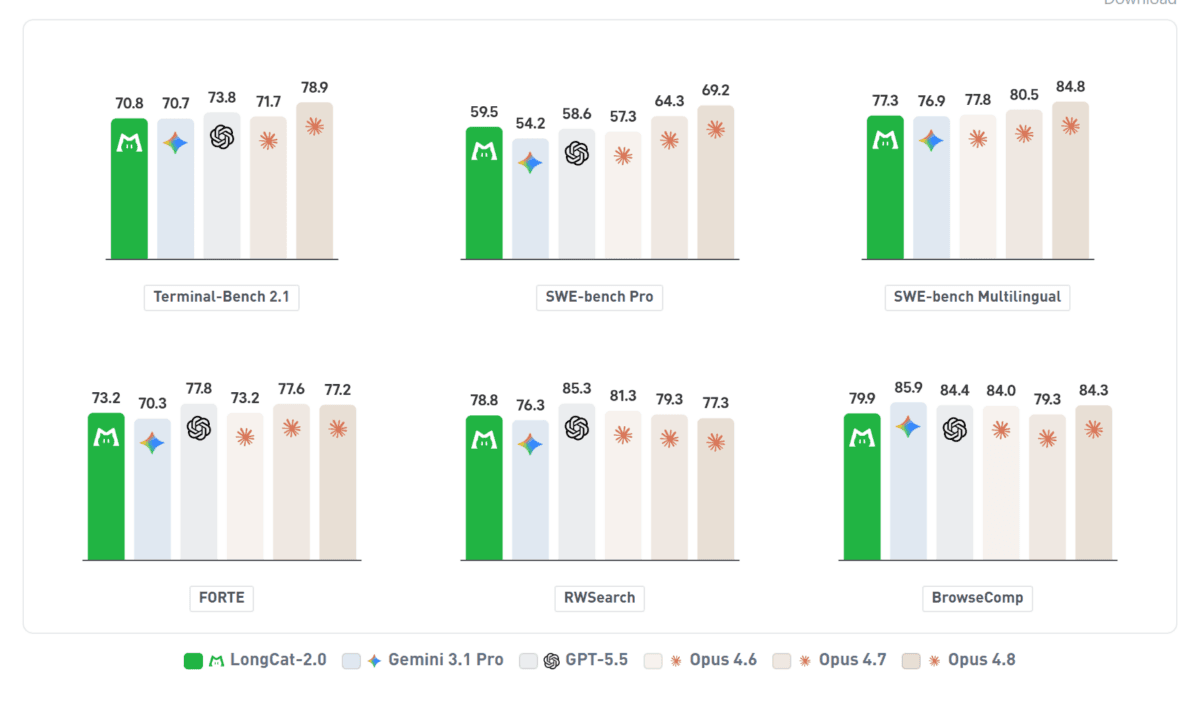
The benchmark profile suggests a model optimized for code generation and multilingual programming tasks. Whether that reflects the team's priorities or limitations of the training infrastructure remains unclear.
Why this matters for US chip policy
Since October 2022, Washington has progressively tightened export controls on advanced AI chips to China. The restrictions targeted Nvidia's A100 and H100 GPUs specifically, aiming to slow Chinese AI development by cutting off access to leading training hardware.
Meituan's announcement, if accurate, suggests those controls are losing effectiveness. A trillion-parameter model trained on domestic chips was supposed to be years away. The LongCat team has only existed since 2023. Its first model shipped late last year.
Meituan didn't name the chip manufacturer. Huawei's Ascend series is the leading candidate. The company has positioned Ascend 910B as a direct alternative to Nvidia's data center GPUs, and Chinese tech giants including Alibaba, Baidu, and ByteDance have purchased the chips at scale.
What remains unverified
Three problems complicate any assessment. First, LongCat-2.0 isn't available on HuggingFace. Without access to model weights, independent researchers can't reproduce the benchmark results or test for contamination. Self-reported numbers on leaderboard tasks are notoriously unreliable.
Second, Meituan disclosed no details about training efficiency. Running 50,000 domestic ASICs for the same result that 10,000 Nvidia H100s could achieve would represent a significant cost disadvantage, not proof of concept parity.
Third, the actual chip manufacturer matters. If Huawei's Ascend powered the run, that's one story. If a smaller domestic player supplied the silicon, the implications for China's semiconductor self-sufficiency are different.
Meituan's AI ambitions
Meituan is better known for food delivery and local services. Think DoorDash combined with Yelp. The company's pivot into foundation models reflects a broader trend: major Chinese tech firms building internal AI capabilities rather than depending on external providers subject to regulatory uncertainty.
For Meituan specifically, AI applications in routing optimization, demand forecasting, and customer service are obvious fits. Whether the company plans to commercialize LongCat as a general-purpose model or deploy it internally hasn't been disclosed.
Logicity's Take
The strategic signal matters more than the benchmark numbers. Even if LongCat-2.0 underperforms Claude or GPT on aggregate, Meituan has demonstrated a training pipeline that doesn't require any US-controlled hardware. For AI teams building products for Chinese markets, this changes the calculus. Domestic alternatives exist, even if they're not yet best-in-class. For teams outside China watching hardware supply chains, the lesson is different: compute diversification is becoming a competitive moat, not just a procurement headache. Watch whether Meituan releases weights. Until then, treat the claims as aspirational.
Frequently Asked Questions
What chips did Meituan use to train LongCat-2.0?
Meituan didn't name the manufacturer. The cluster used over 50,000 domestically made AI ASICs. Huawei's Ascend series is the most likely candidate based on availability and capability.
How does LongCat-2.0 compare to GPT-5.5 and Claude Opus?
LongCat-2.0 reportedly beats GPT-5.5 and Gemini 3.1 Pro on SWE-bench Pro and SWE-bench Multilingual. It trails on IFEval, IMO-AnswerBench, and GPQA-diamond. Claude Opus 4.7 and 4.8 outperform it on coding benchmarks.
Can I access LongCat-2.0 for testing?
Not currently. The model isn't available on HuggingFace, making independent verification of benchmark claims impossible.
What are the implications for US chip export controls?
If verified, LongCat-2.0 suggests China can train competitive trillion-parameter models without Nvidia GPUs. This would indicate the 2022 export controls are losing effectiveness faster than anticipated.
Related AI infrastructure investment and compute strategy
Need Help Implementing This?
If you're navigating AI hardware decisions or evaluating model deployment options for international markets, reach out to the Logicity team. We track compute infrastructure trends and can help teams assess their options.
Source: The Decoder / Maximilian Schreiner
Huma Shazia
Senior AI & Tech Writer
Produced with AI assistance and reviewed by the Logicity editorial team. Learn more in our Editorial Policy.