Key Takeaways
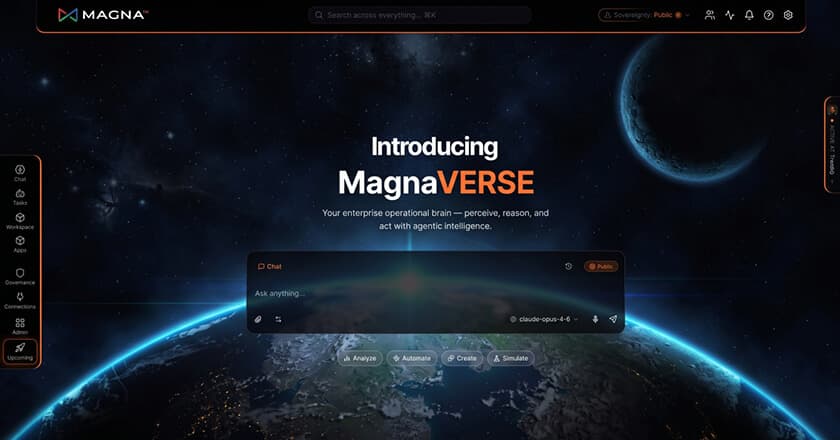
- MagnaVERSE combines AI models, agents, applications, and governance in a single operating environment
- The platform targets sovereign AI requirements with built-in data residency and compliance controls
- Gartner predicts 40% of agentic AI projects will fail by 2027 due to cost and governance issues
Magna AI launched MagnaVERSE at Global AI Show 2026 in Riyadh, positioning the platform as a unified environment where enterprises can deploy, govern, and scale AI workloads. The company, a joint venture between Trend Micro, Wistron Digital Technology Holding, and NVIDIA, is betting that enterprises need more than just AI models. They need the operational infrastructure to actually run them in production.
The timing is deliberate. Gartner predicts more than 40% of agentic AI projects will be cancelled by end of 2027. The culprits: runaway costs, unclear ROI, and weak risk controls. MagnaVERSE aims to solve the last problem by baking governance into the platform architecture rather than bolting it on afterward.
What MagnaVERSE actually does
The platform bundles five layers into one operating environment: models, agents, applications, infrastructure, and governance. Magna AI calls it the "intelligence layer" where organizations handle the full AI lifecycle from design through deployment to ongoing operations. Data residency, access control, security, and compliance sit inside the architecture, not as add-on modules.
"Most organisations understand the potential of AI. The harder challenge is deploying it securely, governing it effectively, and operating it at scale," said Dr. Moataz BinAli, CEO of Magna AI. "MagnaVERSE was built to provide the capabilities required to move from AI ambition to AI execution."
The "sovereign-ready" framing matters here. Countries and large enterprises increasingly want AI systems they control locally, with data that never leaves their jurisdiction. MagnaVERSE targets government, financial services, healthcare, energy, manufacturing, and smart city projects, all sectors where data sovereignty is not optional.
Why Saudi Arabia is the launch venue
Magna AI chose Riyadh for strategic reasons beyond conference visibility. Saudi Arabia's Vision 2030 includes substantial AI investment, and the Kingdom wants local control over AI infrastructure rather than dependence on foreign cloud providers. The sovereign AI pitch resonates in a market spending aggressively on tech diversification.
Magna AI served as Title Sponsor of Global AI Show 2026, signaling serious commitment to the Middle East market. The company's "forward-deployed engineering model" connects AI systems directly to enterprise workloads and regulatory requirements, an approach that requires boots on the ground, not just cloud access.
The joint venture structure
The company combines three distinct capabilities. Trend Micro brings cybersecurity expertise, critical for enterprises worried about AI system vulnerabilities. Wistron Digital Technology contributes hardware and manufacturing infrastructure. NVIDIA provides the compute layer. The combination addresses a common enterprise complaint: AI vendors that excel at models but struggle with security, or security vendors that cannot keep pace with AI innovation.

Whether this hybrid structure delivers on its promise remains to be seen. Joint ventures in enterprise tech have a mixed track record. The partners have aligned incentives here, each covering gaps in the others' portfolios, but execution will determine whether MagnaVERSE gains traction against established players like Microsoft Azure AI, Google Vertex AI, and AWS SageMaker.
What product teams should watch
MagnaVERSE's agent orchestration capabilities address a real gap. Most enterprises building agentic AI systems today stitch together custom pipelines using LangChain, AutoGen, or similar frameworks. A unified platform that handles agent coordination alongside governance could simplify deployment, but only if the abstractions match how teams actually build.
The compliance-first architecture is the other differentiator. Regulated industries have struggled to adopt AI at scale because bolting security and compliance onto existing AI systems creates friction. Building these controls into the platform layer could accelerate enterprise adoption in sectors that have been slow to move.
Logicity's Take
MagnaVERSE enters a crowded field, but the sovereign AI angle gives it a clear lane. The 40% project failure rate Gartner cites reflects a real governance gap that pure-play AI vendors have not solved. For product teams evaluating enterprise AI platforms, the key question is whether MagnaVERSE's integrated approach reduces time-to-production compared to assembling equivalent capabilities from separate vendors. Watch for early deployment case studies from Saudi government projects, these will be the real proof points.
Frequently Asked Questions
What is MagnaVERSE?
MagnaVERSE is Magna AI's unified software platform that combines AI models, agents, applications, infrastructure, and governance into a single operating environment for enterprise AI deployment.
Who are the partners behind Magna AI?
Magna AI is a joint venture between Trend Micro (cybersecurity), Wistron Digital Technology Holding (hardware and manufacturing), and NVIDIA (AI compute infrastructure).
What is sovereign AI?
Sovereign AI refers to AI systems where nations or enterprises maintain local control over infrastructure, data residency, and compliance rather than relying on foreign cloud providers.
Which industries does MagnaVERSE target?
MagnaVERSE targets government, financial services, healthcare, energy, manufacturing, and smart city projects where data sovereignty and compliance are critical requirements.
Another example of sovereign AI and government-focused AI agent deployment
Need Help Implementing This?
Building enterprise AI infrastructure or evaluating sovereign AI platforms for your organization? Contact Logicity for guidance on platform selection and implementation strategy.
Source: TahawulTech.com / Daniel Shepherd
Huma Shazia
Senior AI & Tech Writer
Produced with AI assistance and reviewed by the Logicity editorial team. Learn more in our Editorial Policy.