Key Takeaways
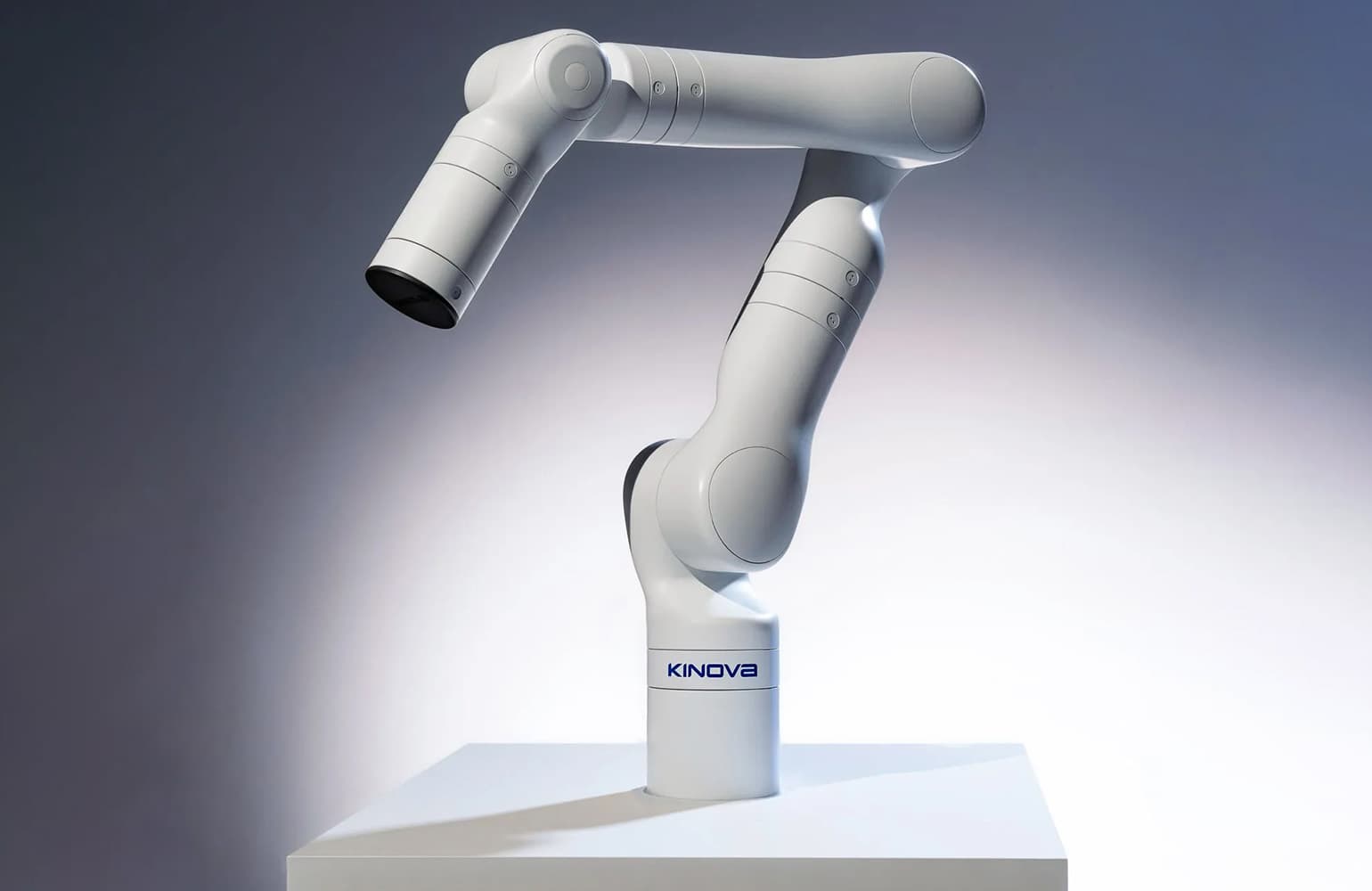
- Kinova's KIMA is designed from scratch for clinical use, not adapted from industrial robots
- The arm weighs under 13kg with 3kg payload capacity and eliminates external control boxes
- KIMA natively integrates IEC 62304 Class C software and ISO 14971 safety standards
Kinova Inc. has launched KIMA, a medical robotic arm designed specifically for surgical and clinical applications. The Canadian robotics company announced the product on its 20th anniversary, positioning KIMA for use in procedures ranging from endoscopy to complex surgical interventions.
What separates KIMA from many surgical robots is its origin. Kinova built it from scratch for medical environments rather than adapting industrial robotics technology for clinical use. That distinction matters because medical robots face regulatory and safety requirements that industrial arms were never designed to meet.
Why did Kinova build KIMA for clinical use specifically?
Operating rooms are cramped. Multiple robots, imaging systems, and surgical equipment compete for floor space around the patient table. Kinova engineered KIMA to address this reality directly.
The arm weighs under 13 kg (28.6 lb) and handles payloads up to 3 kg (6.6 lb). It eliminates the bulky external control boxes that typically accompany robotic arms, shrinking its footprint. Every joint includes redundant torque sensors for monitoring performance in real time.
François Boucher, Kinova's vice president of strategic growth, framed the approach as a departure from industry norms: "We designed this robotic arm specifically for clinical realities, applying absolute quality manufacturing standards to pave the way for technologies better aligned with the needs of patients and practitioners."
What safety certifications does KIMA meet?
KIMA natively integrates IEC 62304 Class C software, the highest risk classification for medical device software. It also meets ISO 14971 standards for risk management in medical devices. These are not aftermarket additions. Kinova built them into the architecture from the start.
The redundant torque sensors at each joint support advanced monitoring functions. This architecture allows operators to track joint-level performance and meets the safety requirements that regulators expect from medical robotic systems.
How does KIMA integrate with existing medical platforms?
Kinova chose an open architecture using EtherCAT communication protocols. The controller-less design gives system integrators direct control over the arm, making it easier to connect KIMA to existing surgical platforms and medical devices.
The instrument drives include power and passthrough I/O capabilities. This setup simplifies attaching surgical instruments and other medical devices to the arm.
A network of technology partners supports integration. QNX, RTI, MedAcuity, MPE, and Acontis work with Kinova to reduce integration complexity for customers building surgical systems around KIMA.

Who is Kinova targeting with KIMA?
Kinova describes KIMA as a modular platform for innovators, from startups to global medtech leaders. The company wants to serve as the robotics component supplier for surgical system developers, not necessarily as a complete surgical robot manufacturer.
This fits Kinova's broader business model. Founded in 2006 and headquartered in Boisbriand, Quebec, the company designs, develops, and assembles its products in Canada. It operates across medical, industrial, and research robotics markets.
Last year, Kinova partnered with Bota Systems AG to integrate its Gen3 robotic manipulator with Bota's SensONE T15 force-torque sensor. That collaboration aimed to bridge the gap between simulation and real-world robot performance.
Charles Deguire, Kinova's co-founder and CEO, offered a measured perspective on the company's progress: "The important thing is not the size of the steps we take, but the willingness to keep moving forward, one step at a time, in the same direction."
What applications can KIMA support?
Kinova lists endoscopy, bronchoscopy, and complex surgical interventions as target applications. The 3 kg payload capacity covers most surgical instruments, though it falls short of what heavier industrial arms can handle.
The compact form factor makes KIMA suitable for procedures where space around the patient is limited. Minimally invasive surgeries, where multiple instruments and cameras crowd the surgical field, are a natural fit.
Logicity's Take
Kinova's decision to build KIMA from scratch for clinical use, rather than retrofitting industrial technology, addresses a real gap in the surgical robotics market. Most robotic arms entering medical applications carry the DNA of factory automation, requiring extensive modifications to meet clinical safety standards. By embedding IEC 62304 Class C and ISO 14971 compliance natively, Kinova removes a significant barrier for medtech companies that want robotic capabilities without the regulatory headache of adapting industrial hardware. The question is whether KIMA can compete on precision and reliability with purpose-built surgical robots from Intuitive and Medtronic.
Frequently Asked Questions
What is the payload capacity of the KIMA medical robotic arm?
KIMA handles payloads up to 3 kg (6.6 lb), suitable for most surgical instruments used in minimally invasive procedures.
Does KIMA require an external control box?
No. Kinova designed KIMA with a controller-less architecture that eliminates bulky external control boxes, reducing the footprint in operating rooms.
What safety certifications does KIMA have?
KIMA natively integrates IEC 62304 Class C software (the highest risk classification for medical device software) and meets ISO 14971 risk management standards.
Where is Kinova based and where does it manufacture its robots?
Kinova is headquartered in Boisbriand, Quebec, Canada, where it designs, develops, and assembles its products.
What communication protocols does KIMA use?
KIMA uses EtherCAT communication protocols with an open architecture, allowing direct control and easier integration into existing medical platforms.
Need Help Implementing This?
If you're developing surgical robotic systems or evaluating robotic arm platforms for medical applications, contact our team for deeper analysis of the competitive landscape and integration considerations.
Source: The Robot Report / The Robot Report Staff
Huma Shazia
Senior AI & Tech Writer
Produced with AI assistance and reviewed by the Logicity editorial team. Learn more in our Editorial Policy.




