Key Takeaways

- A feature isn't 'shipped' until your AI agent can answer questions about it correctly
- Support teams must join product walkthroughs and test features before launch, not after
- AI agents read content literally: vague language produces confused customers
Intercom has published its internal playbook for keeping AI agents ready when product teams ship new features. The company calls it the "new product introduction" (NPI) process, and it solves a problem most companies discover the hard way: your AI agent is only as current as its knowledge base.
The core argument is simple. If your AI agent doesn't know about a feature the moment it goes live, customers ask questions, the agent can't answer, and those tickets route straight to humans. Your support team gets slammed at the exact moment volume peaks. Over time, customers stop trusting the agent. The efficiency gains you bought the tool for evaporate.
Why support teams need to join launch planning early
Intercom's fix starts with organizational change, not tooling. The company argues that a feature should only be considered "shipped" when the AI agent can answer questions about it correctly. That means support joins product and engineering walkthroughs before launch, not after.
At Intercom, this falls to an NPI Manager. Other companies might hand it to a knowledge manager or support lead. The title matters less than the access. Whoever owns agent readiness needs a seat in product marketing kickoff calls and the ability to test features before they go live.
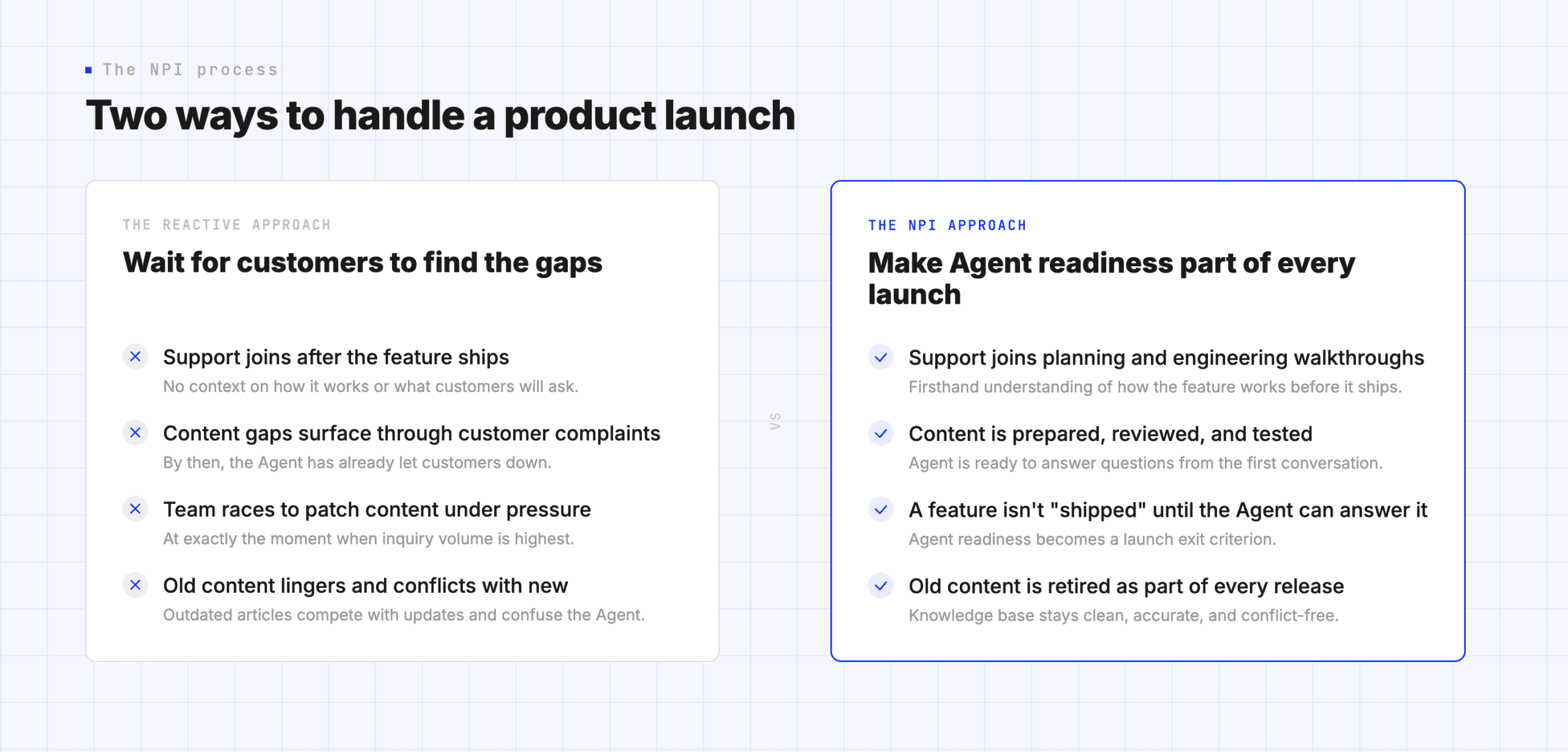
This early involvement catches bugs and unexpected behavior. It also surfaces what existing documentation needs to be retired. Old content that contradicts the new feature is worse than no content at all. The agent will serve outdated answers with confidence.
The three-stage NPI checklist
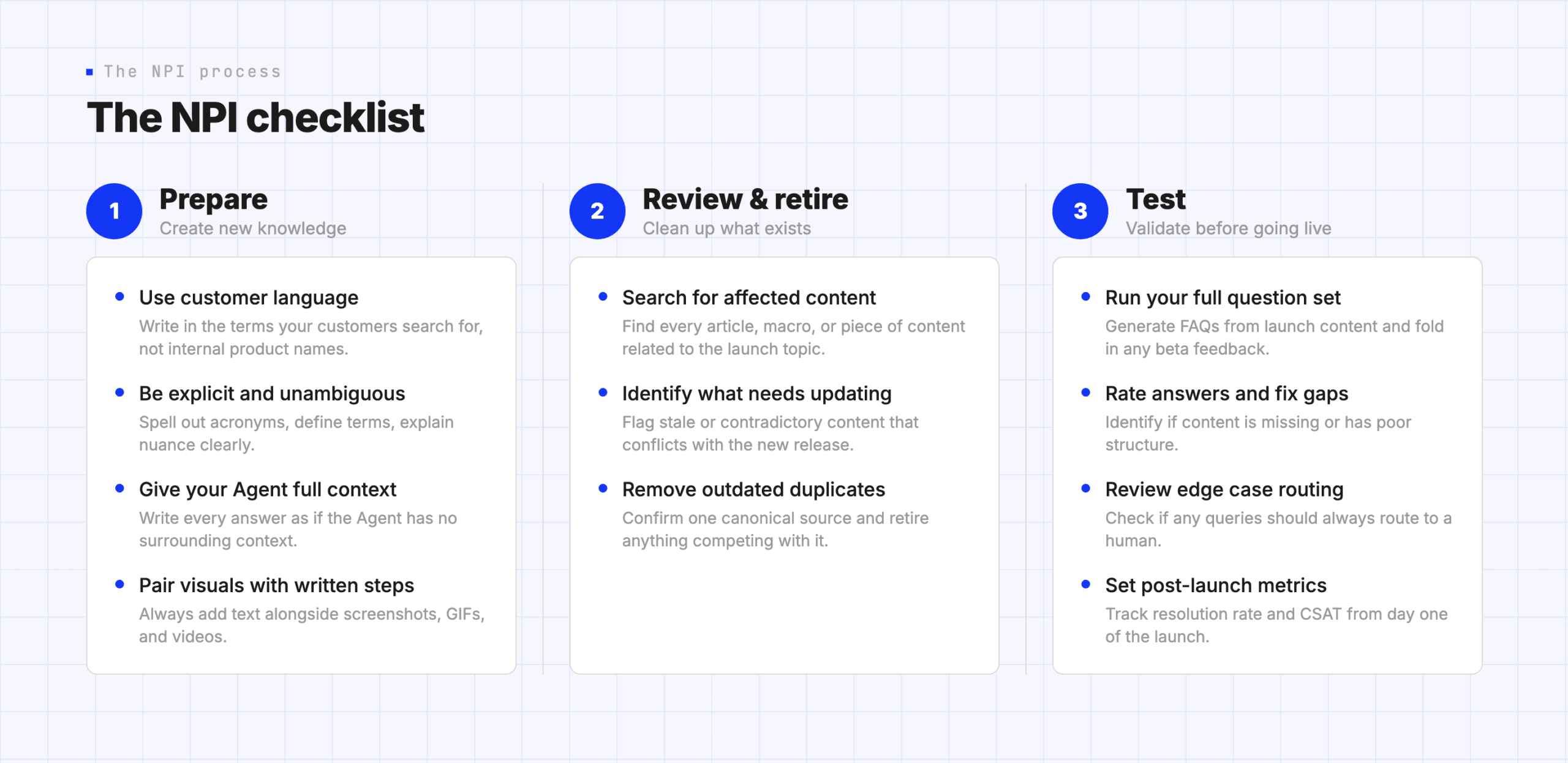
Intercom breaks agent readiness into three stages: prepare new content, review existing content, and test agent performance. Each stage has specific tasks that can be split across a team or handled by one person.
Stage 1: Write content your agent can actually use
AI agents read literally. They don't infer meaning the way a human reader would. This changes how you write documentation.
First, use customer language. Your product team might call something "automated workflow triggers." Your customers search for "how to set up automatic replies." Both terms need to appear in the content so the agent can match queries correctly.
Second, be explicit. Spell out acronyms. Define product terms. If you feed the agent vague language, it returns vague answers.
Third, assume zero context. If a feature is only available on certain plans, don't write "it depends on your plan." The agent needs specifics: which plans include the feature, how to access it, and any setup steps required. Write every answer as if the agent has no surrounding context, because it doesn't.
Fourth, don't rely on images alone. Screenshots and GIFs help human readers, but agents can't interpret them. Pair every visual with written steps covering the same ground.
Stage 2: Kill the content that contradicts the new feature
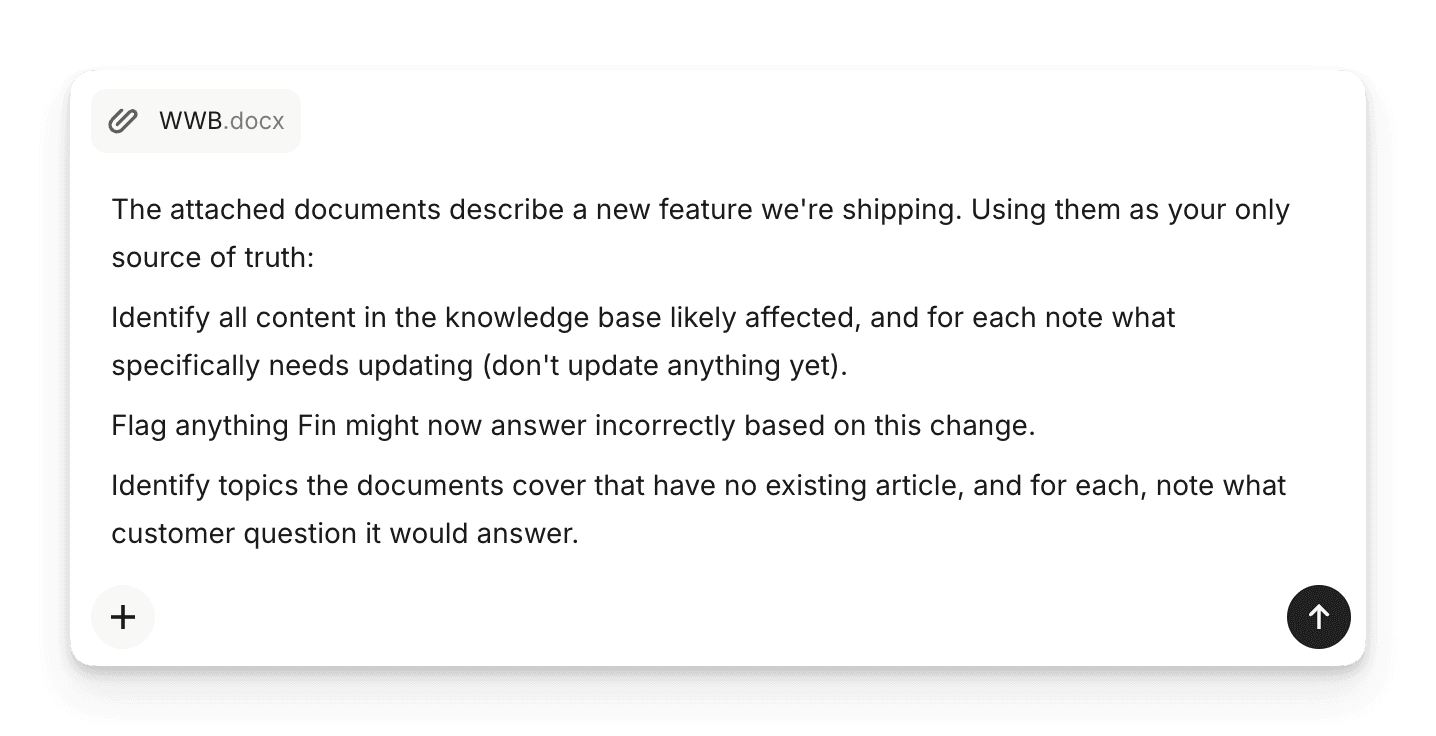
New documentation is only half the job. Old content that describes how a feature used to work can confuse the agent and, by extension, your customers.
Intercom recommends keyword searches to surface everything related to the launch topic: articles, macros, any piece of content the agent might reference. If your knowledge management tooling can flag stale or contradictory content automatically, use it. If not, manual search works.
Check for duplicates. If the same topic has multiple articles, the agent might pull from the wrong one. Consolidate where possible, and retire anything outdated entirely rather than letting it linger.
Stage 3: Test the agent before customers do
The final stage is testing. Someone, whether a QA manager or the NPI owner, needs to query the agent with the questions customers will ask. This happens before launch day, not after.
Intercom doesn't detail their testing protocol in this post, but the principle is straightforward: simulate real customer queries, check the agent's answers, and fix the knowledge base gaps you find. If you wait for customers to discover the gaps, you're already behind.
Who should own agent readiness?
Intercom created a dedicated NPI Manager role. That's an option for companies with enough volume to justify it. For smaller teams, the responsibilities can split across existing roles: knowledge managers handle content prep and review, QA managers run testing.
The key is that someone owns it. Agent readiness left as "everyone's job" becomes no one's job, and you're back to racing to fill content gaps after customers find them.
Logicity's Take
This process isn't unique to Intercom's Fin. Any company running Zendesk AI, Freshdesk Freddy, or an in-house agent built on OpenAI or Anthropic's APIs faces the same challenge. The difference is whether you systematize the fix or keep firefighting. Intercom's competitors charge similar rates: Zendesk AI starts around $50/agent/month for basic automation, while Freshdesk Freddy bundles with Pro plans at $49/agent/month. What none of them can fix is outdated documentation. That's an internal discipline problem, not a vendor one.
Frequently Asked Questions
What is an NPI process for AI agents?
NPI stands for new product introduction. It's a checklist that ensures your AI agent's knowledge base is updated before a product feature launches, not after customers start asking questions the agent can't answer.
How do you keep an AI agent's knowledge base up to date?
Involve support teams in product planning early, write documentation using customer language, retire outdated content before launching new features, and test the agent's responses before go-live.
Why does my AI agent give wrong answers after a product update?
The agent is referencing outdated content in its knowledge base. Old articles describing previous versions of a feature will confuse the agent unless they're updated or removed.
Should AI agent documentation include images and screenshots?
Yes, but always pair visuals with written explanations. AI agents can't interpret images alone and need text-based content to generate accurate answers.
Another look at where AI tooling falls short when it lacks proper configuration
Need Help Implementing This?
If you're building an NPI process for your AI agent or evaluating customer support automation tools, reach out to us at Logicity. We connect companies with implementation partners and can help you benchmark vendors.
Source: The Intercom Blog / Sean Reid
Manaal Khan
Tech & Innovation Writer
Produced with AI assistance and reviewed by the Logicity editorial team. Learn more in our Editorial Policy.