Key Takeaways
- Alphabet raised 2026 investment forecast to $195-205 billion, citing demand outpacing supply
- Google CEO Sundar Pichai says Gemini 4 requires 'much larger base models' to compete at the frontier
- Gemini app reached 950 million monthly active users, up from 750 million in February
Google CEO Sundar Pichai admitted the company needs bigger base models to compete with frontier AI leaders and confirmed Google has begun training Gemini 4. Speaking on Alphabet's Q2 2026 earnings call, Pichai said the next generation of frontier AI requires 'much larger base models' and that Google's current training run for Gemini 4 is the company's 'most ambitious' yet.
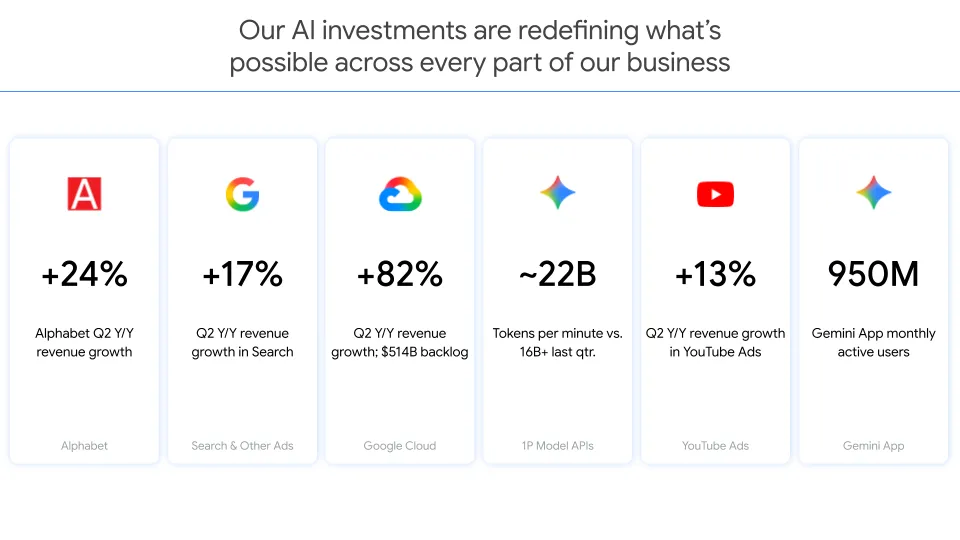
The statement comes as Alphabet raised its 2026 capital expenditure forecast to between $195 billion and $205 billion, up from the previous $180 billion to $190 billion range. The company says demand continues to outpace investment. Google reported Q2 2026 revenue of $119.8 billion, a 24 percent year-over-year increase that beat analyst expectations of $116.9 billion.
Why Google is betting on scale for Gemini 4
Pichai's comments represent a rare public acknowledgment that Google's current models aren't keeping pace with competitors. He pointed to specific weaknesses the company is trying to fix.
“There are areas where we have acknowledged we need to improve. Coding and agentic coding is an example of that, and I think the teams are very, very focused on it.”
— Sundar Pichai, Google CEO
Google is still working on a new frontier model and plans to ship new models monthly. But Gemini 3.5 Pro apparently isn't part of that cadence, even though Google says it's currently being tested. The company is prioritizing scale for Gemini 4 instead.
“We have started our most ambitious pre-training run yet for Gemini 4, and are excited by the progress we are seeing at the frontier.”
— Sundar Pichai, Google CEO
Google Cloud grows 82% as Gemini app hits 950 million users
The earnings report showed strong AI adoption across Google's products. Google Cloud grew 82 percent to $24.8 billion in revenue, while the Services segment rose 15 percent to $94.5 billion. The Gemini app now has 950 million monthly active users, up from 750 million in February.
AI Mode in Google Search crossed one billion monthly active users since its global launch in October. Google claims AI Mode, like AI Overviews before it, is driving more overall search queries. On the advertising side, AI Max has left beta and already has 500,000 advertisers using it.

Cost efficiency vs. frontier capability
The cost per AI response in AI Mode has dropped to its lowest level since launch, even as Google uses more powerful models. The recent Flash 3.6 release demonstrated similar efficiency gains. Over time, that efficiency could give Google an edge on margins for serving AI.
Pichai noted strong demand for Google's lighter-weight models: 'We're seeing tons of demand for our workhorse Gemini Flash series because it hits the sweet spot of performance and cost.'
This raises a strategic question. For daily use cases across Google's ecosystem, efficient mid-tier models may matter more than frontier capability. But for the AGI race and enterprise credibility, Google needs a model that can match OpenAI and Anthropic at the top end.
Another example of AI efficiency gains in production environments
What the $200B capex increase signals
Alphabet raising its capex forecast by $15 billion to $25 billion mid-year signals confidence in AI demand. The company says it cannot build infrastructure fast enough to meet customer needs. Google Cloud's 82 percent growth suggests enterprise AI adoption is accelerating faster than most forecasts predicted.
| Metric | Q2 2026 | Previous |
|---|---|---|
| Total Revenue | $119.8B | $96.6B (Q2 2025) |
| Google Cloud Revenue | $24.8B | 82% YoY growth |
| Gemini App MAU | 950 million | 750 million (Feb 2026) |
| AI Mode MAU | 1 billion+ | Launched Oct 2025 |
| AI Max Advertisers | 500,000 | Exited beta Q2 2026 |
| 2026 Capex Forecast | $195-205B | $180-190B (prior) |
The coding gap Google needs to close
Pichai's explicit mention of 'coding and agentic coding' as areas needing improvement is telling. Coding benchmarks have become a proxy for overall model capability, and competitors like Anthropic's Claude and OpenAI's GPT-4 series have pulled ahead on developer-focused tasks. For Google to win enterprise AI contracts, especially in software development, Gemini 4 needs to close that gap.
Logicity's Take
Pichai's candor about Gemini's weaknesses is unusual for a CEO on an earnings call. It suggests internal pressure to ship a genuinely competitive frontier model. For AI product teams, the implication is clear: Google's API pricing and Flash models will remain attractive for production workloads, but teams building cutting-edge agentic systems may need to hedge with multiple providers. The $200B capex commitment also signals that Google Cloud will aggressively price AI inference to capture market share, worth watching if you're evaluating cloud AI costs for 2027 planning.
Frequently Asked Questions
When will Google release Gemini 4?
Google has not announced a release date for Gemini 4. CEO Sundar Pichai confirmed training has begun and called it Google's most ambitious pre-training run yet.
How many users does the Gemini app have?
The Gemini app has 950 million monthly active users as of Q2 2026, up from 750 million in February 2026.
What is Google's 2026 AI investment forecast?
Alphabet raised its 2026 capital expenditure forecast to between $195 billion and $205 billion, up from the previous range of $180 billion to $190 billion.
What areas is Google trying to improve in Gemini?
CEO Sundar Pichai specifically mentioned coding and agentic coding as areas where Google has acknowledged it needs to improve.
Need Help Implementing This?
Evaluating AI model providers for your product roadmap? Contact Logicity's advisory team for vendor-neutral guidance on API pricing, capability tradeoffs, and infrastructure planning.
Source: The Decoder / Matthias Bastian
Manaal Khan
Tech & Innovation Writer
Produced with AI assistance and reviewed by the Logicity editorial team. Learn more in our Editorial Policy.