Key Takeaways
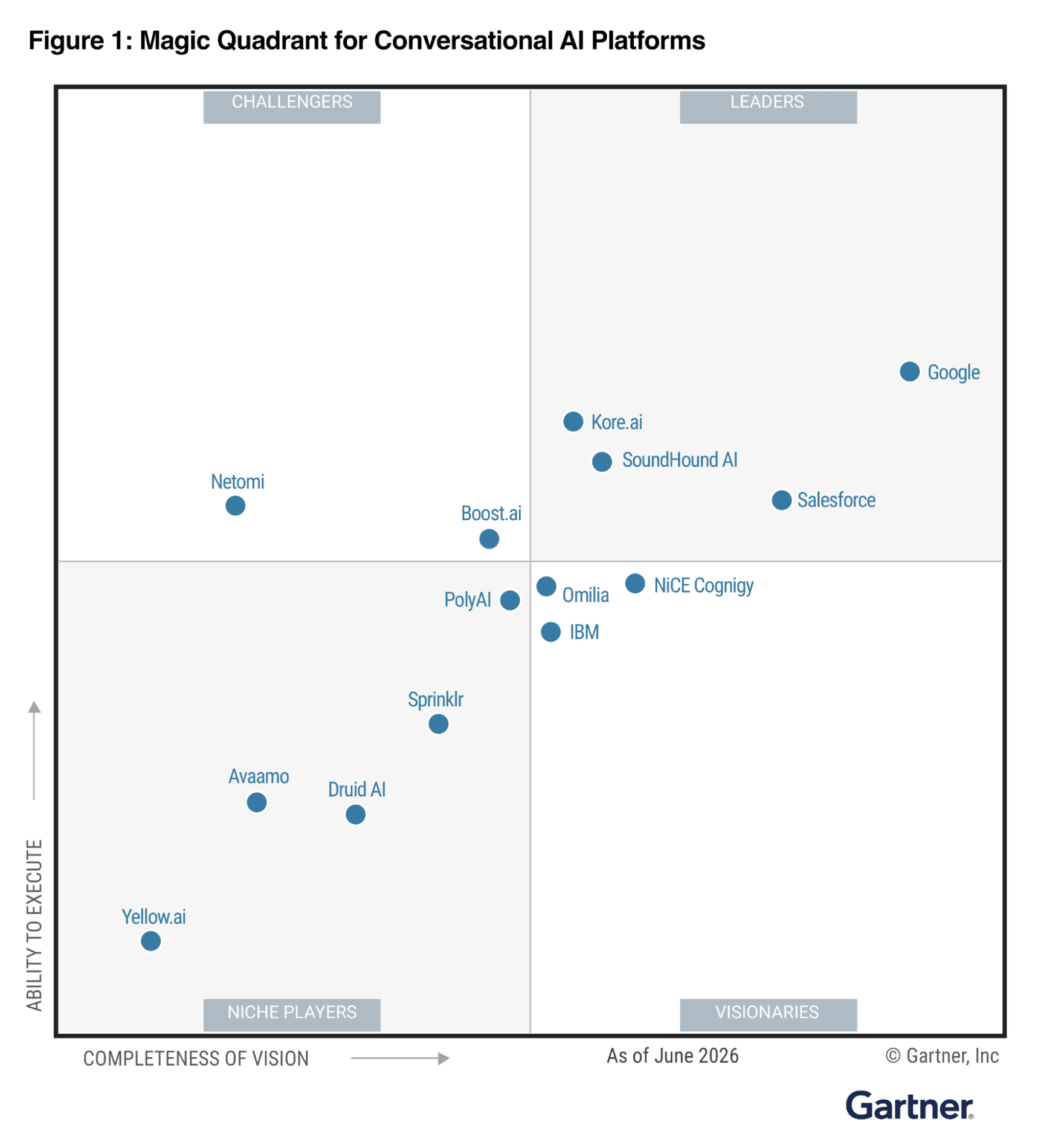
- Google placed furthest in Vision and highest in Execution in the 2026 Gartner Magic Quadrant for Conversational AI Platforms
- The company now ranks #1 in three of four Critical Capabilities Use Cases, up from its 2025 position
- Home Depot reports customers reach solutions up to 4x faster using Google's CX Agent Studio compared to traditional phone menus
Google has secured the top position in the 2026 Gartner Magic Quadrant for Conversational AI Platforms for the second consecutive year. The company placed furthest right on Vision and highest on Execution, while also climbing to #1 in three of four Critical Capabilities Use Cases. The report arrives as enterprises increasingly move AI agents from pilot projects into production customer service deployments.
Ali Rana, Google's Director of Product Management for Applied AI, said the recognition "reflects our continued investment in frontier AI research, enterprise infrastructure, and helping customers move AI from experimentation into production at scale."
What is Gemini Enterprise for Customer Experience?
Google's conversational AI platform centers on CX Agent Studio, a development environment for building voice and chat agents. The platform combines Gemini models from Google DeepMind with enterprise security controls, retrieval systems, and multi-channel deployment options.
Organizations can use CX Agent Studio to build multimodal AI agents that work across voice and digital channels, assist human support representatives in real time, and analyze customer conversations. Google also offers pre-built agents for retail, food ordering, and automotive use cases.
The platform aims to solve a specific problem: customers hate repeating themselves across channels. When someone starts a conversation on chat and later calls in, traditional systems force them to start over. Google's pitch is unified context across touchpoints.
How is Home Depot using CX Agent Studio?
Home Depot provided the most concrete deployment example in Google's announcement. The retailer reports that customers calling stores reach solutions up to 4x faster compared to traditional phone menus. AI voice agents built with CX Agent Studio identify customer intent within 10 seconds, then either complete purchases, initiate service requests, or route to a human associate.
“AI does a tremendous job at recognizing customer intent and taking direct action to help complete a purchase or even start a service request. And of course, if they need to speak with an associate, we'll quickly connect them.”
— Jordan Broggi, EVP of Customer Experience and President of Online, The Home Depot
The 4x improvement claim is notable because it compares against phone trees, a low bar. Still, reducing a 2-minute menu navigation to 30 seconds matters at Home Depot's call volumes.
Why latency and hallucination control matter for voice
Google's announcement emphasizes that voice interactions demand different engineering than text chat. Milliseconds of latency create awkward pauses that break conversation flow. Hallucinations pose real business risks when an AI agent confidently gives a customer incorrect return policies or pricing.
The company claims CX Agent Studio addresses both issues through native multimodal capabilities, agent orchestration, and enterprise retrieval. The last piece is critical: grounding responses in actual company documentation rather than letting the model improvise.
Whether Google's retrieval system actually prevents hallucinations better than competitors remains unclear from the announcement. The Gartner report likely contains comparative analysis, but the full methodology sits behind a paywall.
What the Magic Quadrant ranking actually measures
Gartner's Magic Quadrant evaluates vendors on two axes: Completeness of Vision and Ability to Execute. Scoring involves analyst interviews with vendors and their customers, plus evaluation of product capabilities, market presence, and roadmap credibility.
Being named a Leader means Gartner believes the vendor executes well today and is positioned for tomorrow. The top-right corner, where Google landed, indicates the highest scores on both dimensions.
Google's jump to #1 in three of four Critical Capabilities Use Cases represents meaningful progress from 2025. These use case evaluations weight different product features based on specific deployment scenarios, giving buyers more granular guidance than the quadrant position alone.
Logicity's Take
Google's positioning matters most for enterprises already committed to Google Cloud. The real decision for engineering leaders isn't Google vs. AWS vs. Azure on conversational AI alone; it's which cloud ecosystem you're betting on for the next five years. Teams running workloads on [DigitalOcean](https://logicity.in/r/digitalocean) or multi-cloud setups will find the integration story less compelling. Worth noting: Amazon Lex and Azure Bot Service weren't mentioned in Google's announcement, but both compete in this quadrant. The Home Depot case study is useful but covers a narrow use case. Ask for references in your specific industry before committing.
Disclosure
Some links in this post are affiliate links — Logicity earns a commission if you sign up, at no extra cost to you. We only link products we have used or actively recommend.
What's missing from the announcement
Google's blog post reads like marketing collateral, which it is. A few gaps stand out for engineering teams evaluating the platform.
- No pricing information. Enterprise AI platforms can range from $50K to $1M+ annually depending on call volumes and features.
- No comparison to competitors. Where did Amazon Lex, Microsoft Copilot Studio, or Kore.ai land in the same quadrant?
- No technical benchmarks. Latency claims lack specific numbers. How many milliseconds is 'low latency'?
- No failure case discussion. What happens when the AI agent can't resolve a query? What's the human handoff experience?
The full Gartner report addresses some of these questions. Google offers a complimentary download, though it requires a form submission.
Who should pay attention to this ranking
CTOs and engineering leaders at companies already running significant Google Cloud workloads should take a close look. The integration with existing Google infrastructure, including BigQuery for analytics and Vertex AI for custom models, reduces friction compared to bolting on a third-party conversational AI platform.
Teams evaluating contact center modernization projects should download the full Gartner report and compare at least three vendors. The Magic Quadrant provides a starting shortlist, not a final answer.
Frequently Asked Questions
What is the Gartner Magic Quadrant for Conversational AI Platforms?
An annual analyst report that evaluates enterprise conversational AI vendors on their vision and execution capabilities. Being named a Leader indicates strong current products and future roadmap.
What is Google CX Agent Studio?
Google's platform for building AI-powered customer experience agents that work across voice and chat channels, with features for enterprise retrieval, agent orchestration, and pre-built industry templates.
How much does Gemini Enterprise for Customer Experience cost?
Google has not published public pricing. Enterprise conversational AI platforms typically require custom quotes based on call volumes, channels, and integration requirements.
Who competes with Google in conversational AI platforms?
Major competitors include Amazon Lex (AWS), Microsoft Copilot Studio, Kore.ai, Nuance (Microsoft), and LivePerson. The full Gartner report includes comparative positioning.
Is CX Agent Studio available outside of Google Cloud?
The platform runs natively on Google Cloud infrastructure. Organizations using other cloud providers would need to evaluate integration complexity and data transfer requirements.
Explores the limitations of AI assistants, relevant context for teams evaluating any AI-powered tool
Need Help Implementing This?
Evaluating conversational AI platforms for your contact center? Reach out to our team for vendor-neutral guidance on platform selection and implementation planning.
Source: Cloud Blog
Huma Shazia
Senior AI & Tech Writer
Produced with AI assistance and reviewed by the Logicity editorial team. Learn more in our Editorial Policy.