Key Takeaways
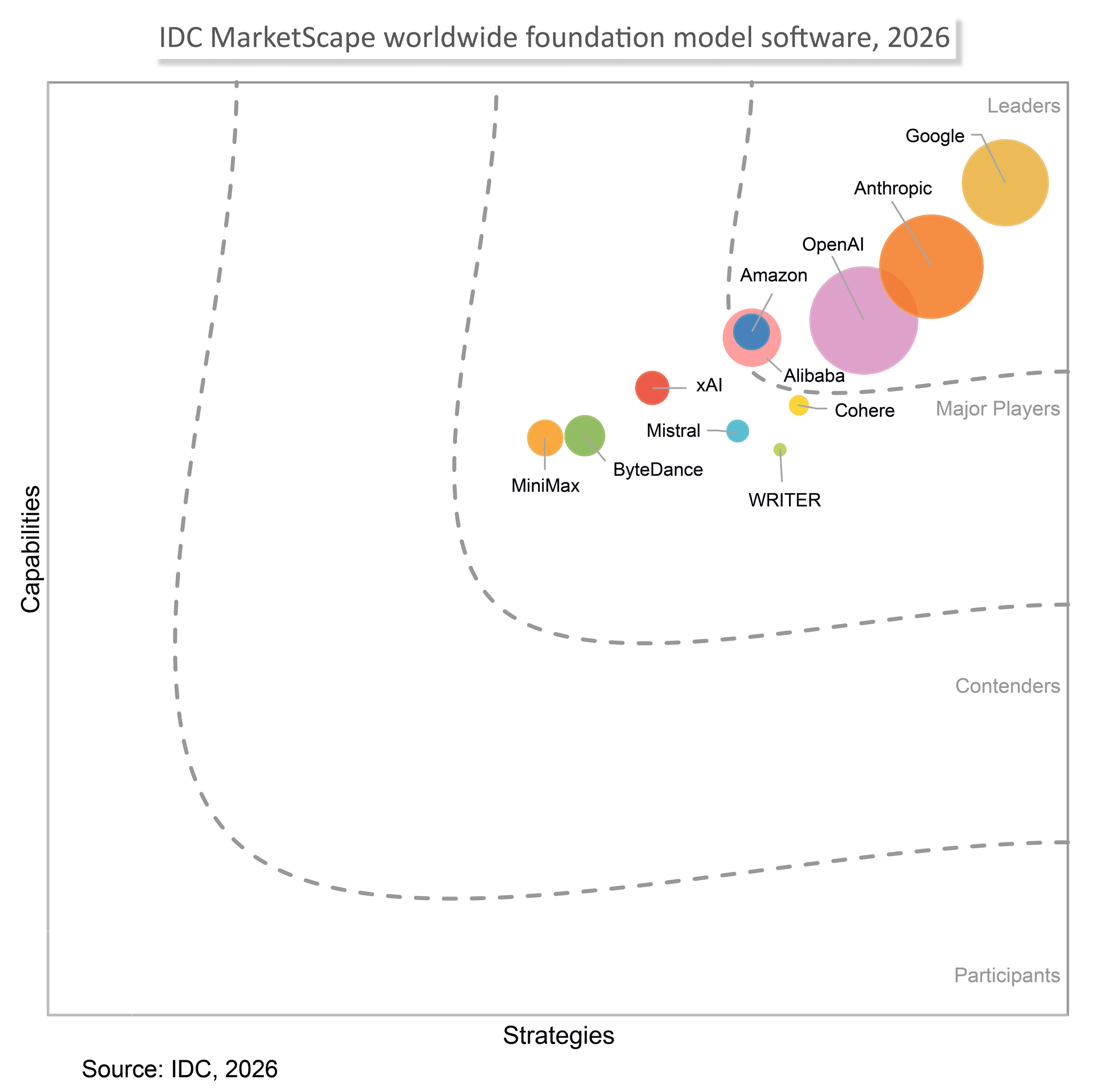
- Google earned Leader status in the IDC MarketScape: Worldwide Foundation Model Software 2026 Vendor Assessment
- Gemini Enterprise combines user-facing AI tools with a developer-focused Agent Platform for building autonomous workflows
- Gemini 3.5 Flash, announced at I/O 2026, targets long-horizon agentic tasks with faster inference
IDC has named Google a Leader in its 2026 MarketScape for foundation model software, ranking the company alongside top-tier vendors on both current capabilities and three-to-five-year strategy. The assessment arrives as enterprises shift from experimenting with generative AI to deploying agents that execute multi-step business workflows autonomously.
Michael Gerstenhaber, VP of Product Management for Cloud AI at Google, framed the recognition as validation of Google's infrastructure-first approach: "Technology is only as good as its reliability, security, and predictability in production." That philosophy now underpins Gemini Enterprise, the unified system Google positions as its answer to enterprise AI deployment.
What is Gemini Enterprise and why does it matter?
Gemini Enterprise bundles two components. The Gemini Enterprise app serves as the front door for business teams. It surfaces AI capabilities without requiring users to understand the underlying models. Behind it sits the Gemini Enterprise Agent Platform, where developers build, scale, and govern agents that automate customer-facing or internal workflows.
The design reflects a bet that the next wave of enterprise AI adoption depends on agents, not chatbots. Agents need memory, tools, and permission to act. They also need guardrails. Google claims cryptographic identity and enterprise security controls are baked into the platform by default, letting organizations deploy agents without custom security engineering for each use case.
Gemini 3.5 Flash: built for agentic tasks
At I/O 2026, Google launched the Gemini 3.5 series with Gemini 3.5 Flash, a model optimized for speed and multi-step reasoning. Google DeepMind co-designed the model with its TPU infrastructure, a tight hardware-software loop that the company says accelerates training of deeper reasoning capabilities with each generation.
The "Flash" branding signals latency-sensitive workloads. For engineering teams, that means the model is intended for scenarios where an agent must chain several API calls, database queries, or tool invocations before returning a result. Slow inference at any step compounds into unusable latency. Fast inference keeps multi-step workflows responsive.
Developers can access Gemini 3.5 Flash through the Agent Platform, Google AI Studio, or Antigravity. Business users see it surface inside the Gemini Enterprise app.
How does the IDC MarketScape rank vendors?
The IDC MarketScape methodology scores vendors on two axes. The Capabilities score measures product execution, go-to-market, and short-term business performance. The Strategy score measures alignment with customer needs over a three-to-five-year horizon. Vendors landing in the Leader quadrant score high on both.
IDC also sizes vendor icons by market share, so the chart communicates relative scale alongside positioning. Google's Leader placement suggests the analyst firm sees strength across execution and roadmap, not just one dimension.
Enterprise security as a differentiator
Google's announcement leans hard on security and governance. The company argues that enterprises have been held back less by model quality and more by risk management. If deploying a model requires months of security review, business teams lose patience. If governance is baked into the platform, adoption accelerates.
This framing aligns with broader market signals. Many enterprises are reconsidering where AI workloads run and how data flows through cloud providers. Security, auditability, and compliance increasingly determine vendor selection, not just benchmark scores.
Context on enterprise AI deployment trade-offs and hybrid strategies
What this means for engineering teams
For DevOps and platform teams evaluating foundation model providers, the IDC recognition is a data point, not a verdict. The MarketScape reflects analyst assessment at a moment in time. It does not measure cost-per-token, model accuracy on your domain, or integration friction with your existing stack.
Still, the report signals that Google Cloud's AI portfolio has matured past the "impressive demo" stage. If your organization already runs on Google Cloud, Gemini Enterprise's tight integration with IAM, VPCs, and Cloud Logging reduces the surface area you need to secure yourself.
Logicity's Take
The real story here is not the Leader badge. It's Google betting that agentic AI, not conversational AI, defines the next enterprise cycle. The Agent Platform abstracts orchestration, memory, and tool use into managed infrastructure. For engineering leaders, the question is whether you want to build that plumbing yourself or rent it. If you're comparing options, Microsoft's Azure AI Studio, AWS Bedrock, and Anthropic's Claude API offer competing agent frameworks with different pricing tiers and model choices. Google's advantage is vertical integration: TPU hardware, first-party models, and enterprise controls in one stack. The disadvantage is lock-in. Pick based on where your data already lives and which vendor's roadmap aligns with your three-year architecture plan.
Frequently Asked Questions
What is the IDC MarketScape?
The IDC MarketScape is an analyst framework that evaluates technology vendors on current capabilities and future strategy, placing them in categories like Leader, Major Player, or Contender based on combined scores.
What is Gemini Enterprise Agent Platform?
It is Google's developer platform for building, scaling, and governing AI agents that automate business workflows, with enterprise security and identity controls built in.
How does Gemini 3.5 Flash differ from previous Gemini models?
Gemini 3.5 Flash is optimized for low-latency, multi-step agentic tasks. It prioritizes fast inference to keep chained actions responsive, rather than maximizing raw benchmark performance.
Is Gemini Enterprise available now?
Yes. Google states that business users can access Gemini 3.5 Flash in the Gemini Enterprise app today, and developers can build agents via the Agent Platform, Google AI Studio, or Antigravity.
How does Google Cloud AI compare to AWS and Azure for foundation models?
All three offer managed foundation model services. Google emphasizes first-party model integration with its infrastructure. AWS Bedrock offers multi-vendor model choice. Azure AI Studio integrates tightly with OpenAI models. Selection depends on existing cloud footprint and model preferences.
Need Help Implementing This?
Logicity helps engineering teams evaluate foundation model platforms and design agent architectures. Contact us for a technical workshop or vendor comparison tailored to your stack.
Source: Cloud Blog
Huma Shazia
Senior AI & Tech Writer
Produced with AI assistance and reviewed by the Logicity editorial team. Learn more in our Editorial Policy.