Key Takeaways
- Gemini 3.5 Flash runs 4x faster than other frontier AI models while matching their benchmark scores
- The model scores 76.2% on Terminal-Bench 2.1 and 83.6% on MCP Atlas for agentic and coding tasks
- Available now across Gemini app, Google AI Studio, Android Studio, and enterprise platforms
Google DeepMind released Gemini 3.5 Flash on May 19, 2026. The company calls it a "frontier intelligence" model built for executing complex, multi-step AI workflows. The headline claim: it runs four times faster than competing frontier models from Anthropic and OpenAI.
The release kicks off a new model family. Google says 3.5 Pro is already running internally and will roll out next month.
Speed Without the Tradeoff
Google's pitch centers on a specific problem: frontier AI models are smart but slow. The company claims 3.5 Flash solves this by delivering comparable intelligence at much higher speeds.
On benchmarks, 3.5 Flash scores 76.2% on Terminal-Bench 2.1, 1656 Elo on GDPval-AA, and 83.6% on MCP Atlas. These measure coding ability and multi-step task completion. For multimodal understanding, CharXiv Reasoning, it hits 84.2%.
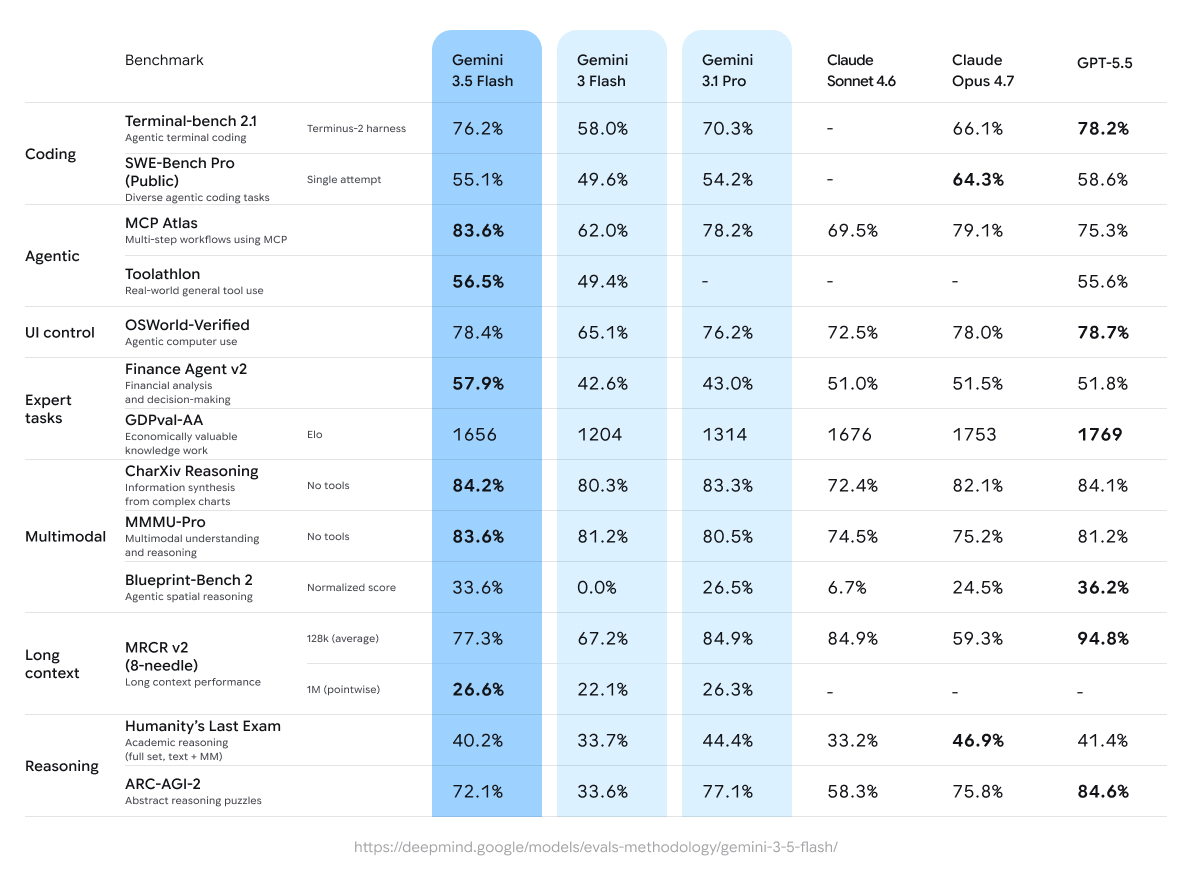
Google says 3.5 Flash outperforms its own Gemini 3.1 Pro on these benchmarks. That matters because Pro was the flagship, while Flash was the lightweight option. This release blurs that line.
What 'Agentic' Actually Means Here
Google uses "agentic" to describe AI that can plan, execute, and iterate on multi-step tasks without constant human guidance. Think: an AI that doesn't just answer a question but actually completes a workflow.
The company gives examples: developing applications, maintaining codebases, preparing financial documents. Tasks that "used to take a developer days or an auditor weeks," Google says, 3.5 Flash can help complete "in a fraction of the time, often at less than half the cost of other frontier models."
The model pairs with Google's Antigravity platform, which the company describes as an "agent-first development platform." Antigravity lets developers deploy "collaborative subagents" that work together on complex problems.
Where You Can Access It
Google is rolling out 3.5 Flash across its product stack simultaneously:
- Consumer: Gemini app and AI Mode in Google Search
- Developers: Google Antigravity platform, Gemini API in Google AI Studio and Android Studio
- Enterprise: Gemini Enterprise Agent Platform and Gemini Enterprise
The company says 3.5 Flash is "available today to billions of people globally." That's marketing speak for: if you use Google products, you'll start seeing this model.
Google's AI Mode in Search uses Gemini models
The Competitive Picture
Google directly compares 3.5 Flash to Claude and GPT models in its benchmark charts. The company positions the model in the "top-right quadrant of the Artificial Analysis index," meaning high intelligence and high speed.
The framing is clear: OpenAI and Anthropic offer smart but slow models. Google offers smart and fast. Whether real-world performance matches benchmark scores is a different question.
Shows how third-party apps integrate Gemini capabilities
What's Coming Next
Google confirmed 3.5 Pro is in internal use and will launch next month. The company didn't share benchmark numbers for Pro, but the naming suggests it will outperform Flash on raw capability while possibly running slower.
The announcement also mentions deploying "subagents" under supervision for "the most demanding use cases." This points to Google building toward AI systems that can handle enterprise-scale automation with human oversight.
Logicity's Take
Frequently Asked Questions
What is Gemini 3.5 Flash?
Gemini 3.5 Flash is Google DeepMind's latest AI model, designed for agentic workflows and coding tasks. It claims to match frontier model intelligence while running four times faster.
How does Gemini 3.5 Flash compare to GPT and Claude?
Google's benchmarks show 3.5 Flash competing with or exceeding Claude and GPT models on coding and agentic tasks, while running significantly faster on output speed.
Where can I access Gemini 3.5 Flash?
It's available in the Gemini app, AI Mode in Google Search, Google AI Studio, Android Studio, and Google's enterprise platforms.
When is Gemini 3.5 Pro releasing?
Google says 3.5 Pro is in internal use and will roll out next month, though no specific date was announced.
What is Google Antigravity?
Antigravity is Google's agent-first development platform that lets developers deploy collaborative AI subagents to tackle complex multi-step workflows.
Need Help Implementing This?
Source: Hacker News: Best
Huma Shazia
Senior AI & Tech Writer
Produced with AI assistance and reviewed by the Logicity editorial team. Learn more in our Editorial Policy.




