Key Takeaways
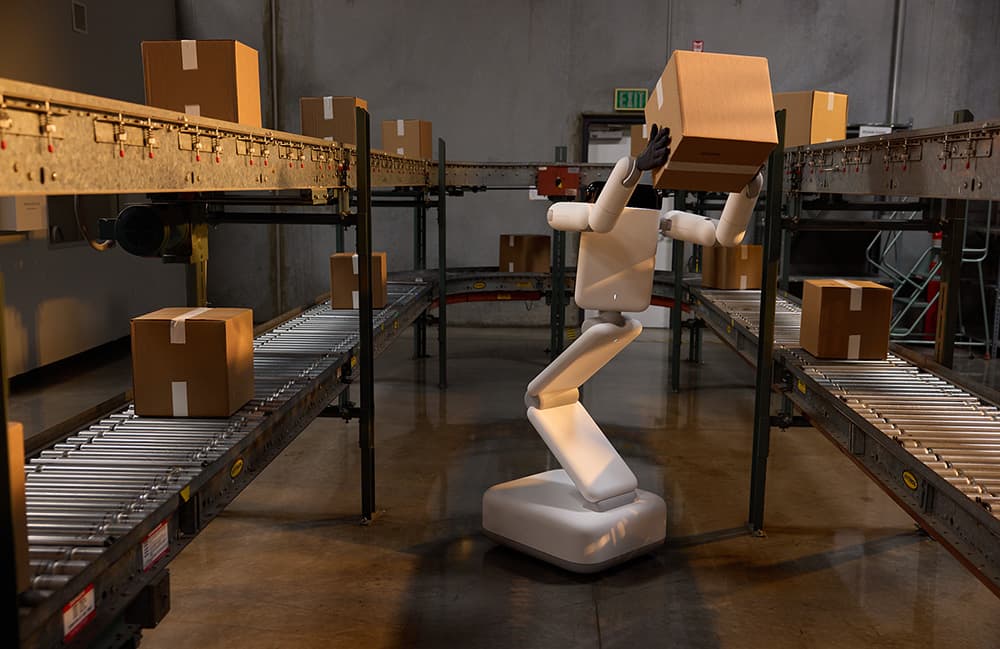
- Genesis AI revealed Eno, a wheeled general-purpose robot with 20-degree-of-freedom hands, targeting end-of-2026 production
- The GENE foundation model enables multi-step task planning and real-time reasoning rather than isolated command execution
- An optional cognitive interface screen shows what the robot is thinking, addressing human-robot trust concerns
Genesis AI unveiled Eno, a wheeled general-purpose robot designed to handle complex tasks in warehouses, factories, and eventually homes. Production begins by end of 2026, with industrial customers first in line.
The San Carlos, California company raised $105 million in seed funding last year. Now it's showing what that money bought: a mobile manipulator that skips the humanoid look in favor of a minimalist tower design with articulated panels, proprietary hands featuring 20 degrees of freedom, and an AI brain called GENE that handles multi-step task planning.
Why wheels instead of legs?
Eno rolls. That's a deliberate choice. Genesis AI says it prioritized mobility, dexterity, and real-world functionality over mimicking human form. The wheeled base provides stability for manipulation tasks, while the articulated tower adjusts height and reach on the fly. When not working, the whole thing folds down for compact storage.
The hands are where Genesis focused its humanoid ambitions. They match the form and function of human hands, allowing Eno to use tools, open doors, and interact with environments designed for people. Twenty degrees of freedom is substantial. For context, the human hand has roughly 27.
“The only path to creating a robot that can truly deliver value to society and excel in the real world is through intentional design and a single, comprehensive system.”
— Zhou Xian, Co-founder and CEO of Genesis AI
Daniel Hundt, head of design, described the philosophy: "We reduced the form to its essential elements so that every detail serves a purpose, from the way it moves between environments to the precision, range, and sensitivity required to operate alongside people in the real world."
What does the GENE foundation model actually do?
Genesis claims GENE moves Eno beyond simple command execution. Give the robot a high-level goal, and it should understand context, retain memory, reason through changing conditions, and dynamically plan multi-step tasks. The company calls this operating as a "physical agent" rather than a traditional industrial robot.
In practice, Genesis says this means Eno can manage entire workflows. Keep production lines stocked. Prepare facilities for the next shift. Coordinate with people and machines rather than just executing predefined motions.
The word "claims" matters here. These are demos and descriptions, not independent benchmarks. The gap between controlled warehouse footage and reliable real-world deployment remains the central challenge for every company in this space.
The transparency play: showing the robot's thinking
One detail stands out. Genesis is offering an optional screen version with what it calls a "cognitive interface" that displays what the robot is thinking and doing in real time. The stated goal is building trust through transparency.
This addresses a genuine problem. People struggle to trust robots they can't predict. If Eno shows its intent before acting, workers can anticipate its movements and intervene when needed. Whether calling this a "cognitive interface" overpromises what's actually displayed remains to be seen.

When does Eno ship, and to whom?
Genesis plans production and targeted customer deployments by end of 2026. The rollout sequence: manufacturing, logistics, and laboratories first. Hotels and hospitals follow. Consumer home and outdoor applications come last.
That sequence makes sense. Industrial environments are more controlled. Tasks are more defined. Customers can absorb higher price points. Home deployment is the hardest market, so Genesis is building toward it rather than starting there.
The wheeled vs. humanoid debate
Online reaction has been mixed. On r/robotics and Hacker News, enthusiasts are impressed by the dexterity specs and the GENE model's ambitions. Skeptics question whether the wheeled form factor can compete with emerging humanoid designs from Tesla, Figure, and others.
The skepticism isn't unfounded. Stairs exist. Uneven terrain exists. Many environments were designed for bipedal movement. But wheels offer stability, efficiency, and fewer points of failure. For warehouse floors and hospital corridors, they may prove the better choice.
Genesis is betting that what a robot can do with its hands matters more than how it gets around. Industrial customers likely agree. The consumer market may feel differently.
Logicity's Take
Genesis AI is making a calculated bet: in a field crowded with humanoid prototypes, utility beats aesthetics. The wheeled design sacrifices stair-climbing for stability and cost efficiency. More interesting is the cognitive interface screen. If Genesis can genuinely show a robot's intent in ways workers find useful, that's a meaningful differentiation. Most robotics companies treat the trust problem as a marketing challenge. Genesis is treating it as a product feature.
Frequently Asked Questions
When will the Genesis AI Eno robot be available?
Genesis AI plans to begin production and targeted customer deployments by the end of 2026, starting with industrial customers in manufacturing, logistics, and laboratories.
How much funding has Genesis AI raised?
Genesis AI raised $105 million in seed funding in 2025 to develop its general-purpose robotics platform and the GENE foundation model.
What makes Eno different from humanoid robots?
Eno uses a wheeled base instead of legs, prioritizing stability and efficiency over human-like appearance. Its hands feature 20 degrees of freedom for near-human dexterity.
What is the GENE foundation model?
GENE is Genesis AI's robotics-native AI system that enables Eno to understand context, retain memory, reason through changing conditions, and plan multi-step tasks rather than executing isolated commands.
What is Eno's cognitive interface?
An optional screen that displays what the robot is thinking and doing in real time, designed to build trust by making the robot's intentions transparent to nearby workers.
Need Help Implementing This?
If you're evaluating robotics solutions for manufacturing, logistics, or laboratory automation, Logicity can connect you with industry experts and analysts tracking the general-purpose robotics space. Reach out at contact@logicity.in.
Source: The Robot Report / The Robot Report Staff
Manaal Khan
Tech & Innovation Writer
Produced with AI assistance and reviewed by the Logicity editorial team. Learn more in our Editorial Policy.




