Key Takeaways
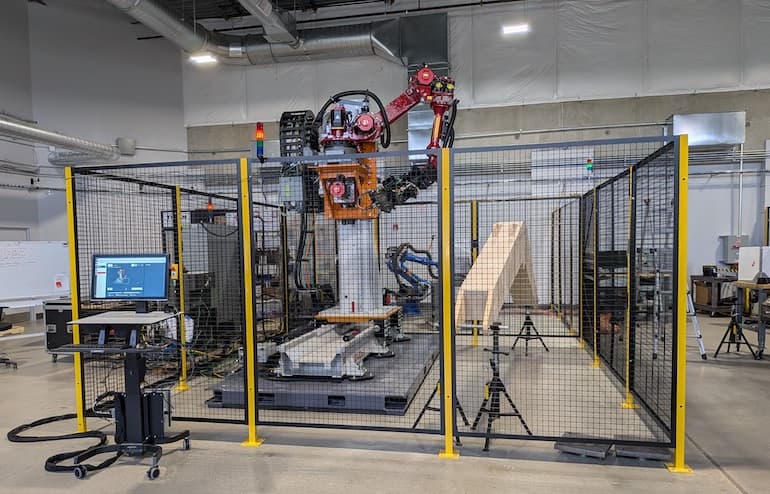
- Güdel's TrackMotion system adds vertical and horizontal motion to a single robot, eliminating the need for multiple fixed robots or complex part repositioning
- The Automate 2026 demo features a FANUC R-1000 with grinding tool, developed by Titan Robotics for an off-road equipment manufacturer
- The approach targets large weldments and fabricated parts in aerospace, heavy equipment, and power generation where manual grinding remains common
Güdel AG will demonstrate a grinding system at Automate 2026 that lets a single robot cover work envelopes typically requiring multiple fixed units. The Swiss automation company's TrackMotion system adds vertical lift and horizontal travel to extend a robot's reach across large fabricated parts, an approach aimed at aerospace, heavy equipment, and power generation manufacturers still grinding by hand.
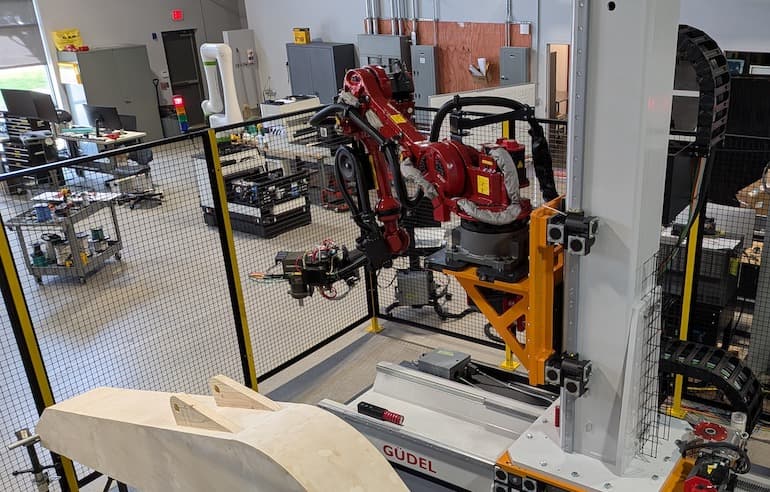
The demo, scheduled for Booth 1806 at Chicago's McCormick Place, pairs a FANUC R-1000 robot with Güdel's TMV (TrackMotion Vertical) and TMF (TrackMotion Floor) systems. Systems integrator Titan Robotics developed the application for a major off-road equipment manufacturer that needed to grind large weldments without repositioning the parts.
Why stationary robots struggle with large-part grinding
Grinding and surface finishing rank among the classic candidates for automation. The work is dull, dirty, and dangerous. Sparks, abrasive dust, and repetitive force exposure make human operators expensive to protect and prone to fatigue-related inconsistency.
The problem is scale. A typical industrial robot reaches about three meters. Large weldments, wind turbine components, or aircraft parts can span fifteen meters or more. Manufacturers either deploy multiple robots, each handling one zone, or reposition the workpiece multiple times during the cycle. Both options add capital cost, programming complexity, and new sources of variation.
“Expanding the robot's workspace isn't just a helpful addition; it's the factor that finally makes automation feasible for large, difficult-to-reach parts.”
— Brenda Courim, Director of Sales and Marketing, Güdel US
How Güdel's TrackMotion system works
Güdel's solution mounts a robot on a precision vertical lift, which itself rides along a floor-mounted horizontal track. The result is two additional degrees of freedom beyond the robot's native six axes. A single robot can now traverse the length of a large part while adjusting height to maintain optimal tool angle.
The company claims three advantages over fixed cells. First, reduced capital investment: one robot replaces several, simplifying cell design, safety fencing, and controls integration. Second, better process stability: the track keeps the robot in favorable working postures, avoiding joint extremes that cause wear and degrade repeatability during high-force grinding. Third, durability in harsh environments: the track systems shield critical components from abrasive debris.
Courim also emphasized software flexibility. As part designs evolve, the system can adapt through programming changes rather than mechanical rework. That matters for manufacturers with multiple product families or frequent engineering revisions.
FANUC and Titan Robotics fill out the cell
FANUC supplied the R-1000 robot, a model rated for heavy payloads and extended reach. Lou Finazzo, vice president of sales at FANUC America, framed the partnership as a response to demand for large-part automation that neither company could address alone.
"By combining FANUC's robot performance with Güdel's vertical and floor-mounted motion, customers gain the reach, stability, and process consistency needed to automate large, demanding grinding applications," Finazzo said.
Titan Robotics, the systems integrator behind the demo cell, developed the specific grinding application for an unnamed off-road equipment manufacturer. That customer context matters: heavy equipment frames and structural weldments represent exactly the scale and complexity where manual grinding persists.

Who this targets and what it replaces
Güdel US, headquartered in Ann Arbor, Michigan, serves customers in automotive, aerospace, logistics, heavy industrial, and power generation sectors. The company's 45,000 sq. ft. facility provides engineering, design, and production support for North American buyers.
The parent company, Güdel Group, has manufactured linear motion products in Langenthal, Switzerland since 1954. That seven-decade history in precision mechanics underpins the claim that track systems can maintain repeatability during high-force, high-vibration grinding cycles.
For manufacturers, the alternative to this approach is either manual grinding with its labor costs and ergonomic risks, or multi-robot cells with complex part handling. Güdel is betting that a simpler, single-robot architecture will win on total cost when the work envelope exceeds what stationary robots can cover.
Logicity's Take
The real test for Güdel isn't proving the concept works in a trade show demo. It's proving the economics at scale. Large-part grinding remains manual in many shops because the capital and programming costs of multi-robot cells never paid back. If Güdel's single-robot approach genuinely cuts capital requirements by half while maintaining process consistency, they've cracked a segment that has resisted automation for decades. The partnership with FANUC and Titan suggests Güdel is positioning this as a turnkey package, not just a motion component.
Frequently Asked Questions
What is Güdel's TrackMotion system?
A linear motion platform that mounts industrial robots on vertical and horizontal tracks, extending their work envelope beyond stationary reach limits. The system adds two degrees of freedom to the robot's native six axes.
When and where is Automate 2026?
Automate 2026 runs May 12-15, 2026, at McCormick Place in Chicago. Güdel will be at Booth 1806.
What robot is used in the Güdel grinding demo?
A FANUC R-1000 equipped with a grinding end-of-arm tool. The application was developed by systems integrator Titan Robotics.
Why is large-part grinding difficult to automate?
Standard industrial robots reach about three meters. Large weldments can span fifteen meters or more, requiring multiple robots or part repositioning, which adds cost and variation.
What industries does Güdel target with this system?
Automotive, aerospace, logistics, heavy industrial, press automation, and power generation, with particular emphasis on manufacturers handling large fabricated parts.
Need Help Implementing This?
If you're evaluating automation for large-part grinding or surface finishing, Logicity can help you assess vendors, compare architectures, and model ROI. Contact us to discuss your specific application requirements.
Source: The Robot Report / The Robot Report Staff
Huma Shazia
Senior AI & Tech Writer
Produced with AI assistance and reviewed by the Logicity editorial team. Learn more in our Editorial Policy.




