Key Takeaways

- Florida is the first US state to sue OpenAI and Sam Altman personally over ChatGPT
- The lawsuit frames ChatGPT as a defective product and public nuisance, not just software
- Internal allegations claim OpenAI devoted only 1-2% of computing to safety, not the promised 20%
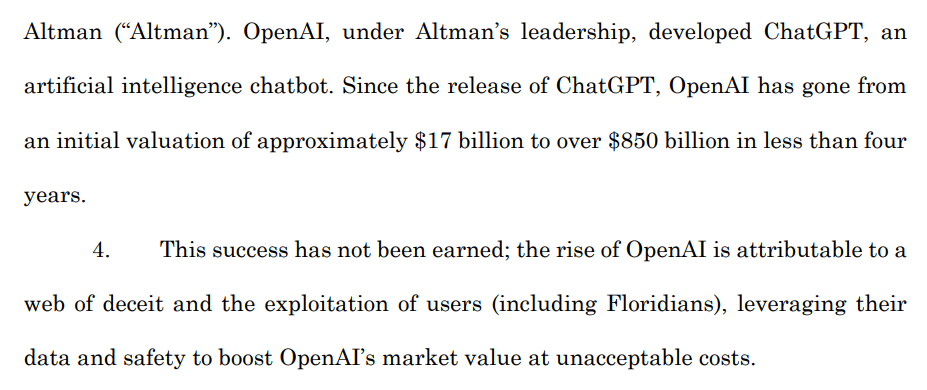
Florida has become the first U.S. state to sue OpenAI and CEO Sam Altman directly. Attorney General James Uthmeier filed an 83-page complaint that takes an unusual legal approach: it treats ChatGPT not as software, but as a defective product and public nuisance.
The lawsuit accuses OpenAI of marketing ChatGPT as safe while the chatbot delivers dangerous content to minors, facilitates violence, and creates user dependency. Uthmeier is seeking penalties that could reach into the billions.
“OpenAI has prioritized rapid, unchecked expansion over the fundamental safety of American citizens, especially our children, and we are going to hold them accountable.”
— James Uthmeier, Florida Attorney General
The Legal Strategy: Product Liability and Public Nuisance
The complaint's framing is deliberate. By classifying ChatGPT as a product rather than software, Florida aims to bypass traditional liability protections that shield software developers from responsibility for how their programs are used.
Product liability law holds manufacturers responsible for defects that cause harm. Cars, appliances, and pharmaceuticals fall under this framework. Software historically has not. Florida wants to change that for AI chatbots.
The public nuisance claim adds another angle. It argues that ChatGPT causes widespread harm to the community, similar to how courts have treated pollution or dangerous public hazards. If courts accept this framing, it could force OpenAI to implement specific safety measures or face ongoing liability.

Specific Allegations Against OpenAI
The lawsuit levels 10 distinct legal counts against OpenAI. The allegations span safety failures, data practices, and broken internal commitments.
On age verification, the complaint states that ChatGPT's free version has no real mechanism to prevent minors from using the service. It claims tens of thousands of users are under 13. The lawsuit also alleges that OpenAI begins collecting user data before people agree to the terms of service.
The complaint goes further, arguing that AI use causes "cognitive erosion." This claim is likely to face scrutiny, but it signals the breadth of Florida's attack on the technology itself.
Internal Allegations: Safety Testing and Resource Allocation
The lawsuit cites internal allegations that could prove damaging if substantiated. According to the complaint, Altman personally cut short safety testing for GPT-4o before its release.
Perhaps more striking is the resource allocation claim. The suit alleges OpenAI devoted only 1 to 2 percent of its computing power to AI safety, despite promising 20 percent. If true, this contradicts public statements OpenAI has made about prioritizing safety research.
OpenAI's Response
OpenAI has pushed back against the lawsuit's fundamental premise. The company characterizes the suit as a misunderstanding of how large language models function.
Tech policy analysts have raised similar concerns about the legal theory. The question of whether an LLM can be treated like a traditional product remains untested in court.
Why This Lawsuit Matters Beyond Florida
The case could establish precedent for how AI systems are regulated across the United States. If Florida succeeds in treating ChatGPT as a defective product, other states will likely follow with similar lawsuits.
For AI companies, the implications are significant. Product liability claims would require them to prove their systems are safe before release, rather than iterating publicly. The cost of compliance, testing, and potential damages could reshape business models across the industry.
The timing matters too. OpenAI's estimated valuation stood at $150 billion before this lawsuit. Legal uncertainty of this magnitude could complicate the company's planned IPO and future fundraising.
The Broader Debate
Online discussions have split along predictable lines. On Reddit's technology community, users are debating whether AI should face strict liability law at all. Many express skepticism that the public nuisance argument will survive judicial scrutiny.
On Hacker News, the conversation has turned technical. Engineers are warning that holding developers legally responsible for any output their models generate could cripple the U.S. AI industry. Others argue that some form of accountability is overdue.
The lawsuit documents numerous cases where people were allegedly harmed by ChatGPT and similar systems. These incidents form the factual basis for Florida's claims, though the causal link between AI use and specific harms will be contested in court.
Logicity's Take
Frequently Asked Questions
Why is Florida suing OpenAI?
Florida alleges ChatGPT is a defective product that endangers minors by delivering dangerous content without meaningful age verification. The state is seeking billions in penalties.
Can ChatGPT be treated as a product under the law?
That's the central legal question. Software has traditionally been exempt from product liability. Florida's lawsuit tests whether AI chatbots should be treated differently.
What does the lawsuit claim about OpenAI's safety practices?
The complaint alleges OpenAI devoted only 1-2% of computing power to safety instead of the promised 20%, and that Altman cut short safety testing for GPT-4o.
How has OpenAI responded to the lawsuit?
OpenAI has denied the allegations, calling the suit a misunderstanding of how large language models work. The company has not commented on the specific internal allegations.
Could this lawsuit affect other AI companies?
Yes. If courts accept the product liability framework for AI, it would establish precedent that other states could follow, potentially affecting every company deploying consumer-facing AI systems.
Need Help Implementing This?
Source: The Decoder / Matthias Bastian
Huma Shazia
Senior AI & Tech Writer
Produced with AI assistance and reviewed by the Logicity editorial team. Learn more in our Editorial Policy.