Key Takeaways

- Etched closed a $300M Series C at $10.3B valuation, doubling from December 2025
- The company claims $1B in orders for its transformer-optimized inference systems
- Etched built custom prefill and decode chips using low-voltage inference and cluster-scale memory
Etched, the AI chip startup that bet everything on transformer-based inference, has closed a $300 million Series C at a $10.3 billion valuation. Sequoia led the round. The company doubled its valuation in seven months, a pace that makes skeptics uncomfortable and believers more confident.
The round also included Andreessen Horowitz, SK Hynix, Jane Street, and Diffusion Capital. Notable angel backers remain on the cap table: Peter Thiel, Andrej Karpathy, Dylan Field, and Amjad Masad. According to co-founder Robert Wachen, this marks the highest valuation ever for a Sequoia-led Series C.
What has Etched actually built?
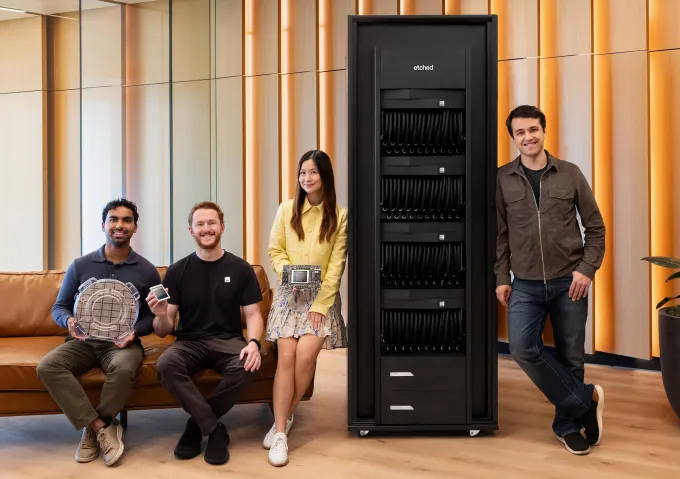
Etched sells complete rack systems, not standalone chips. The hardware is designed specifically for inference, the compute step that happens after a user submits a prompt. Wachen breaks inference into two phases: prefill (understanding the prompt) and decode (generating the response).
For prefill, Etched built a chip that runs at lower voltage than competitors. Lower voltage means less heat. Less heat means more transistors per chip. The company calls this "low-voltage inference." For decode, they created what Wachen calls "cluster-scale memory," a new interconnect technology that lets multiple chips share a memory pool at low latency.
The promise: faster speeds at lower costs. The caveat: almost nobody outside investors and early customers has tested the hardware.
Why did everyone call the bet crazy?
When three Harvard dropouts launched Etched in 2022, building a chip optimized for transformer architectures seemed reckless. Transformers powered GPT and Claude, yes, but betting an entire company on one architecture? That looked like a good way to get stranded if the field moved on.
The founders still fight that perception. Wachen insists the systems run any AI model: Mixture of Experts architectures like DeepSeek and Qwen, even non-transformer designs like Mamba (a state-space model). The chips are optimized for transformers but not locked to them.
Interestingly, the idea of etching model components directly into silicon no longer sounds fringe. Google reportedly pursues the same concept with its Frozen v2 chip for Gemini.
Context on Big Tech's massive AI infrastructure investments
Where does $1 billion in orders come from?
Last month, Etched announced that TSMC had successfully manufactured its chips, that systems were being tested by clients, and that the company had booked $1 billion in orders. That last number caught attention. Who's buying?
Wachen didn't name customers, but the investor list hints at demand. Andrej Karpathy (formerly OpenAI, now at Anthropic), Noam Brown (OpenAI), and Geoffrey Hinton all tried the hardware in private demos. SK Hynix, the memory giant, participated in this round. The inference market is real, and the incumbents are expensive.
The garage-startup origin story
The founding narrative is almost too on-the-nose. CEO Gavin Uberti, Wachen, and Chris Zhu dropped out of Harvard without knowing how to raise money or hire engineers. Wachen remembers landing in the Bay Area with no apartment, sleeping on a friend's floor with a towel for a blanket.
They set up the servers for chip-design tools in an early employee's garage. Every reboot required a physical trip. "We had no idea how hard it was going to be," Wachen said. "I think we still have to be humbled by what it will take to actually get to scale."
That humility is notable. The company has raised over $800 million total, hit a $10 billion valuation, and still hasn't mass-shipped product. The hardest part may be ahead.
How Etched compares to AI chip competitors
| Company | Focus | Stage | Latest Valuation |
|---|---|---|---|
| Etched | Transformer inference (prefill + decode) | Testing with early customers | $10.3B (July 2026) |
| Cerebras | Wafer-scale training chips | Shipping to customers | ~$4B (2024) |
| Groq | LPU inference architecture | Shipping, API available | ~$2.8B (2024) |
| NVIDIA | General AI compute (H100, B200) | Market leader | $3T+ (public) |
Etched occupies a distinct lane: purpose-built inference at low voltage, sold as complete systems. Whether that specificity becomes an advantage or a trap depends on how transformer architectures evolve and how fast Etched can ship.
Shows the scale of AI inference demand these chips must serve
Logicity's Take
Etched's valuation jump says more about investor conviction in inference bottlenecks than about proven hardware. The $1B order book is significant, but the company still hasn't mass-shipped systems. For CTOs evaluating AI infrastructure, Etched represents a speculative but potentially cheaper alternative to NVIDIA's H100/B200 stack. The real test: can they deliver consistent, production-grade performance at scale? If so, hyperscalers and AI labs will pay. If not, this becomes a cautionary tale about hardware bets. Watch for customer deployments in late 2026.
What's next for the company?
The $300 million will fund manufacturing scale-up. Etched needs to move from early customer tests to production delivery. That transition breaks many hardware startups. Supply chain, yield rates, and customer support all become harder at volume.
The founders seem aware. Wachen's comments avoid triumphalism. "We still have to be humbled by what it will take to actually get to scale," he said. At $10.3 billion, the expectations are now enormous. The next milestone isn't another funding round. It's racks in data centers, running inference workloads, at the speeds they promised.
Another high-profile valuation story with scrutiny on fundamentals
Frequently Asked Questions
What does Etched's AI chip do differently?
Etched builds chips optimized specifically for AI inference, using low-voltage prefill processors and cluster-scale shared memory for decode. This approach aims to deliver faster inference at lower cost than general-purpose GPUs.
Can Etched chips only run transformer models?
No. While optimized for transformers, Etched systems also run Mixture of Experts models like DeepSeek and Qwen, as well as non-transformer architectures like Mamba.
Who are Etched's main competitors?
NVIDIA dominates AI compute broadly. For inference-specific hardware, competitors include Groq (LPU architecture) and Cerebras (wafer-scale chips). Each has a different technical approach.
How much has Etched raised in total?
Over $800 million across multiple rounds. The company raised $500 million in December 2025 at a $5 billion valuation, then $300 million in July 2026 at $10.3 billion.
When will Etched systems be widely available?
The company announced successful chip manufacturing in June 2026 and is testing systems with early customers. Mass production and broader availability are expected later in 2026 or 2027.
Need Help Implementing This?
Evaluating AI infrastructure options for your stack? Our team tracks the chip landscape closely. Reach out at hello@logicity.in for a briefing on what Etched, Groq, and NVIDIA alternatives mean for your inference costs.
Source: TechCrunch / Julie Bort
Huma Shazia
Senior AI & Tech Writer
Produced with AI assistance and reviewed by the Logicity editorial team. Learn more in our Editorial Policy.