Key Takeaways
- Dream tripled its valuation from $1B to $3B in roughly 16 months, raising $260M from Bicycle Capital, Group 11, and others.
- The company targets governments seeking 'sovereign AI' to avoid dependence on US or Chinese cloud infrastructure.
- Co-founder Shalev Hulio previously led NSO Group, maker of the controversial Pegasus spyware.
Dream, the Israeli AI and cybersecurity startup founded by former NSO Group CEO Shalev Hulio, has raised $260 million at a $3 billion valuation. The round, led by Bicycle Capital and Group 11, nearly triples the company's worth from $1 billion in February 2025.
The pitch is straightforward: governments and state-owned enterprises that handle sensitive data cannot rely on American or Chinese AI systems. Dream sells them on-premise alternatives they fully own and control.
Who is backing Dream?
Bicycle Capital and Group 11 led the round. Bain Capital Ventures, Antler, and Tru Arrow Partners joined as additional investors. Dovi Frances, founder of Group 11, called Dream the "world's fastest-growing cyber startup" when announcing the milestone.
The company has generated almost $300 million in cumulative sales since launching commercial operations in late 2024. Annual recurring revenue reportedly exceeds $100 million.
What is sovereign AI, and why do governments want it?
Sovereign AI refers to artificial intelligence systems that a nation builds, hosts, and operates independently of foreign cloud providers. The appeal is control: governments can audit the code, store data within their borders, and avoid policy decisions made in Washington or Beijing.
"As AI becomes central to national security, economy and public services, governments face a fundamental choice: depend on systems they do not control from the US or China, for example, or build capabilities they fully own," Hulio told the Economic Times. "Dream was founded to eliminate that trade-off."
The timing helps. Last week, the White House decided to withhold Anthropic's latest AI models from foreign nationals. Hulio described it as "a wake-up call for all nations to understand that if they want to move to AI, they can't rely on foreign model clouds or tools."
Related coverage of the US policy shift that Dream's pitch directly references
What does Dream actually sell?
The company started with AI-based cyber defense for nation-states. It has since expanded into a custom AI platform called Atlas, designed for governments and critical infrastructure operators.
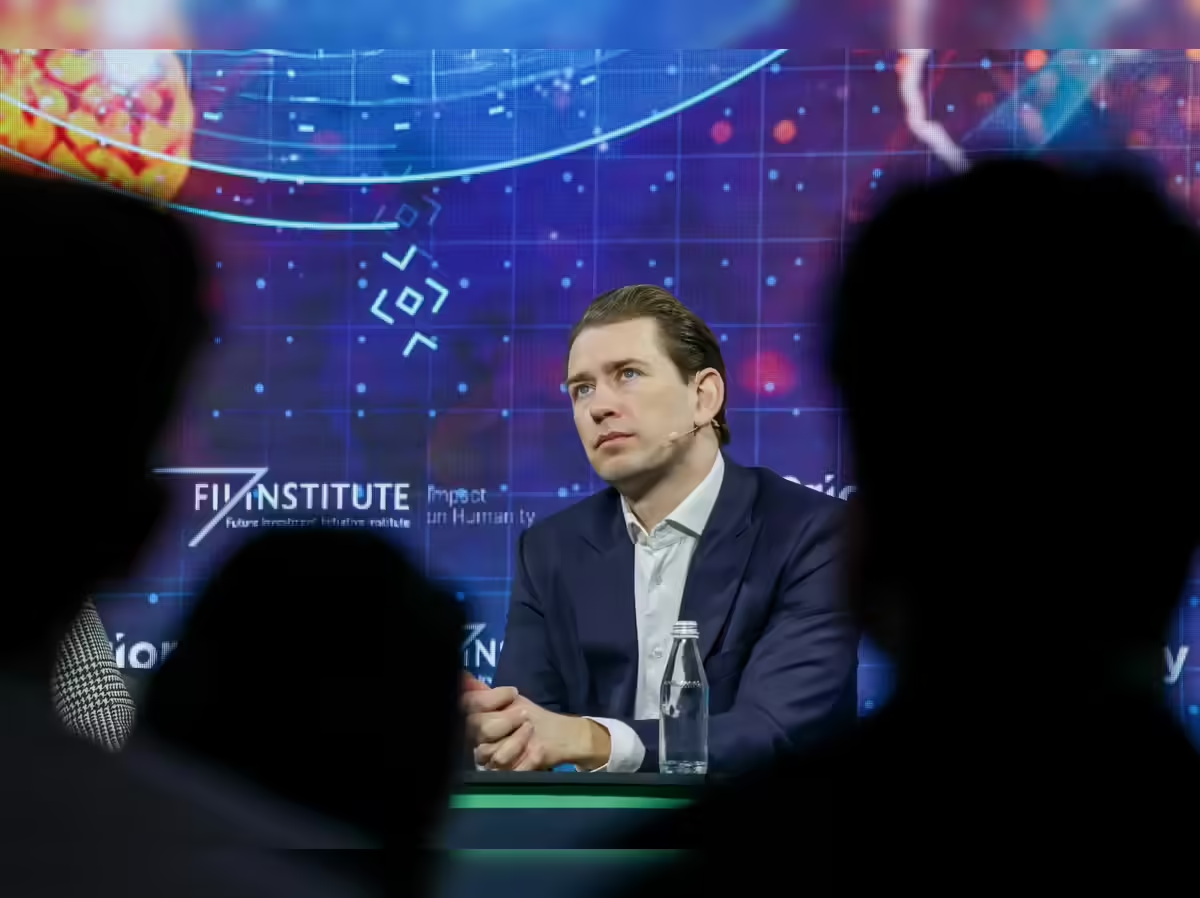
Sebastian Kurz, the former Austrian chancellor who co-founded Dream alongside Hulio and Gil Dolev, pointed to counterfraud as one of Atlas's strongest use cases. Hulio added procurement optimization, corporate operations, and supply chain theft detection to the list.
Last year, Dream launched Hero, an autonomous AI agent that helps governments identify and patch security vulnerabilities. The new capital will fund expansion across Europe, the Middle East, Asia, and the Americas. "Especially in Europe, there's much need to prepare for these new threats," Kurz said.
The founders' baggage
Neither co-founder comes without controversy. Hulio built NSO Group, the company behind Pegasus spyware, which was used by governments to surveil journalists, activists, and political opponents. He left NSO before founding Dream in 2023.
Kurz resigned as Austrian chancellor in 2021 amid corruption allegations. He is currently under investigation, though a court cleared him of perjury charges last year.
Investors appear undeterred. Marcelo Claure of Bicycle Capital expressed enthusiasm about the company's global expansion plans. The valuation jump suggests venture capital sees the sovereign AI thesis as compelling enough to overlook the founders' histories.
What does a tripled valuation signal?
A $1 billion to $3 billion jump in 16 months is aggressive. It reflects two things: genuine revenue traction ($300 million in sales is not vaporware) and investor conviction that the sovereign AI market will grow rapidly as geopolitical tensions push governments toward tech independence.
Europe is a natural target. The EU has spent years debating digital sovereignty, and the recent US policy on AI model exports gives Dream a concrete example to reference in sales meetings. Whether governments will actually pay premium prices to avoid dependence on OpenAI or Anthropic remains the open question.
Frequently Asked Questions
What is Dream's current valuation?
Dream is now valued at $3 billion after its latest $260 million funding round, nearly tripling from $1 billion in February 2025.
Who founded Dream?
Dream was founded in 2023 by Shalev Hulio (former NSO Group CEO), Sebastian Kurz (former Austrian Chancellor), and Gil Dolev.
What is sovereign AI?
Sovereign AI refers to artificial intelligence systems that a nation or organization fully owns, hosts, and operates independently of foreign cloud providers.
How much revenue has Dream generated?
Dream has generated approximately $300 million in cumulative sales since launching commercial operations in late 2024, with annual recurring revenue exceeding $100 million.
What products does Dream offer?
Dream offers Atlas, a custom AI platform for governments, and Hero, an autonomous AI agent for identifying and patching security vulnerabilities.
Logicity's Take
Dream's pitch is well-timed but not guaranteed to succeed. Governments talk about digital sovereignty constantly, but procurement cycles are slow, and many will balk at paying premium prices for on-premise AI when cheaper cloud alternatives exist. The real test is whether the Anthropic export restrictions become a recurring pattern. If they do, Dream's founders, controversial as they are, will have built the right product at the right moment.
Need Help Implementing This?
If your organization is evaluating sovereign AI solutions or navigating government tech procurement, our team can help you assess options. Reach out to Logicity's advisory services for strategic guidance on AI infrastructure decisions.
Source: Tech-Economic Times / ET
Huma Shazia
Senior AI & Tech Writer
Produced with AI assistance and reviewed by the Logicity editorial team. Learn more in our Editorial Policy.




