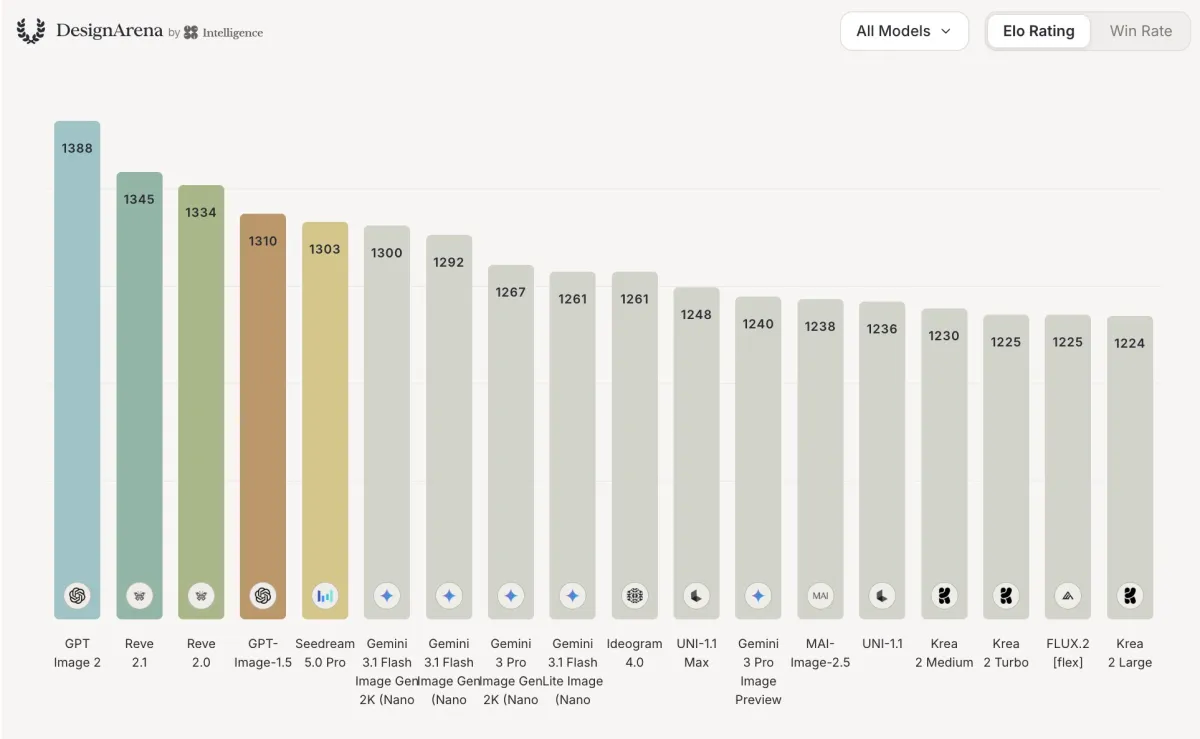
Intelligence, the company behind design-feedback tool DesignArena, has closed a $7.9 million seed round led by Index Ventures. The platform lets 5.3 million users rank AI-generated outputs, and frontier labs pay for the resulting preference data. Intelligence says it's now generating $60 million in annual recurring revenue.
The round also includes Conviction (Sarah Guo and Mike Vernal), A*, and Valkyrie. Co-founder Grace Li says the company started weeks before her 2025 graduation, when she and college friends discovered their AI game engine could produce functional games that weren't actually fun to play.
How DesignArena works
Consumer users interact with DesignArena like a model router. They enter a prompt, select a format (website, image, or one of a dozen other visual options), and receive a series of A/B comparisons. The user ranks outputs from best to worst. That ranking becomes training signal.
The commercial value sits on the other side. Participating AI labs treat DesignArena as an always-on feedback loop for their media-generating models. Users don't care which model produced which output. They just want the best result. That indifference, Li argues, produces honest rankings.
"It was the missing bottleneck for a lot of these models to make improvements in the design space," Li told TechCrunch. "About a week later, we closed our first major deal with a frontier lab, and the rest is kind of history."
Why labs pay for taste
Automated benchmarks can run at scale, but they're gameable. Last week's Hugging Face breach illustrated the vulnerability in dramatic fashion. Human evaluations are harder to manipulate, and they capture something benchmarks miss: whether output feels right to actual users.
Because DesignArena requires login, Intelligence can track how preferences shift across continents and over time. Li notes that web dashboards in Asia tend toward a more maximalist design style. That kind of cultural segmentation is invisible to automated scoring.
Explores architectural choices for AI systems that could inform how feedback loops integrate into model pipelines
A market with fresh casualties
Crowdsourced AI feedback is not a guaranteed win. Yupp, which raised $33 million from a16z crypto's Chris Dixon and claimed over 1.3 million users, shut down earlier this year. It had frontier labs as customers but couldn't build a sustainable business.
Intelligence's path looks different so far. The $60 million ARR figure, if accurate, puts it in rare territory for a seed-stage company. The comparison is LM Arena, which takes a similar approach for text-based responses. LM Arena raised $150 million in a Series A in January 2026, four months after launching its paid product.
Logicity's Take
Intelligence's economics look unusually strong for seed stage, but the Yupp collapse is a warning. The difference may come down to stickiness: labs that integrate DesignArena's feedback into their training loops have switching costs, while Yupp's consumer-facing crypto incentives didn't create the same lock-in. The real test is whether Intelligence can retain its frontier lab customers when competitors inevitably undercut on price.
What this signals for AI development
The rise of human-evaluation startups reflects a maturing AI market. Early model development leaned heavily on automated benchmarks. As outputs get more subjective, so does evaluation. Design, creative writing, and user-interface generation all require some version of "does this feel right?"
That creates a new infrastructure layer between AI labs and end users. The question is whether that layer consolidates around a few dominant platforms or fragments. For now, Intelligence has scale and revenue. Whether it can defend that position depends on how quickly frontier labs build their own feedback loops in-house.
Need Help Implementing This?
If you're evaluating AI model quality or building feedback systems for your own products, reach out to Logicity's consulting team for implementation guidance.
Source: TechCrunch / Russell Brandom
Huma Shazia
Senior AI & Tech Writer
Produced with AI assistance and reviewed by the Logicity editorial team. Learn more in our Editorial Policy.