Key Takeaways
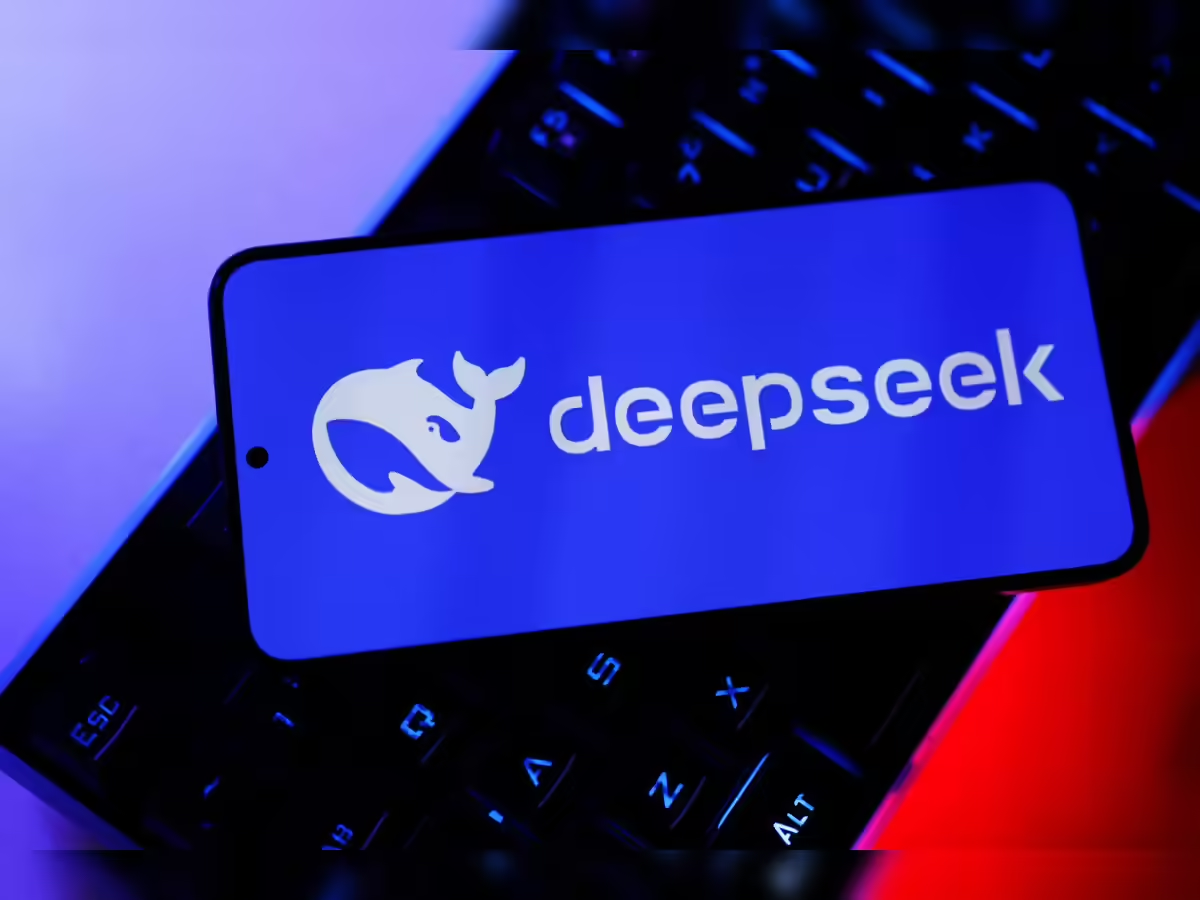
- Anhui Korrun's subsidiary paid 2.90 billion yuan for a 0.8265% indirect stake in DeepSeek, implying a $51.82 billion valuation
- This filing provides the first public evidence of DeepSeek's external fundraising, which the company has never officially announced
- The valuation comes months after DeepSeek triggered massive tech selloffs by claiming to train competitive AI models for a fraction of US costs
DeepSeek, the Chinese AI startup that rattled global tech markets in January, is now valued at roughly $52 billion. That figure comes from a stock exchange filing by Anhui Korrun, a Chinese luggage manufacturer whose subsidiary invested in a fund that acquired a 0.8265% indirect stake in DeepSeek for 2.90 billion yuan. The math: 350.88 billion yuan, or $51.82 billion at current exchange rates.
The filing matters because DeepSeek has never publicly announced or detailed any fundraising. The company, founded in 2023 by hedge fund manager Liang Wenfeng, operates with unusual opacity for a firm that briefly erased hundreds of billions of dollars from US tech stocks.
What does this valuation tell us about DeepSeek?
A $52 billion valuation puts DeepSeek in rarefied company. For context, Anthropic is seeking additional credit facilities as it pursues its own IPO, and that company last raised at a $60 billion valuation in early 2025. DeepSeek's number, derived from an actual transaction rather than press releases, suggests investors are pricing it close to American AI labs that have raised far more capital.
The valuation also puts numbers to the narrative that emerged in January. DeepSeek claimed it trained its V3 model for roughly $6 million, a figure that would represent a 99% cost reduction compared to what OpenAI and Anthropic reportedly spend on frontier models. Whether that claim holds up to scrutiny remains debated. But clearly, sophisticated investors in China believe the company is worth backing at a valuation that implies massive future revenue.
The January shock and its aftermath
DeepSeek entered global consciousness on January 27, 2025. That day, US tech stocks shed close to $1 trillion in market cap after DeepSeek released its R1 reasoning model. The model matched or exceeded OpenAI's o1 on multiple benchmarks while supposedly costing a fraction to train and run. Nvidia alone lost nearly $600 billion in value as investors questioned whether AI infrastructure spending would need to be as enormous as previously assumed.
Microsoft CEO Satya Nadella called it a "wakeup call." The panic subsided, and Nvidia recovered, but the episode established DeepSeek as a serious player. The company's models now rank competitively on public leaderboards, and its open-weight approach has attracted developers who want capable models without API costs.
Why did this filing surface now?
Anhui Korrun is a publicly traded company on Chinese exchanges. Its disclosure requirements forced transparency that DeepSeek itself has avoided. The filing does not specify when the investment occurred, only that it happened. It also routes through an intermediary fund, adding distance between DeepSeek and the public record.
This structure is common in Chinese private equity. It lets startups maintain their preferred opacity while complying with listed companies' disclosure rules. The result: we know DeepSeek's implied valuation, but little about who else has invested, on what terms, or how the company plans to generate revenue at a scale that justifies $52 billion.
Questions this raises for Western AI labs
If DeepSeek's efficiency claims hold up, the implications extend beyond one company's valuation. The entire thesis behind massive AI infrastructure spending rests on the assumption that frontier capabilities require frontier budgets. DeepSeek's existence, and its ability to raise at this valuation, suggests at least some sophisticated investors believe there's another path.
That doesn't mean OpenAI, Anthropic, or Google should abandon their approaches. DeepSeek operates in a different regulatory and data environment. It can train on content that Western labs cannot. It faces different compute constraints due to US export controls on advanced chips, which may have forced the efficiency innovations it now touts as competitive advantages.
But $52 billion is not a science project. Someone expects DeepSeek to compete commercially, whether in China's domestic market or globally through its open-weight model distribution.
Logicity's Take
This filing confirms what January's market reaction suggested: DeepSeek is not a research curiosity but a commercially serious competitor. The $52 billion valuation lands it squarely between Anthropic (~$60B) and the tier below, despite far less disclosed funding. For CTOs evaluating AI infrastructure, the question isn't whether to use DeepSeek. The question is whether its efficiency claims change the economics of build-vs-buy decisions and whether American labs will respond with their own cost optimizations. Watch for pricing pressure across the API market in the coming quarters.
Frequently Asked Questions
How was DeepSeek's $52 billion valuation calculated?
Anhui Korrun's subsidiary invested 2.90 billion yuan for a 0.8265% indirect stake. Dividing the investment by the ownership percentage yields an implied valuation of 350.88 billion yuan, or approximately $51.82 billion at current exchange rates.
Has DeepSeek confirmed this valuation?
No. DeepSeek has never publicly announced or detailed any fundraising. The valuation derives entirely from a third-party filing by a listed company required to disclose its investments.
How does DeepSeek's valuation compare to US AI companies?
Anthropic last raised at approximately $60 billion. OpenAI has been valued at over $80 billion in recent rounds. DeepSeek's $52 billion places it below these leaders but above most other AI startups globally.
Why did DeepSeek cause US tech stocks to drop in January 2025?
DeepSeek released models that matched top US AI labs' performance while claiming training costs of only $6 million. This challenged assumptions about how much infrastructure spending AI development requires, hitting Nvidia and other AI hardware stocks particularly hard.
Who founded DeepSeek?
Liang Wenfeng, who also founded High-Flyer Capital, a Chinese quantitative hedge fund. The company was established in 2023.
Context on how Western AI labs are financing their operations compared to DeepSeek's approach
Need Help Implementing This?
Evaluating AI infrastructure decisions for your organization? Logicity works with tech leaders navigating the build-vs-buy question across LLM providers. Reach out to discuss how these market shifts affect your roadmap.
Source: Tech-Economic Times / ET
Huma Shazia
Senior AI & Tech Writer
Produced with AI assistance and reviewed by the Logicity editorial team. Learn more in our Editorial Policy.