Key Takeaways

- CuspAI raised $450M at a $2.6B valuation, quadrupling its worth since September 2024
- The startup launched an AI Materials Foundry with 45+ partners including Nvidia, Meta, and Samsung
- Investors include Jeff Bezos's family office, AMD Ventures, and the UK's Sovereign AI Venture Fund
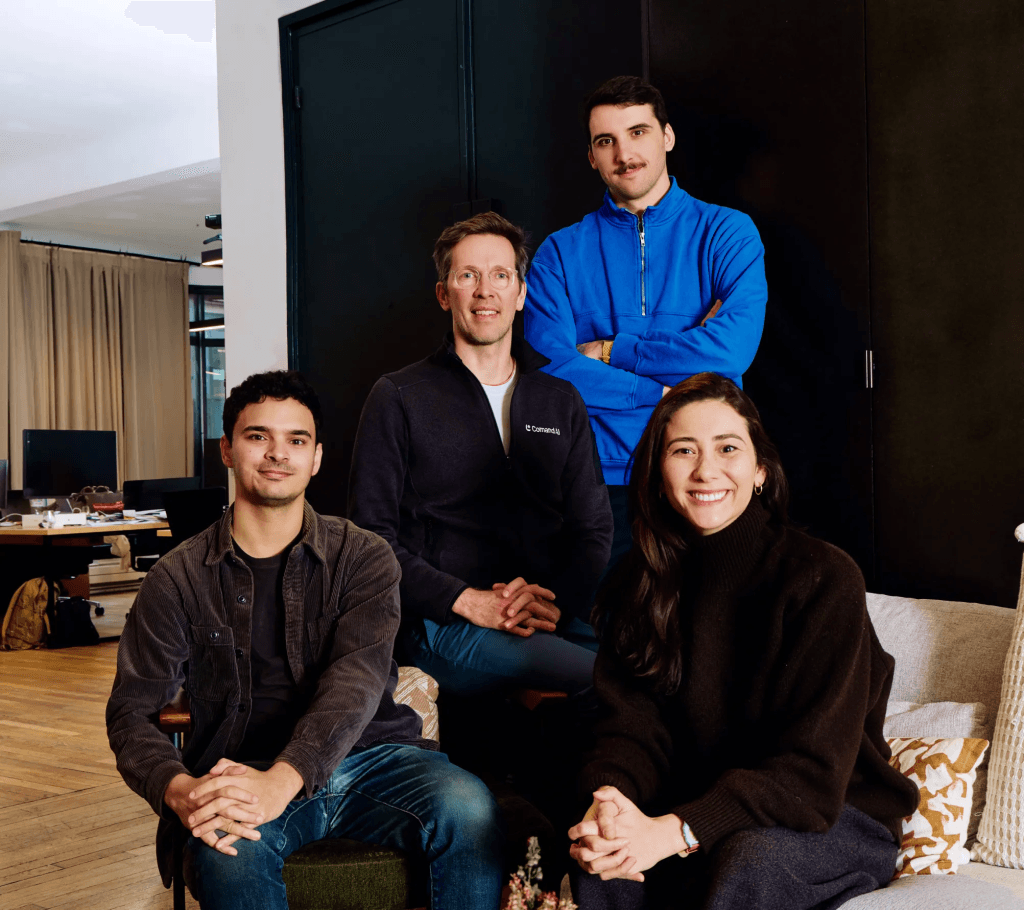
CuspAI, a Cambridge-based startup applying AI to discover new materials, has raised $450 million in a Series B round that values the company at $2.6 billion. The round was led by Kleiner Perkins and NEA, with participation from Jeff Bezos's family office, Bezos Expeditions. The company, founded in 2024, has quadrupled its valuation in under a year.
The funding confirms earlier Financial Times reporting that CuspAI was seeking a $2.6 billion valuation. In September 2024, the company had raised $100 million. That puts CuspAI's growth trajectory among the fastest in European AI, reaching unicorn status within roughly 12 months of founding.
Who invested in CuspAI's Series B?
Beyond the lead investors, the round drew strategic and sovereign capital. New backers include Glade Brook Capital Partners, Lux Capital, AMD Ventures, Britain's Sovereign AI Venture Fund, the Netherlands' Invest-NL, and venture capitalist John Doerr. Existing investors Lightspeed Venture Partners, Northzone, NEA, and Temasek also participated.
The board features two of the most influential figures in AI research: Yann LeCun, Meta's chief AI scientist, and Geoffrey Hinton, the Nobel laureate who left Google to warn about AI risks. Their presence signals the technical credibility CuspAI carries in machine learning circles.
What does CuspAI actually build?
CuspAI's platform, called MIRA, uses AI to design candidate materials, simulate their properties, and coordinate experimental validation. The goal is to discover materials that do not yet exist, targeting applications in semiconductors, clean energy, and advanced manufacturing.
Alongside the funding, CuspAI announced its AI Materials Foundry. This is a network of compute providers, labs, proprietary datasets, and scientific expertise intended to accelerate discovery. More than 45 organizations have joined as founding members.
The founding members include Nvidia, which will supply compute infrastructure, Meta's Fundamental AI Research team, Samsung, Hyundai Motor Group, Hitachi High-Tech, and Merck. The breadth of industries represented, from chips to cars to chemicals, reflects how many sectors face bottlenecks tied to materials limitations.
Why materials discovery matters now
CEO Chad Edwards framed the problem directly: "If we don't make progress fast, the next 50 years of industrial progress will be constrained by a single challenge: the world needs materials that don't yet exist." Battery chemistry, chip substrates, carbon capture, hydrogen storage. Progress in each domain depends on materials not yet invented.
The company follows a path that DeepMind's AlphaFold blazed in biology. AlphaFold predicted protein structures that would have taken decades to solve experimentally. CuspAI is betting that similar AI techniques, particularly generative models and graph neural networks, can do the same for inorganic materials.
Co-founder Max Welling is one of the most cited researchers in machine learning. He pioneered variational autoencoders and contributed foundational work on graph neural networks, both directly relevant to molecular modeling. His academic credibility likely helped attract the caliber of partners now in the Foundry.
How will CuspAI use the funding?
CuspAI said it will expand operations across the US, Europe, and Asia. The $450 million provides runway to scale the Foundry network, hire researchers, and likely build or lease compute capacity. With AMD Ventures as an investor and Nvidia as a Foundry partner, the company has locked in access to the hardware supply chain that many AI labs struggle to secure.
The involvement of sovereign funds from the UK and Netherlands signals that governments view AI-driven materials discovery as strategically important. Semiconductors and clean energy are geopolitically sensitive. Countries want domestic capabilities, not dependence on foreign suppliers for critical materials.
Logicity's Take
CuspAI's speed to $2.6 billion valuation reflects investor conviction that AI-for-science is the next frontier after large language models. The Foundry model is smart: by aggregating compute, data, and lab access into one network, CuspAI positions itself as the coordination layer rather than trying to own the full stack. For founders building AI-for-X startups, the lesson is clear. Technical credibility (a Max Welling) plus a platform play (the Foundry) plus strategic partners (Nvidia, AMD, sovereign funds) is the combination attracting late-stage capital in 2025.
Where CuspAI fits in the European AI landscape
CuspAI topped Sifted's AI 100 ranking last year for the most promising European AI startups valued below $1 billion. It has since blown past that threshold. Cambridge continues to produce AI companies with deep technical roots, drawing on the university's computer science and physics departments.
The raise comes as European AI companies are proving they can compete for capital with Silicon Valley. Investors are willing to write large checks when the technical team and problem set are compelling enough. CuspAI joins Mistral and a handful of others in the European AI unicorn cohort.
Another deep-tech startup using advanced science and AI, pursuing aggressive valuations
Frequently Asked Questions
Who founded CuspAI?
CuspAI was founded in 2024 by Chad Edwards and Max Welling. Welling is a prominent machine learning researcher known for his work on variational autoencoders and graph neural networks.
What is CuspAI's AI Materials Foundry?
The Foundry is a network of compute providers, laboratories, proprietary data sources, and scientific experts coordinated by CuspAI's MIRA platform to accelerate materials discovery.
What applications does CuspAI target?
The company focuses on semiconductors, clean energy, and advanced manufacturing, all sectors where progress depends on discovering materials that do not yet exist.
Who are CuspAI's main investors?
Key investors include Kleiner Perkins, NEA, Bezos Expeditions, Lightspeed Venture Partners, Temasek, Lux Capital, AMD Ventures, and sovereign funds from the UK and Netherlands.
Need Help Implementing This?
If you're building an AI-for-science startup or exploring how to structure partnerships like CuspAI's Foundry model, reach out to Logicity's editorial team. We cover the companies defining the next wave of enterprise AI.
Source: Sifted
Manaal Khan
Tech & Innovation Writer
Produced with AI assistance and reviewed by the Logicity editorial team. Learn more in our Editorial Policy.