Key Takeaways

- Doctorow argues seven AI companies account for more than a third of the stock market, creating systemic risk
- The 'reverse centaur' concept describes workers serving machines rather than being augmented by them
- When AI investment mania halts, most models will disappear because data centers won't be economical to run
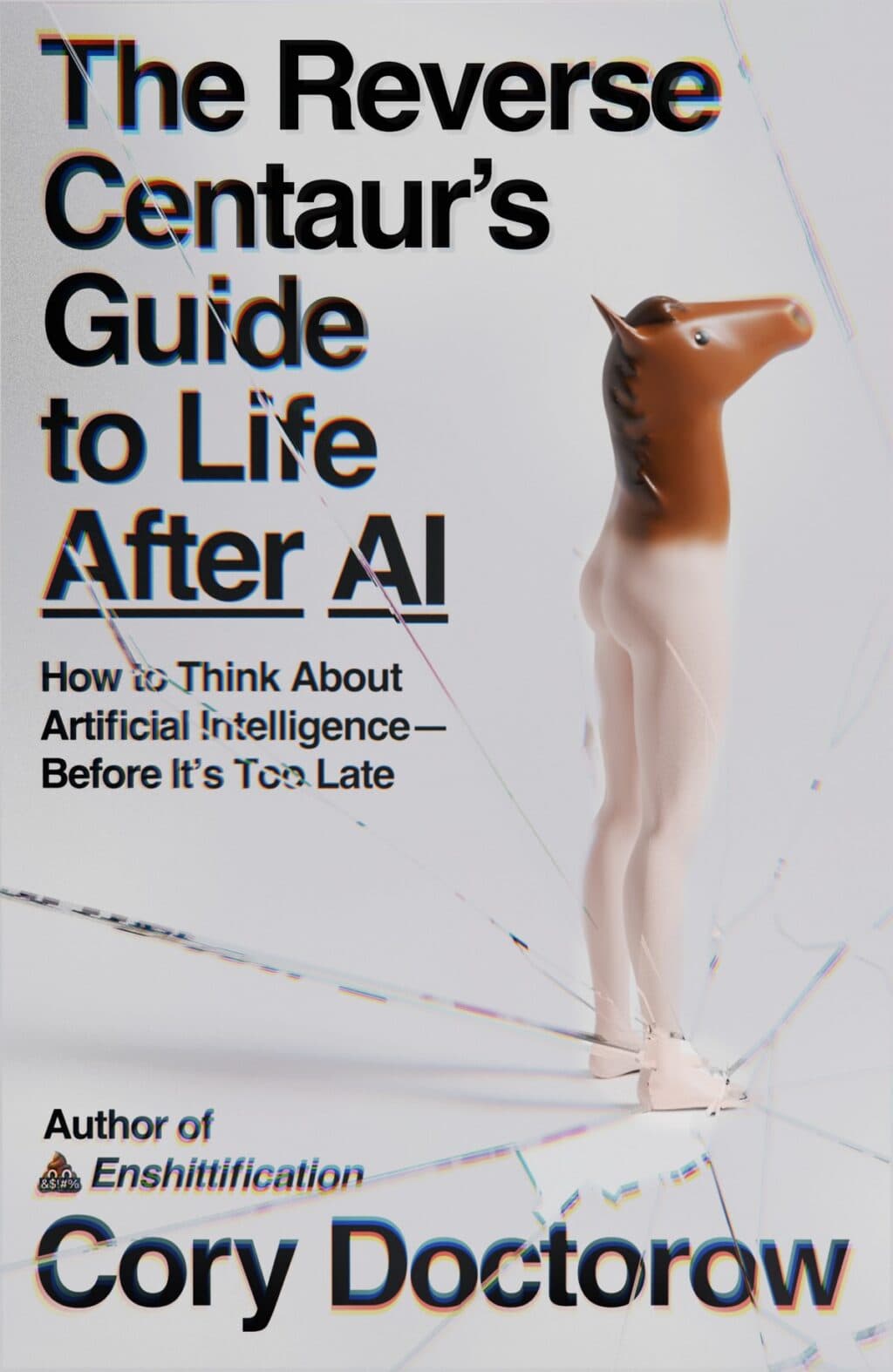
Cory Doctorow thinks the AI bubble will pop, and it will be ugly. In his new book 'The Reverse Centaur's Guide to Life After AI', the tech journalist and science fiction author argues that seven AI companies now account for more than a third of the entire stock market. They pass around the same $100 billion in investment like an IOU. When the music stops, most AI models will simply vanish because running the data centers won't make financial sense.
Doctorow spoke with Ars Technica about the book, which he describes as an attempt to 'sort out the bullshit from the material reality.' He's not anti-AI. He uses the tools himself and sees value in useful plugins and apps. What alarms him is the scale of capital expenditure, the self-serving messaging, and what happens to the broader economy when reality catches up with the hype.

What is a 'reverse centaur' and why should you care?
The book's title comes from automation theory. A centaur, in Doctorow's framing, is a human augmented by technology. Think of a radiologist using machine learning to spot tumors, or anyone using autocomplete. The human remains in control, with the tool extending their capabilities.
A reverse centaur flips that relationship. It's a machine head on a human body. The person becomes, in Doctorow's words, 'a squishy meat appendage for an uncaring machine.' His example: an Amazon delivery driver surrounded by AI cameras monitoring every action. The driver serves the van, not the other way around.
“The bubble doesn't want cheap useful things. It wants expensive 'disruptive' things: big foundational models that lose billions of dollars every year.”
— Cory Doctorow
The distinction matters because it clarifies what's actually happening in many AI deployments. The tech industry sells the centaur vision. Workers get the reverse centaur reality. Consider the difference between AI that helps 10 radiologists work faster and AI that fires nine of them, leaving one to rubber-stamp machine decisions and absorb blame for errors.
Why does Doctorow think the AI bubble will collapse?
Doctorow connects AI mania to the dynamics he explored in his previous book on enshittification. The core problem: companies that dominate their markets run out of room to grow. Investors then start viewing them as mature stocks rather than growth stocks. Mature stocks trade at much lower multiples.
Growth stocks, by contrast, are liquid. Companies can acquire other firms by issuing shares. As Doctorow put it, 'shares are an endogenous substance that you make on the premises by typing zeros into a spreadsheet.' Mature companies must use actual money to grow, and making money on the premises gets you arrested.
So companies with 90 percent market share need narratives that maintain the perception of growth. AI became that narrative. The problem is that the foundational models at the center of the boom lose billions annually. They're not profitable businesses. They're stories that sustain stock prices.
“The capital markets have the object permanence of a toddler, and they would lose a game of peekaboo if they were drafted to play in the league.”
— Cory Doctorow
When investor sentiment shifts, the economics collapse. Data centers are expensive. Without fresh capital, most models won't survive. Doctorow compares AI to 'asbestos in the walls of our technological society, stuffed with wild abandon.' We'll be extracting it for a generation.
How does this connect to Doctorow's enshittification thesis?
The Reverse Centaur's Guide is a direct follow-up to Doctorow's 2025 book on enshittification. That work argued that platforms follow a predictable decay: they start by being good to users, shift value to business customers, then extract from both once competition disappears.
The AI book extends that analysis. Without competitive pressure, firms pursue perverse outcomes. One of those outcomes is promoting AI not because it's profitable, but because it maintains the growth narrative that keeps stock prices elevated. The tech works just well enough to sustain belief.
Doctorow wrote the book partly out of frustration. He's constantly asked to comment on AI and doesn't enjoy it. 'I made the tactical error of being sick of talking about AI,' he told Ars. 'So I wrote a book about why I think it's a dumb thing to keep asking people to talk about, and now I have to talk about it.'
What's Doctorow's prescription?
The interview hints at pushback strategies against what Doctorow calls 'the prevailing narrative of AI's inevitability.' The full book presumably develops these ideas. His general approach, visible across his work, favors restoring competition, limiting corporate power, and rebuilding constraints that have eroded.
He's not calling for a ban on AI tools. He uses them himself. The target is the bubble dynamics, the concentration of market power in seven companies, and the economic structure that prioritizes expensive disruption over cheap utility.
A recent look at how AI benchmarks can mislead about actual capabilities
Frequently Asked Questions
What is Cory Doctorow's reverse centaur concept?
A reverse centaur is a person who serves as a peripheral to a machine, rather than being augmented by it. Doctorow uses the example of Amazon drivers monitored by AI cameras who essentially work for the delivery van.
Why does Doctorow think the AI bubble will burst?
He argues that foundational AI models lose billions annually and survive on investment mania rather than profits. Seven companies account for a third of the stock market. When sentiment shifts, data centers become uneconomical and most models will disappear.
Is Doctorow anti-AI?
No. He uses AI tools and sees value in them as plugins and apps. His critique targets the bubble dynamics, capital concentration, and deployment patterns that turn workers into reverse centaurs.
How does this book relate to enshittification?
It's a direct follow-up. Both books examine what happens when competitive constraints fall away. The AI book specifically looks at how companies use AI narratives to maintain growth-stock status after saturating their markets.
Logicity's Take
Doctorow's framing cuts through two equally lazy positions: AI doom and AI utopia. The reverse centaur concept is useful precisely because it's specific. It doesn't ask whether AI is good or bad. It asks who serves whom in a given deployment. That's a question founders and CTOs can actually answer about their own products. The bubble analysis is harder to evaluate. Seven companies holding a third of market cap is factual. Whether that means imminent collapse depends on how long investors maintain faith, and that's never predictable. The smart play is probably to build on AI capabilities you can run profitably at smaller scale, not bet everything on giants that may vanish.
Need Help Implementing This?
Logicity helps technology leaders navigate emerging trends and make smarter implementation decisions. Subscribe to our newsletter for weekly analysis, or contact our consulting team for custom guidance on AI strategy and risk assessment.
Source: Ars Technica
Manaal Khan
Tech & Innovation Writer
Produced with AI assistance and reviewed by the Logicity editorial team. Learn more in our Editorial Policy.




