Anthropic's Claude Opus 5 can generate playable 3D games, complete with physics, textures, and procedural music, from a single text prompt. The model writes all code from scratch and outputs an editable HTML file that runs directly in the browser. Community benchmarks show Opus 5 outperforming GPT-5.6 Sol and Kimi K3 on physics realism and mechanical complexity.

Over the past few days, developers have produced first-person shooters, submarine games, kart racers, and Minecraft clones without a single external asset. The model handles geometry, shaders, controls, and audio. One Minecraft recreation consumed 25 million tokens and shipped with 15 biomes and both survival and creative modes.
What did developers actually build?
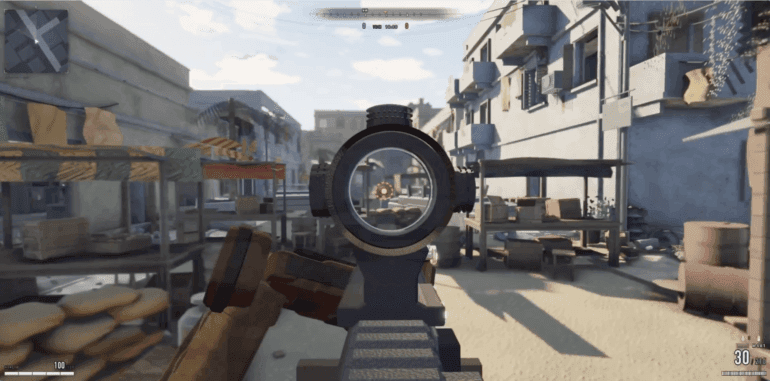
Matt Shumer posted a Call of Duty-style shooter where every texture is generated code. "Not a single external asset was used," he wrote on X. The prompt and source code are public on GitHub under the name Claude-of-Duty.
Alex Ermolov released a snowboard demo and said Opus 5 is on par with Fable and ahead of every other model he's tested. His first run came back with no visual glitches, he says, and the "sliding physics feel right."
Chetaslua's ballista demo sharpens the gap. A Roman siege weapon sits in front of a castle with a complete control panel. It feels closer to a finished game than a prototype. He ran the same prompt through GPT-5.6 Sol and Kimi K3. Both produced a recognizable ballista but with fewer working parts and far less environmental detail.
How fast has quality improved?
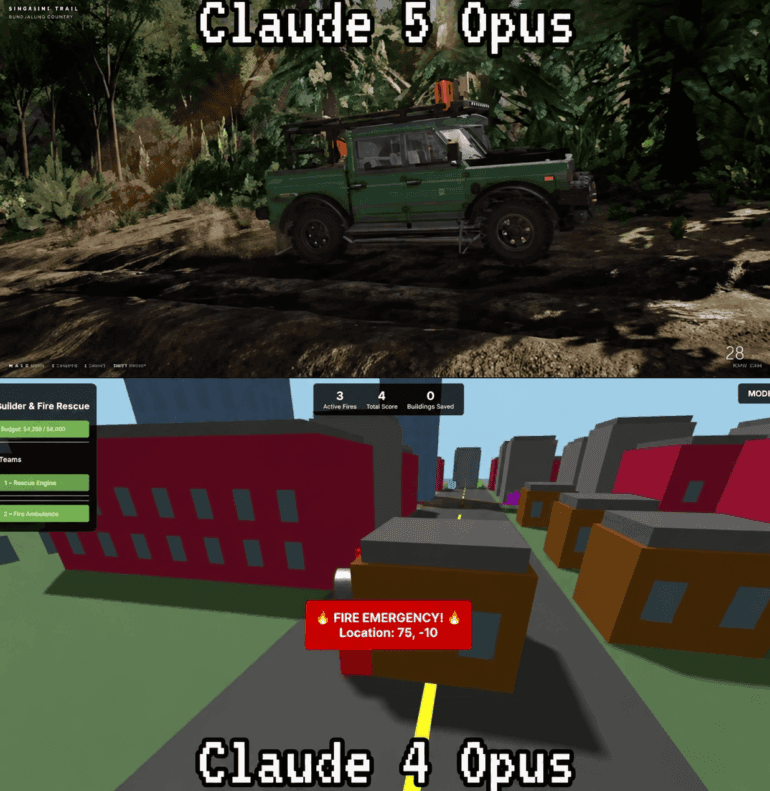
User Chris ran a side-by-side comparison. He put year-old output from Claude 4 Opus next to what Opus 5 produces today. For the new run, he asked for a car on a dirt road, explicitly without textures. Opus 5 returned mud tracks, vegetation, and layered lighting. A year ago, the same kind of request produced flat blocks of color.
More demos show the range. Lentils packed a scenic landscape into one HTML file, with millions of grass blades bending to simulated wind. Pietro Schirano built a submarine game where the model generated the 3D objects, textures, and music itself. Ryan Campbell put his kart racer online as a playable website.
Procedural code replaces asset pipelines
Traditional 3D development relies on asset libraries, image files for textures, and physics engines. The Opus 5 demos work differently. Geometry is procedural, computed at runtime. Textures exist as shaders. The model writes physics and controls alongside everything else, and since it all runs on Three.js, one HTML file is enough.
Anthropic says in its Opus 5 announcement that the model produces "much stronger visual outputs" than earlier versions. One testing partner quoted there calls the results the best animations, games, and 3D work he's seen from any Opus model.
This differs from Google's Genie 3 or video models sometimes described as world models. Those systems compute every frame and return an image sequence. The output exists only as a video stream, nothing to edit or reuse afterward. What Opus 5 produces is code you can open and change.
Minecraft clones are the community's stress test
Beyond one-off demos, the community has settled on an informal benchmark: rebuild Minecraft from a single prompt. Pankaj Kumar's Opus 5 version has an infinite procedural world, 15 biomes, and both survival and creative modes. Every graphic asset comes from code, he writes, with textures and sounds generated at runtime. The build ate 25 million tokens.
Other head-to-head tests follow the same script. Harshith had Opus 5, Fable 5, GPT-5.6 Sol, and several other models generate a 3D Airbus H145 in Three.js, then lined up the results.
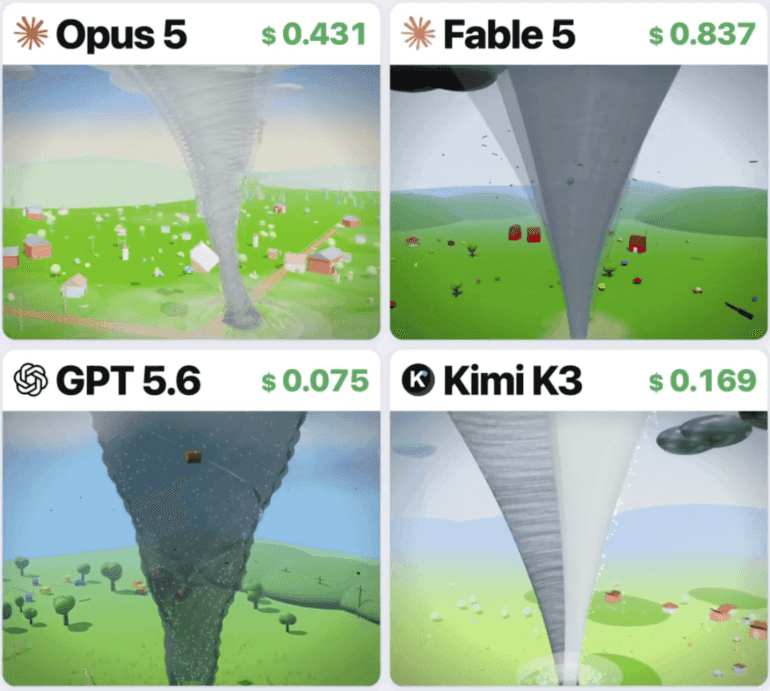
atomic.chat went further and had all four models build three physics scenes: a tornado tearing across a field, a wrecking ball swinging into an apartment block, and a third simulation. By atomic.chat's account, only Opus 5 handled all three.
Logicity's Take
For AI product teams, Opus 5's output flips prototyping economics. A game designer can now test mechanics in minutes without touching Unity or hiring a 3D artist. The 25 million token bill for a full Minecraft clone is steep, but context windows keep growing and costs keep falling. The real question: how long before someone ships a commercial title where the AI wrote the first playable build? [Vercel](https://logicity.in/r/vercel)'s recent SDK integration for Claude agents suggests the tooling stack is already lining up.
Details how Vercel's SDK integration enables Claude agents in production apps
Disclosure
Some links in this post are affiliate links — Logicity earns a commission if you sign up, at no extra cost to you. We only link products we have used or actively recommend.
Need Help Implementing This?
Building AI-powered tools or integrating generative models into your product? Reach out to the Logicity team for consulting, implementation support, or just to talk through architecture decisions.
Source: The Decoder / Gregor Kobsik
Manaal Khan
Tech & Innovation Writer
Produced with AI assistance and reviewed by the Logicity editorial team. Learn more in our Editorial Policy.