Key Takeaways

- Claude's paying consumer base grew 75% from January to May 2026, according to Indagari credit card transaction data from 28 million U.S. consumers
- DataCamp reports 'Claude' is now their most-searched term, surpassing 'AI', with consumer demand for Claude courses outpacing ChatGPT 3-to-1
- ChatGPT still dominates overall, but Anthropic is proving it can compete beyond its enterprise niche
Anthropic's Claude is eating into ChatGPT's consumer market share. Credit card transaction data from Indagari shows Claude's paying user base grew roughly 75% between January and early May 2026. The numbers come from analysis of 28 million U.S. consumers, offering a rare window into the AI subscription market.
This matters because Anthropic has long been typecast as an enterprise and developer shop. Claude Code attracted startups and engineering teams, but the assumption was that everyday consumers stuck with ChatGPT. That assumption looks increasingly wrong.
What the credit card data actually shows
Indagari tracks billions of anonymized transactions. It can't tell us Anthropic's total revenue or exact customer counts, but the sample size is large enough to spot directional trends. And the direction is clear: up and to the right.
The data spans weekly transactions from 2025 through May 10, 2026, covering subscriptions and API token purchases. Growth continued even after a March spike, when Anthropic publicly refused to let the Trump administration use its models for mass surveillance or autonomous weapons. That political stance apparently didn't hurt, and may have helped.
DataCamp signals a shift in consumer interest
Transaction data tells part of the story. Search behavior tells another. DataCamp, an education platform with about 20 million users, reports that "Claude" is now its most-searched term. More popular than "AI" itself.
Corporate training still favors ChatGPT courses. But among self-directed learners, demand for Claude courses is outpacing ChatGPT three to one. DataCamp says Claude course interest jumped 18x in the last 30 days alone.
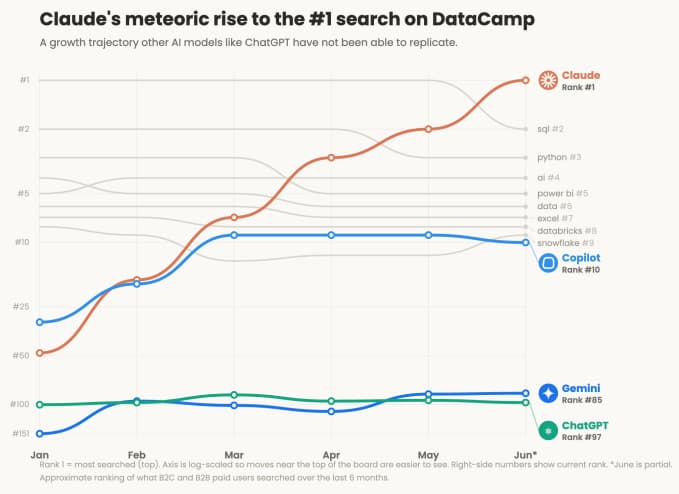
That's a leading indicator. People don't search for courses on tools they're not planning to use. If training demand is any signal, Claude adoption has momentum beyond what current subscription numbers capture.
ChatGPT still dominates, but the gap is closing
Context matters here. ChatGPT remains the consumer AI market leader by a wide margin. Sensor Tower data shows Claude growing across all platforms in 2026, but still trailing ChatGPT significantly in absolute terms.
ChatGPT's growth has been more modest lately, but that's partly because its user base is already enormous. When you're already at scale, percentage gains get harder. Indagari's data shows ChatGPT still has many more paying users than Claude.
Still, the revenue gap is narrowing. Claude has started to gain on ChatGPT in dollars collected from consumers, not just in growth rate. Consumer awareness and interest are rising in parallel.
The government ban on Mythos 5 and Fable 5
Anthropic faces one major uncertainty. Earlier this month, the U.S. government banned the company from offering its most powerful cybersecurity-focused models, Mythos 5 and Fable 5, to non-Americans. Anthropic responded by pulling both models from the market entirely.
It's unclear what impact this will have on business. The affected models serve a specialized audience, not typical consumers. But regulatory friction at this scale is new territory for Anthropic, and it comes at a sensitive moment. Both OpenAI and Anthropic are reportedly approaching public offerings.
So far, though, every data point available shows Anthropic continuing to grow across consumer and enterprise segments. The company declined to comment on the Indagari findings.
What this means for the AI subscription market
The AI assistant market looked like a one-horse race 18 months ago. ChatGPT had the brand, the distribution, and the head start. Google's Gemini struggled to gain traction. Meta's Llama played in a different sandbox.
Claude's growth changes the calculus. Anthropic has built a credible consumer business without the marketing budget or mainstream visibility that OpenAI enjoys. That suggests product quality and word-of-mouth are doing real work.
For OpenAI, the pressure isn't existential, but it's real. A 75% growth rate from a serious competitor demands attention, especially as both companies prepare to face public market scrutiny.
Logicity's Take
The most interesting signal here isn't the 75% growth. It's the DataCamp data. When consumers actively seek training on a tool, they're committing to it. ChatGPT has coasted on being the default. Claude is becoming the choice. If Anthropic can sustain this momentum through its regulatory challenges, the IPO story gets much stronger.
Frequently Asked Questions
Is Claude more popular than ChatGPT?
No. ChatGPT still has far more paying users and overall market share. However, Claude is growing faster, with a 75% increase in paying consumers since January 2026, while ChatGPT's growth has slowed due to its already massive user base.
Why are consumers switching to Claude?
The data doesn't explain motivations directly, but factors likely include product quality improvements, Claude's March 2026 public stance against government surveillance use, and growing awareness through word-of-mouth and training platforms.
What happened to Anthropic's Mythos 5 and Fable 5 models?
The U.S. government banned Anthropic from offering these cybersecurity-focused models to non-Americans. Anthropic pulled both models from the market entirely rather than restrict access.
How much does Claude cost compared to ChatGPT?
Both Claude Pro and ChatGPT Plus are priced at approximately $20 per month for consumer subscriptions. Pricing is similar, so competition is happening on features and user experience rather than price.
Is Anthropic going public?
Reports indicate both Anthropic and OpenAI are approaching public offerings, though neither company has confirmed specific IPO timelines.
Another major AI development challenging established players
Need Help Implementing This?
Evaluating AI assistants for your team or business? Logicity can help you assess Claude, ChatGPT, and other options based on your specific use cases. Contact our advisory team for a consultation.
Source: TechCrunch / Julie Bort
Anthropic تتهم علي بابا بأكبر محاولة لاستنساخ Claude
المقال الجديد يتناول موضوعاً مختلفاً تماماً: اتهام Anthropic لشركة علي بابا الصينية بشن أكبر هجوم لاستنساخ قدرات Claude، حيث تم إنشاء أكثر من 28.8 مليون تفاعل عبر 25,000 حساب احتيالي بين أبريل ويونيو 2025. هذا خبر أمني جديد لا علاقة له بنمو المستخدمين المدفوعين.
Manaal Khan
Tech & Innovation Writer
Produced with AI assistance and reviewed by the Logicity editorial team. Learn more in our Editorial Policy.