Key Takeaways
- Free Claude users can send roughly 15-40 messages per rolling five-hour window, but complex prompts or Opus 4.8 usage can exhaust limits in minutes
- Anthropic shifted from message caps to compute-based quotas in June 2026, with Opus 4.8 counting as 5x the load of Sonnet 4.6
- The Max tier at $100-$200/month offers 1,000+ daily messages and separates interactive chat from API usage for developers
Why AI Chatbots Have Rate Limits
Every time you type a prompt into Claude, a process called inference kicks in. The large language model applies patterns it learned during training to your new input. This costs real money. There's no natural ceiling on how much a single user can spend in compute resources, which is why Anthropic and its competitors cap usage.
As an AI company, you have a complicated relationship with your most active users. Without restrictions, power users can rack up thousands of dollars in processing costs. Anthropic doesn't publish exact limits, but the company does explain the structure: a rolling five-hour window that starts when you first prompt Claude.
This window doesn't reset at midnight. You can't game the system by cramming prompts before the clock turns. Anthropic also notes that limits vary based on demand, prompt complexity, and attachment size. During one five-hour stretch, you might hit your cap after a few prompts. In another, you could send a dozen before seeing a warning.
What Free Users Actually Get
As a rule of thumb, most free users can send about 15 to 40 messages to Claude every five hours. But that range is wide for a reason. The new compute-based quota system doesn't just count messages. It measures what Anthropic calls "cognitive load" on their infrastructure.
“We are no longer just measuring messages; we are measuring the total cognitive load a session places on our infrastructure.”
— Anthropic Spokesperson, May 2026 infrastructure update
Here's the catch: Opus 4.8, Anthropic's flagship model as of June 2026, carries a 5x "compute load" weight compared to Sonnet 4.6. If you're using the free tier and select Opus for complex reasoning tasks, you'll burn through your allowance in minutes, not hours. One Reddit user reported hitting the five-hour limit after a single Claude Code prompt.
How Tokens Work
Claude, like all large language models, uses "tokens" to generate answers. Think of tokens as the operating currency of AI systems. When you type a question, Claude converts words, character groups, and punctuation into numbers through tokenization. These numbers map to patterns the model learned during training.
Longer, more involved questions consume more tokens upfront. They also require more tokens to answer. This is why a simple "What's the weather?" costs far less than "Analyze this 50-page contract and summarize the key risks." Attachments multiply the load further.
Paid Tiers: Pro, Max, and Beyond
Anthropic restructured its subscription models in June 2026 to handle Opus 4.8's compute demands. The company moved away from simple message caps toward dynamic, compute-based quotas. Paid users also gained access to 1 million tokens in the context window, a major upgrade for processing long documents.
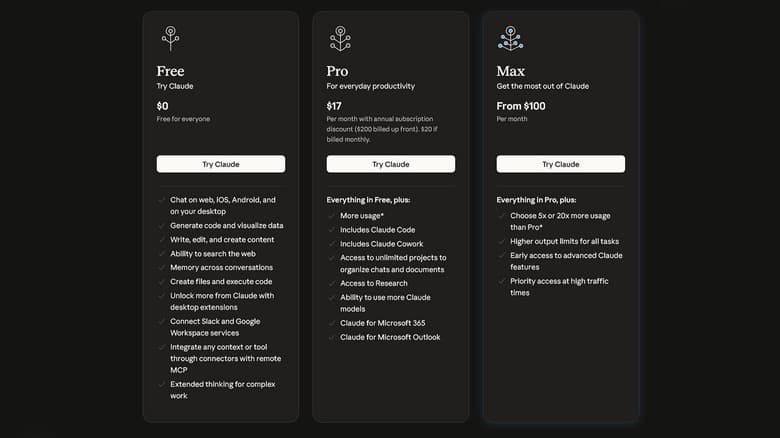
| Feature | Free | Pro ($20/mo) | Max ($100-$200/mo) |
|---|---|---|---|
| Messages per 5 hours | 15-40 | ~50-100 (varies) | 1,000+ daily |
| Opus 4.8 access | Limited | Yes | Yes |
| Context window | Standard | 1 million tokens | 1 million tokens |
| Programmatic credits | No | No | Yes |
| Priority access | No | Yes | Yes |
The Max tier at $100 or $200 per month introduces "programmatic credits" for developers. This separates interactive chat from automated API usage, so your daily brainstorming doesn't eat into your coding workflows.
“The separation of interactive chat from agentic API usage is the most requested feature from our enterprise partners; it ensures that your daily brainstorming doesn't cannibalize your automated workflows.”
— Daniela Amodei, President & Co-Founder at Anthropic
What Changed in June 2026
Anthropic's June restructure came after a major infrastructure expansion through a new data center partnership. This enabled a permanent doubling of rolling rate limits for all paid tiers. The company also introduced the compute-based quota system that now governs all usage.
Community reaction has been mixed. Power users on Reddit's r/ClaudeAI praise the new Max tiers for providing predictable, high-limit environments for full-time coding. But long-term Pro subscribers complain that Opus 4.8 depletes their quotas far faster than the older Sonnet versions did.
Workarounds for Free Users
If you're staying on the free tier, a few tactics can stretch your allowance. First, choose Sonnet 4.6 over Opus 4.8 when possible. Sonnet uses one-fifth the compute load for tasks that don't require Opus's advanced reasoning.
- Use Sonnet 4.6 for routine tasks. Save Opus for complex reasoning.
- Keep prompts concise. Longer inputs burn more tokens.
- Avoid large file attachments when possible.
- Break complex requests into smaller, sequential prompts.
- Track your usage window. The five-hour clock starts at your first prompt.
These tactics won't give you unlimited access, but they'll help you get more out of each five-hour window.
Ads and Model Training
One question free users often ask: does Claude use my data for training? Anthropic states that conversations with Claude are not used to train models by default. This applies to both free and paid users. The company also doesn't run ads in the free tier, though this could change as competition intensifies.
Logicity's Take
Frequently Asked Questions
How many messages can I send on Claude's free tier?
Most free users can send 15-40 messages per rolling five-hour window. The exact number depends on prompt complexity, attachment size, and which model you use. Opus 4.8 burns through quotas 5x faster than Sonnet 4.6.
Does Claude's rate limit reset at midnight?
No. Claude uses a rolling five-hour window that starts when you send your first prompt. It doesn't reset at midnight or any fixed time.
What's the difference between Claude Pro and Max?
Pro costs $20/month and offers higher limits plus 1 million token context windows. Max at $100-$200/month adds programmatic credits that separate interactive chat from API usage, plus 1,000+ daily messages.
Does Anthropic use my conversations to train Claude?
Anthropic states that conversations are not used for model training by default. This applies to both free and paid users.
Why did I hit my limit after just one prompt?
Complex prompts, large attachments, or using Opus 4.8 can consume your entire five-hour allowance quickly. Opus carries a 5x compute weight compared to Sonnet 4.6.
Understanding hardware bottlenecks helps you get more from your tech investments
Need Help Implementing This?
Source: Engadget
Manaal Khan
Tech & Innovation Writer
Produced with AI assistance and reviewed by the Logicity editorial team. Learn more in our Editorial Policy.