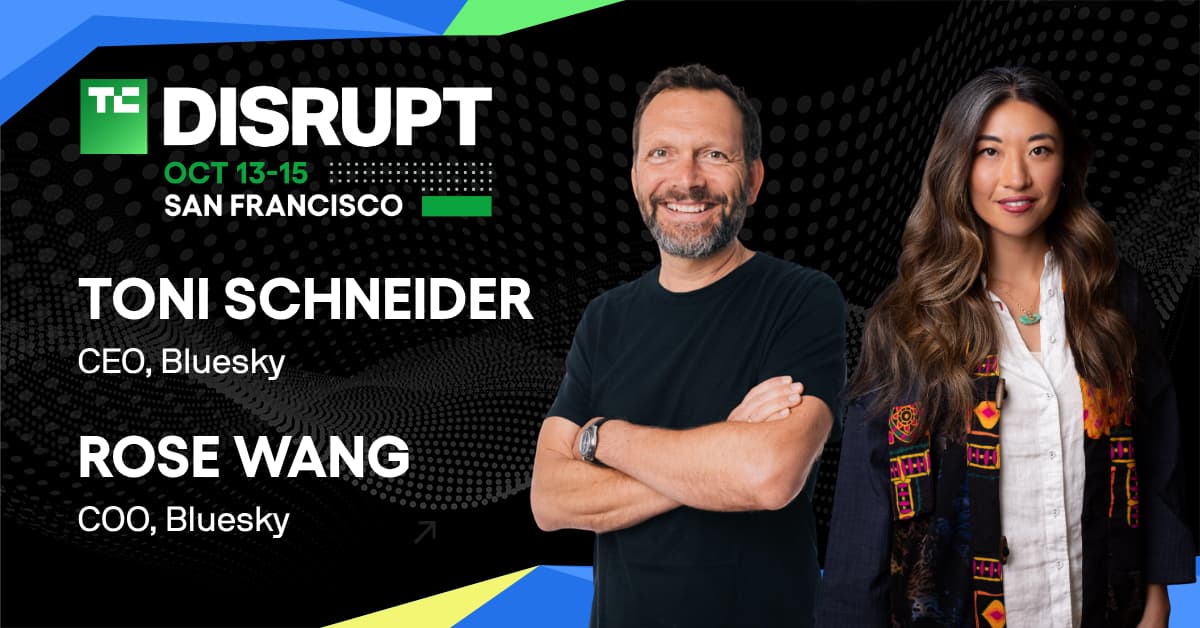
Bluesky CEO Toni Schneider and COO Rose Wang will present their case for open-protocol social media at TechCrunch Disrupt 2026, running October 13-15 in San Francisco. The session, titled "Can social media start over?", is the clearest signal yet that the company sees this as a make-or-break moment for its bet against centralized platforms.
Schneider took over as permanent CEO after a four-month interim stint that began in March, succeeding founder Jay Graber, who moved to a new chief innovation officer role. In his appointment post, Schneider framed the task ahead as a decade-long project: "We're at the very beginning of this story, with a decade of exciting work ahead to build an open web that reflects the full richness of how people connect, communicate, and build livelihoods together."
Why Bluesky wants this moment
How Bluesky’s new CEO will build an open social ecosystem
Wang, who joined Bluesky's founding team in 2021, has been explicit about the company's angle of attack. At SXSW London earlier this year, she argued that entrenched platforms cannot pivot easily. "Facebook and Twitter are huge, and they have tons of users, so for them to turn the shift is really difficult. Also, they're basically AI companies at this point," she said.
Her argument: as incumbents double down on algorithmic AI feeds, users hunger for human-to-human connection. That gap is Bluesky's window.
The leadership shift behind the pitch
Graber's move to chief innovation officer was framed internally as a scaling decision. She wrote that Bluesky "needed a seasoned operator focused on scaling and execution." Schneider, a former Automattic CEO and WordPress.com executive, fits that profile. Wang's background includes leading customer experience at Forethought AI, giving her operational credibility alongside her founding-team tenure.
The pairing signals that Bluesky is no longer pitching itself as a scrappy experiment. It wants to be taken seriously as an operating company.
What's actually at stake
The open-protocol thesis is simple: if users can port their identity and followers across apps built on the same underlying standard (in Bluesky's case, the AT Protocol), no single platform can lock them in. That is a direct challenge to Meta's and X's network-effect moats.
For founders building consumer products, the outcome matters. If protocols win, distribution shifts. New communities, new monetization models, and new entry points open up. If they don't, the existing giants retain control of attention markets.
Logicity's Take
Bluesky's leadership reshuffle was clearly designed to project operational maturity before this pitch. The question Disrupt attendees should ask is not whether open protocols are philosophically better, but whether Bluesky can monetize without replicating the ad-driven algorithmic feed it criticizes. Mastodon proved decentralization can attract early adopters; it also proved that growth stalls without a clear business model. Schneider's track record at Automattic, which built a real business on open-source WordPress, is the strongest argument Bluesky has that it won't repeat that mistake.
The harder question Disrupt may not answer
Wang's critique of incumbents as "AI companies" is pointed, but it sidesteps Bluesky's own content-moderation challenge. Open protocols make centralized moderation structurally harder. The company has built tooling around "labelers" and composable moderation, but at scale, that system remains untested. Whether Schneider and Wang address this in San Francisco will say a lot about how seriously they are taking the scaling problem they just hired themselves to solve.
Need Help Implementing This?
If you're evaluating decentralized social infrastructure or building consumer products on open protocols, reach out to Logicity for coverage requests or consulting referrals.
Source: TechCrunch / TechCrunch Events
Huma Shazia
Senior AI & Tech Writer
Produced with AI assistance and reviewed by the Logicity editorial team. Learn more in our Editorial Policy.