Key Takeaways
- AWS Builder Center has grown to 5,548 authors, 6,448 articles, and 10.4 million page views in its first year
- New sandbox environments give developers free 8-hour AWS accounts for workshop exercises with no credit card required
- Security Hub now scans network reachability from the public internet and extends monitoring to Microsoft Azure resources
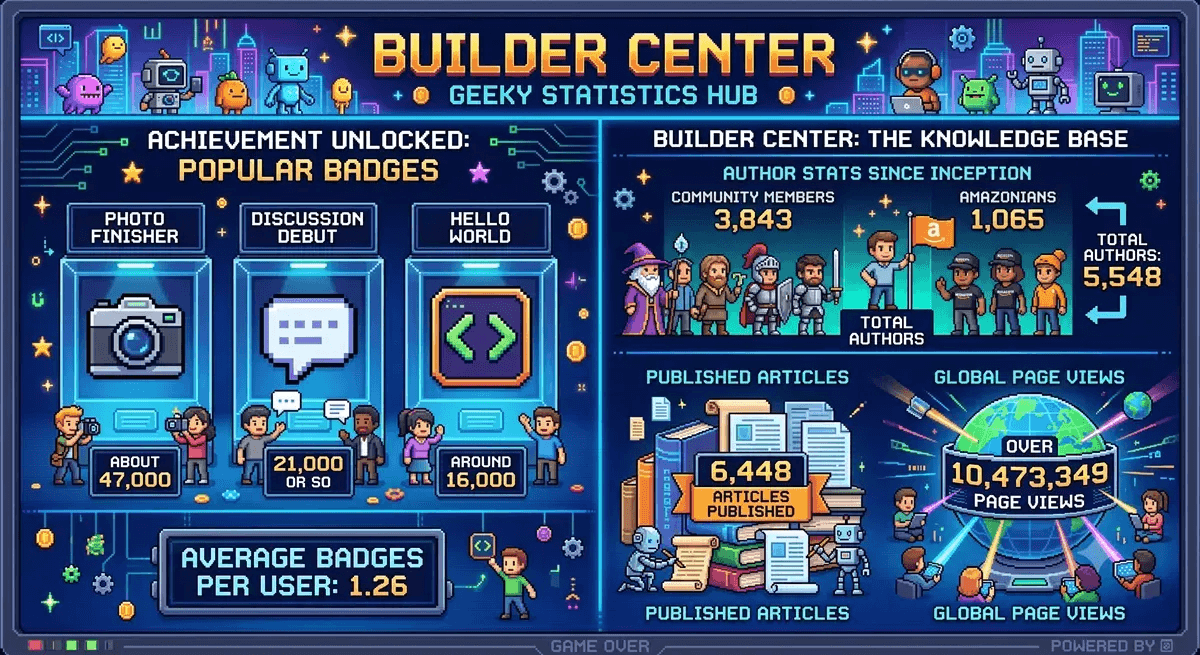
AWS Builder Center turned one year old on July 9, 2026. What launched as a community hub with Wishlist voting and basic profiles has grown into a platform with sandbox environments, workshops, community Spaces, and a Builders' Library. The numbers after 12 months: 5,548 authors, 6,448 published articles, 10.4 million page views, and 99,226 badges earned since the badge system went live in March 2026.
The headline feature for the anniversary is free sandbox environments. Developers can now get a pre-provisioned AWS account to complete workshop exercises without a credit card or personal AWS account. Each sandbox stays active for 8 hours, then AWS automatically de-provisions the account and all its resources. One sandbox at a time, one per week.
What Builder Center actually ships
Rick Suttles published a full feature timeline covering everything shipped since launch. The platform now tracks AWS Capabilities by Region, covering 1,500+ services across 37 Regions. Community members can create Spaces for group discussions, filter workshops by category and complexity, earn badges and streaks, and save items for later. Sign-in works with GitHub and Amazon accounts. Students can flag their status for relevant content.
The Wishlist feature has generated 565 community requests. Ten have shipped. Another 20 are on the near-term roadmap. That's roughly a 5% shipped rate with another 4% committed, which is honest but not exceptional for a feedback system.
Jeff Barr's retrospective highlighted the top community articles. Dineshraj Dhanapathy's piece on building an AWS Study Buddy with MCP + Strands Agents SDK hit 50,000+ views. Chris Miller's guide to migrating an end-of-life Linux server to AWS in 8 hours using Kiro reached 45,000+. Yash Aggarwal's AIdeas article on NeuroVoice for early neurological disease screening crossed 38,000+.
Security Hub gets network scanning and Azure support
The bigger operational news this week: AWS Security Hub now probes your resources from the public internet to detect actual reachability. Network Scanning discovers public IP addresses, VMs, and load balancers across AWS and Azure, identifies reachable ports, and determines what services run behind them. Each reachable port generates a finding with evidence.
This is different from existing network reachability findings, which identify configurations that could make a resource reachable. Network Scanning tells you what is reachable right now, from outside your network. Security Hub Exposures then correlates these findings with other signals to prioritize broader risk.
For new customers, Network Scanning is on by default. Existing customers can enable it per account, per Region, or organization-wide through a configuration policy. It's included with Security Hub Essentials at no additional cost.
Security Hub also extended unified security management to Microsoft Azure. It now automatically discovers Azure VMs, container images, Function Apps, and identities, then evaluates them for misconfigurations, internet exposure, and software vulnerabilities. AWS and Azure findings appear in the same prioritized view with the same formats and automation workflows. For teams running multi-cloud, this reduces the tool sprawl.
SageMaker gets one-click Hugging Face integration
Amazon SageMaker Studio now integrates directly with Hugging Face. Select any supported model on Hugging Face, click "Customize on SageMaker AI" or "Deploy on SageMaker AI," and land directly on the corresponding workflow page with the model pre-loaded. New customers get a Studio environment created in seconds with pre-configured permissions for serverless fine-tuning, model evaluation, and deployment to SageMaker or Bedrock endpoints.
Verified customers get default GPU access to G5, G6, and G4dn instances without requesting quota increases. Quota utilization is visible inside Studio. This removes one of the friction points that slows down ML experimentation: waiting for quota approvals before you can test on real hardware.
GPU management fees drop up to 60%
Starting July 1, 2026, EKS Auto Mode and ECS Managed Instances reduced management fees for accelerated instance types. G-series fees dropped 35%. P-series and AWS Trainium fees dropped 60%. The reductions apply automatically to existing clusters with no action required.
For teams running GPU workloads at scale, this changes the economics meaningfully. The management overhead for accelerated instances was a frequent complaint, particularly for P-series instances used in training jobs. A 60% cut makes the managed layer more competitive with self-managed Kubernetes clusters.
Logicity's Take
The sandbox environments are the real story here for DevOps teams. AWS has historically made it hard to learn by doing without risking a surprise bill. An 8-hour free account, even limited to one per week, removes that friction for workshop completion and early experimentation. The Security Hub Azure integration matters more than it sounds: most enterprises run multi-cloud whether they planned to or not, and having a single security view beats stitching together Prisma Cloud, Wiz, or Orca alongside native tools. The GPU fee cuts are AWS responding to pressure from GCP's Kubernetes pricing and the growing popularity of managed GPU clusters from CoreWeave and Lambda Labs.
Frequently Asked Questions
How long do AWS Builder Center sandbox environments last?
Each sandbox environment stays active for 8 hours. After that, AWS automatically de-provisions the account and all resources. You can request one sandbox per week.
Does AWS Security Hub Network Scanning cost extra?
No. Network Scanning is included with Security Hub Essentials at no additional cost. It's enabled by default for new customers.
Can AWS Security Hub monitor Azure resources?
Yes, as of this week. Security Hub now discovers Azure VMs, container images, Function Apps, and identities, evaluating them for misconfigurations, exposure, and vulnerabilities alongside AWS resources.
What are the new EKS Auto Mode GPU fee reductions?
G-series instance management fees dropped 35%. P-series and AWS Trainium fees dropped 60%. The reductions apply automatically to existing clusters starting July 1, 2026.
Relevant for security teams evaluating automated threat detection alongside Security Hub's new scanning capabilities
Need Help Implementing This?
If your team is evaluating AWS Security Hub's new network scanning or planning multi-cloud security monitoring, Logicity's consulting partners can help architect the rollout. Contact us for vendor-neutral guidance on cloud security tooling.
Source: AWS News Blog
Huma Shazia
Senior AI & Tech Writer
Produced with AI assistance and reviewed by the Logicity editorial team. Learn more in our Editorial Policy.