Key Takeaways
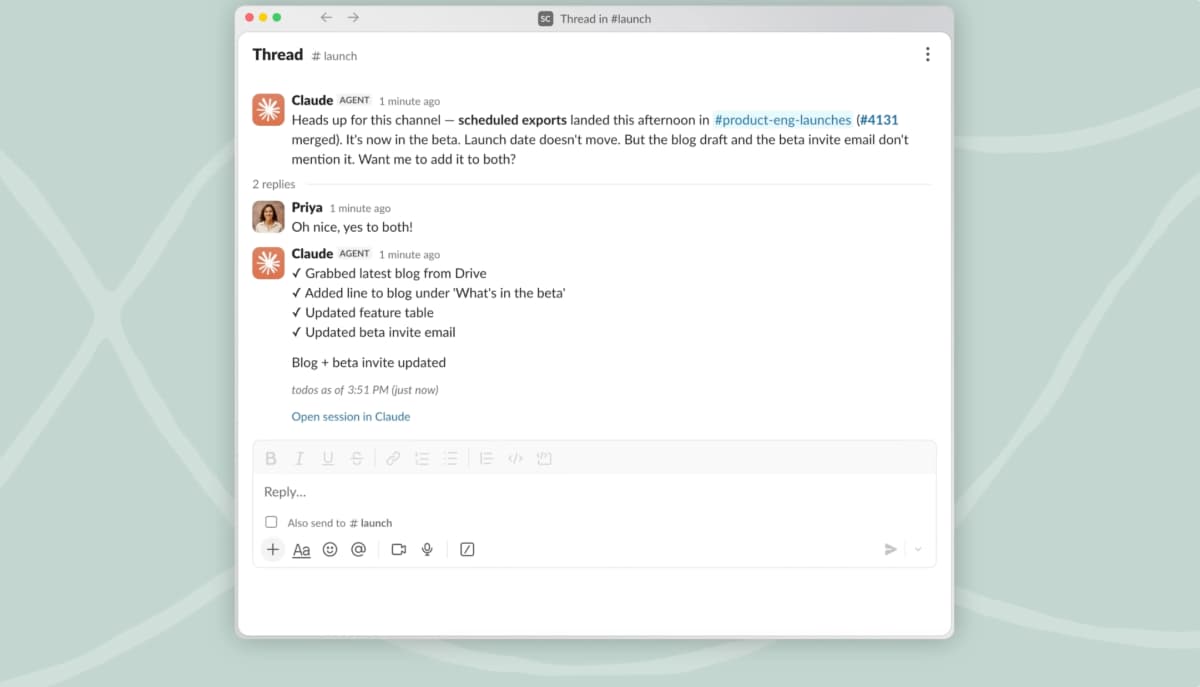
- Claude Tag creates a persistent AI teammate in Slack that remembers context across conversations
- Admins control which channels and tools each Claude identity can access
- An ambient mode proactively surfaces relevant information without being asked
Anthropic just launched Claude Tag, an always-on AI assistant that lives inside Slack and builds persistent memory of your company's work. Available in beta for Claude Enterprise and Claude Team customers, the feature lets anyone in a channel tag @Claude to assign tasks, get insights, or pick up where a colleague left off. The key difference from existing Claude integrations: this one remembers.
Claude has lived in Slack for a while. You could DM it or tag it in channels for quick help. Claude Code already routes coding questions to full sessions on the web. But those interactions were largely stateless. Ask Claude something today, and tomorrow it won't recall the conversation.
Claude Tag changes that. "As Claude follows along with its channel, it learns ever more about the work," Anthropic says. If admins grant permission, Claude can pull facts from other channels across the organization. The result is an AI that accumulates institutional knowledge, not just answers prompts.
How does Claude Tag actually work?
Each Slack channel gets a single Claude identity that everyone shares. When someone assigns a task, Claude breaks it into stages and works through them using whatever tools it has access to. Progress updates appear in the thread. Anyone can see what Claude produced and continue the conversation.
System administrators define the boundaries. They specify which tools, data sources, and channels each Claude identity can access. A Claude configured for legal work stays scoped to legal channels. It cannot seed memories into engineering discussions. This compartmentalization matters for companies worried about sensitive information leaking across teams.
The more interesting feature is ambient mode. Claude doesn't just respond when tagged. It watches the channel and proactively jumps in to flag relevant information from elsewhere in the organization, follow up on forgotten tasks, or surface updates the team might have missed. Anthropic describes the experience as "working with a real colleague, one that can produce work in public view, with far greater context and understanding than before."
Why persistent context matters for enterprise AI
Most AI assistants today are amnesiac. Each conversation starts fresh. That works fine for one-off questions but falls apart for ongoing projects. You end up re-explaining context repeatedly, wasting time and losing the benefit of accumulated understanding.
Anthropic isn't alone in recognizing this gap. Microsoft's Copilot draws on Graph to understand organizational relationships and data. Snowflake and Databricks position their platforms as back-end repositories of tacit company knowledge that AI agents can tap. Glean builds an intelligence layer that sits between the model and enterprise data, providing context the model didn't have at training time.
The race is on to make AI understand not just language but your company: the jargon, the project histories, the team dynamics, the unwritten rules. Claude Tag is Anthropic's bid to own that layer inside the tool where many knowledge workers already spend their day.
What are the risks of an always-on AI?
An AI that reads every message raises obvious questions. Who reviews what Claude learns? Can employees opt out of being observed? What happens if Claude surfaces something sensitive at the wrong moment?
Anthropic addresses some concerns through admin controls. Scoping each Claude identity to specific channels limits blast radius. But the ambient mode, where Claude proactively interjects, will test team dynamics. Some people will find it helpful. Others will find it intrusive. Companies adopting Claude Tag will need clear norms about when the AI should speak and when it should stay quiet.
There's also the question of trust. If Claude is wrong, but confidently wrong, in a busy channel, bad information could propagate before anyone catches it. The visibility of Claude's work, everything in public threads, is a partial safeguard. But teams will need to treat Claude's output as they would a junior colleague's: useful, but requiring review.
Who should consider Claude Tag?
This is an enterprise play. Claude Enterprise pricing runs around $200 per seat per month. That's not a casual expense. The companies likely to get value are those with knowledge-heavy workflows where context loss is a real cost: consulting firms, legal teams, product organizations managing complex roadmaps, engineering teams juggling multiple codebases.
If your team already lives in Slack and struggles with information scattered across channels, Claude Tag addresses that pain directly. If you're a smaller team with simple workflows, the overhead of configuring and managing an always-on AI may not pay off.
Logicity's Take
Claude Tag's real competitive advantage isn't the AI model. It's the memory layer. Anthropic is betting that persistent context, not smarter responses, is what separates useful enterprise AI from a novelty. If they're right, the winner in this market will be whoever accumulates the most organizational knowledge fastest. That creates lock-in Microsoft and OpenAI will struggle to break.
Frequently Asked Questions
What is Claude Tag?
Claude Tag is Anthropic's always-on AI assistant for Slack that maintains persistent memory of channel conversations, learns from company discussions, and can proactively surface relevant information.
How much does Claude Tag cost?
Claude Tag is included with Claude Enterprise and Claude Team subscriptions. Enterprise pricing is approximately $200 per seat per month.
Can Claude Tag access all company Slack channels?
No. System administrators control which channels and tools each Claude identity can access, preventing cross-team information leakage.
How is Claude Tag different from regular Claude in Slack?
Regular Claude integrations are largely stateless. Claude Tag maintains persistent memory, breaks down multi-step tasks, and proactively contributes to discussions without being tagged.
When will Claude Tag be generally available?
Claude Tag is currently in beta for Claude Enterprise and Claude Team customers. Anthropic has not announced a general availability date.
Need Help Implementing This?
Contact Logicity's enterprise consulting team for help evaluating Claude Tag against Microsoft Copilot and other enterprise AI solutions. We offer vendor-neutral assessments tailored to your workflow.
Source: Enterprise News | TechCrunch / Rebecca Bellan
تفاصيل جديدة: متابعة المهام المعلقة ومرحلة الإطلاق التجريبي
المقال الجديد يضيف تفاصيل محددة عن إمكانية متابعة @Claude للمهام التي لم تحصل على تحديث لفترة (follow-up on tasks). كما يوضح أن الخدمة متاحة حالياً في مرحلة research preview لعملاء Claude Enterprise وClaude Team مع خطط للتوسع مستقبلاً.
Claude Tag مبني على نموذج Opus 4.8 ويساهم في 65% من كتابة الأكواد داخل Anthropic
The new article reveals that Claude Tag is powered by the Opus 4.8 LLM model, which was not mentioned in the original. It also includes a direct quote from Andrej Karpathy (newly joined as pre-training team lead at Anthropic) explaining the paradigm shift. Additionally, it provides a significant new statistic: Anthropic's internal Claude Tag contributes to over 65% of product-team code generation.
Anthropic: Claude Tag يولّد 65% من الكود داخلياً والأداة متاحة الآن بنسخة تجريبية
المقال الجديد يتضمن إحصائية محددة وهامة: أن الأداة تولّد بالفعل 65% من الكود البرمجي في فريق المنتج داخل Anthropic. كما يذكر أن Claude Tag متاح الآن كنسخة تجريبية (beta) لعملاء Enterprise وTeam، ويوضح استخدامات إضافية خارج الهندسة مثل تتبع مقاييس المنتج ومعالجة تذاكر الدعم وتشخيص الأخطاء.
Huma Shazia
Senior AI & Tech Writer
Produced with AI assistance and reviewed by the Logicity editorial team. Learn more in our Editorial Policy.




