Key Takeaways
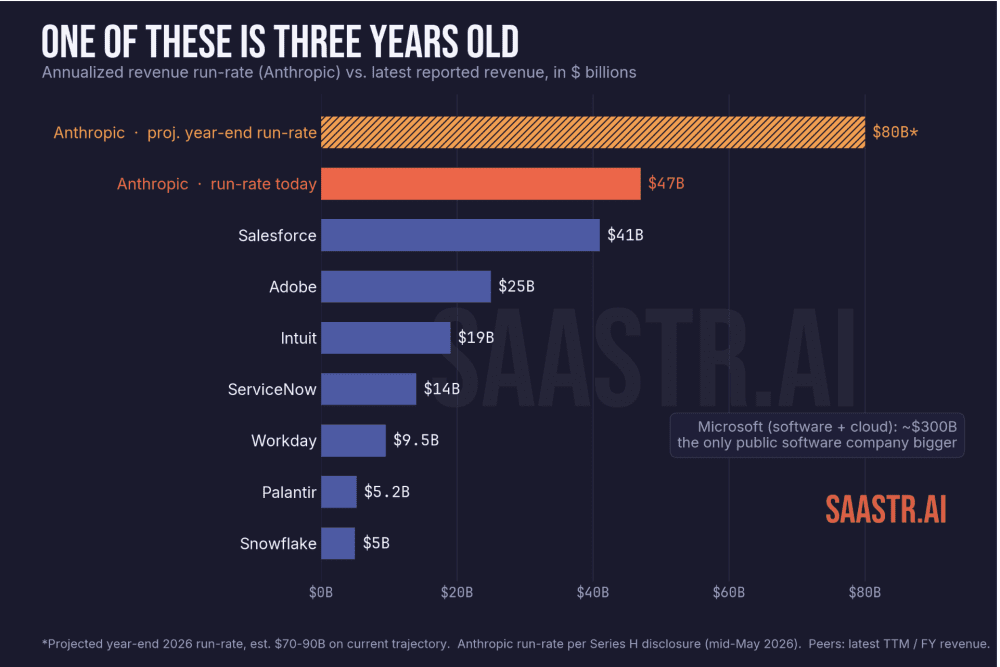
- Anthropic's run-rate grew from $9B to $47B in five months, passing Salesforce's $41B annual revenue
- By December 2025, Anthropic could hit $70-90B run-rate, second only to Microsoft in software
- The company earns more than Palantir, Snowflake, CrowdStrike, and seven other major software names combined
Anthropic disclosed a $47 billion annualized run-rate alongside its Series H funding in mid-May 2025. That figure, derived from one month's revenue multiplied by twelve, now exceeds the trailing annual revenue of Salesforce ($41B), Adobe ($25B), Intuit ($19B), ServiceNow ($14B), and Workday ($9.5B). A three-year-old company has, by this measure, become the second-largest software business in the world.
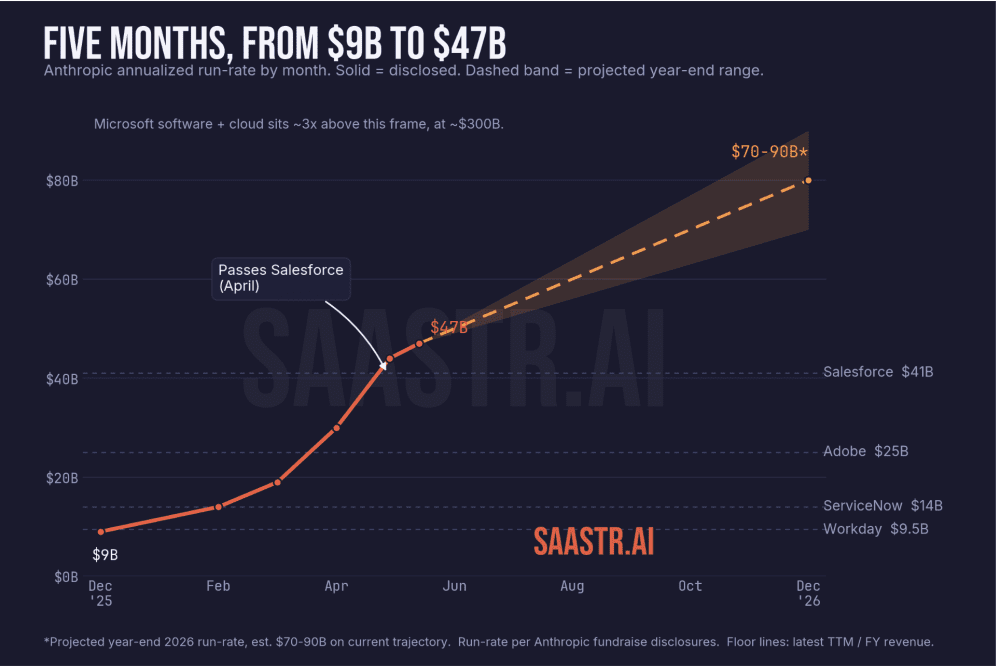
The trajectory is the real story. Anthropic exited 2024 at roughly $9 billion in run-rate. By February it was $14 billion. March brought $19 billion, April $30 billion, early May $44 billion. Each jump represents billions of dollars in new monthly revenue, and Anthropic has been disclosing these figures in fundraising documents where misstatement would constitute securities fraud.
Why Oracle and IBM don't count as counterexamples
Two names look like they should rank above Anthropic. Oracle reported $67.4 billion for fiscal 2026 and guided to $90 billion for fiscal 2027. IBM runs around $60 billion. Neither qualifies as a software peer.
Oracle's actual software segment was $24.5 billion and shrank 1% last year. The growth comes from $34 billion in cloud revenue, most of it renting GPUs to AI labs, plus services and hardware. Oracle is now an AI-datacenter landlord with a database attached. IBM follows the same shape: a consulting and infrastructure business with a software segment around $30 billion. On a software-versus-software basis, both sit below Anthropic.
Anthropic is bigger than ten next-gen software leaders combined
The comparison that stings most for venture-backed software: take Palantir, Snowflake, CrowdStrike, Datadog, Zscaler, Okta, HubSpot, MongoDB, Cloudflare, and Confluent. Their combined trailing revenue is roughly $33 billion. Anthropic's current run-rate exceeds all ten stacked together.
Disclosure
Some links in this post are affiliate links — Logicity earns a commission if you sign up, at no extra cost to you. We only link products we have used or actively recommend.
Palantir, at $5.2 billion in trailing revenue, is the largest on that list. Anthropic has been adding more than a full Palantir to its run-rate in a matter of weeks. That is not hyperbole. The jump from $30 billion in April to $47 billion in mid-May is $17 billion of annualized run-rate in roughly six weeks.
What the numbers actually mean (and don't)
Two caveats matter here. First, run-rate is not annual revenue. The $47 billion is one strong month annualized. The public comparisons above use trailing-twelve-month actuals. On calendar-2025 revenue, Anthropic will land somewhere around $20 to $26 billion, which puts it in the top five of software, not at number two. The run-rate shows where the line is heading. Trailing revenue shows where it has been.
Second, Anthropic books a meaningful share of revenue gross. Sales through AWS, Google Cloud, and Azure count full end-customer spend, with the partner's cut booked as cost of goods sold. That inflates the top line relative to a net-reporting B2B SaaS company. The trajectory remains the same, but the run-rate and a clean subscription metric are not identical.
Why this changes how VCs think about B2B software
Anthropic did not get here selling seats. It got here selling tokens. A single developer can spin up millions of dollars in API spend in weeks. A single enterprise integration can scale to eight figures without a sales team negotiating per-seat pricing.
This is why many VCs now struggle to get excited about traditional B2B software. The unit economics of token-based AI revenue compress the time from first dollar to massive scale in ways seat-based licensing never could. Salesforce took two decades to reach $41 billion. Anthropic passed it in three years.
“Our jaws drop at Anthropic's growth rate, and its valuation. But sometimes we can lose sight of just how big it already is... versus everyone else in software.”
— Jason Lemkin, Founder & CEO, SaaStr
By December 2025, Anthropic's run-rate is tracking toward $70 to $90 billion. At that level, only Microsoft's software and cloud business, running around $300 billion, remains larger. The gap between a three-year-old startup and the entire venture-backed software ecosystem is not narrowing. It is widening every month.
Logicity's Take
For AI builders, the signal is clear: API-based consumption pricing unlocks revenue velocity that seat-based SaaS cannot match. If you're building on Claude, GPT-4, or open models like Llama, your pricing architecture matters as much as your product. Teams should study how Anthropic's distribution through AWS Bedrock and Google Cloud Vertex amplifies reach without proportional sales cost. The gross-revenue accounting means margins are thinner than headline numbers suggest, but that trade-off buys distribution at scale. Traditional SaaS tools like [HubSpot](https://logicity.in/r/hubspot), [Salesforce](https://logicity.in/r/salesforce), and [Notion](https://logicity.in/r/notion) will face pressure to integrate AI features or watch usage migrate to platforms that charge by the token.
Frequently Asked Questions
What is Anthropic's current revenue run-rate?
As of mid-May 2025, Anthropic disclosed a $47 billion annualized run-rate in its Series H fundraising documents. This figure represents one month's revenue multiplied by twelve.
How does Anthropic compare to Salesforce in revenue?
Salesforce generates approximately $41 billion in annual revenue. Anthropic's annualized run-rate surpassed that figure in April 2025.
Is run-rate the same as actual annual revenue?
No. Run-rate annualizes a single month's performance. Anthropic's actual calendar-2025 revenue is projected at $20-26 billion, while the run-rate shows trajectory.
Why don't Oracle and IBM count as larger software companies?
Oracle's software segment is $24.5 billion; most of its $67 billion comes from cloud infrastructure and services. IBM's software segment is around $30 billion within a $60 billion business dominated by consulting.
What is Anthropic's projected revenue by end of 2025?
Based on current trajectory, Anthropic's run-rate is expected to reach $70-90 billion by December 2025, second only to Microsoft in software.
Need Help Implementing This?
Building AI-powered products and want to understand consumption-based pricing models? Contact Logicity's team for guidance on API integration strategies and revenue architecture for AI applications.
Source: SaaStrAI
Manaal Khan
Tech & Innovation Writer
Produced with AI assistance and reviewed by the Logicity editorial team. Learn more in our Editorial Policy.