Key Takeaways
FIRST LOOK: Anthropic Launches Rupee Pricing as India Becomes Claude's No.2 Market

- Claude Pro now costs ₹2,000/month in India (about $21), slightly higher than the US price of $17
- India is Anthropic's second-largest market, accounting for 5.8% of global Claude usage
- Unlike OpenAI's ChatGPT, Claude still lacks UPI payment support, requiring card or app store billing
Anthropic has begun displaying rupee-denominated prices for Claude subscriptions in India, marking a significant step toward capturing paying users in its second-largest market globally. The move addresses a longstanding complaint from Indian users who faced currency conversion fees and billing friction when subscribing to the AI assistant.
There's a catch, though. Anthropic still doesn't accept payments through UPI, India's dominant instant payment network that processes over 13 billion transactions monthly. Indian users must pay by credit card or through Apple and Google's app store billing systems. That's a notable gap compared to OpenAI, which added UPI support for ChatGPT subscriptions back in August.
What are the new Claude India prices?
The localized pricing appears on Claude's website and mobile apps, though mobile prices differ slightly from web listings. Here's what Indian users will pay:
- Claude Pro: ₹2,000/month (~$21) billed annually, versus $17/month in the US
- Claude Max: ₹11,999/month (~$125), versus $100/month in the US
- Claude Team: ₹2,399/seat/month (~$25), versus $20/seat/month in the US
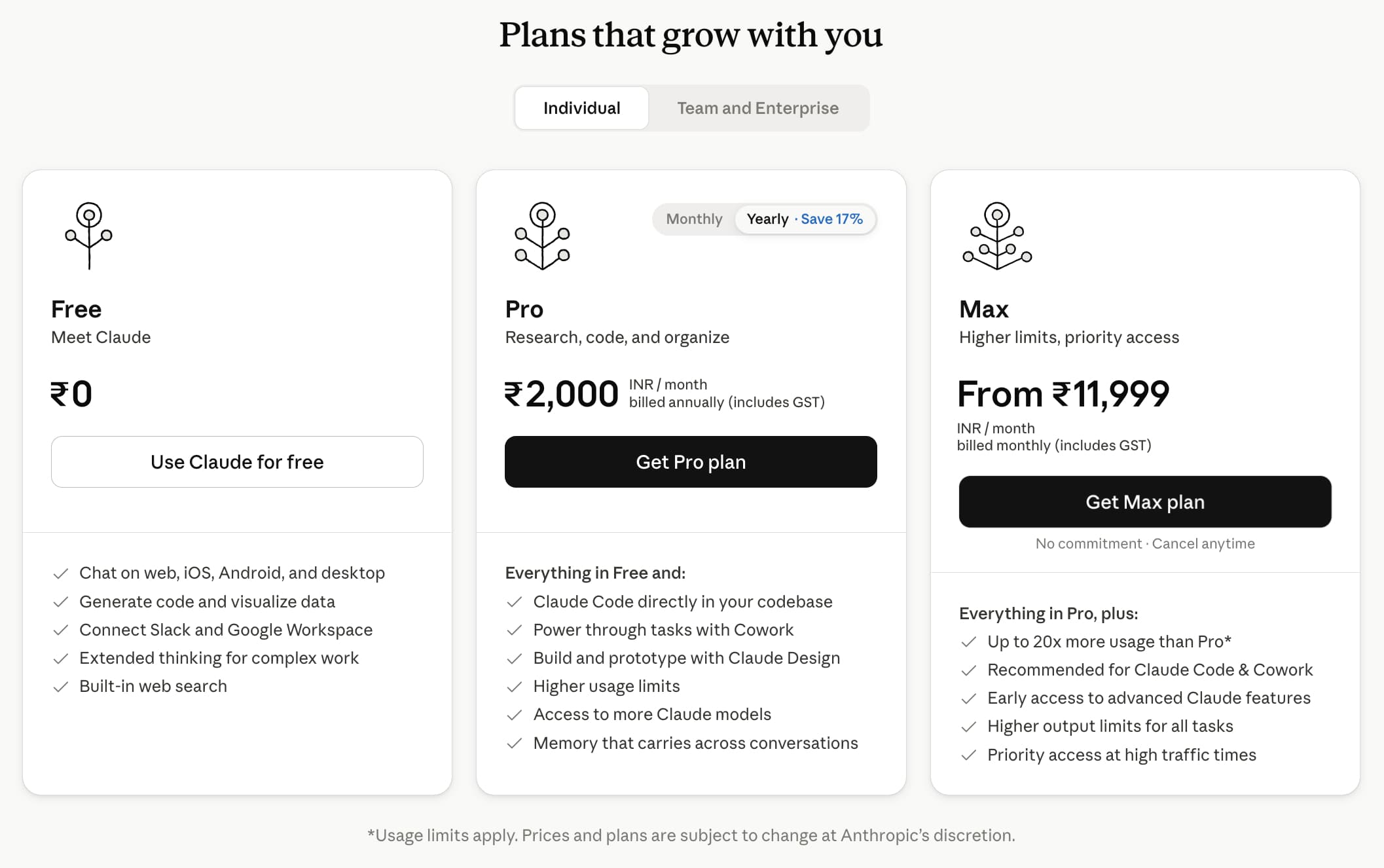
The India prices include local taxes, which partly explains the premium over US rates. Still, paying ₹2,000 for Claude Pro is cheaper than what Indian users were effectively paying before. Converting $17 to rupees and adding international transaction fees often pushed the real cost above ₹1,800, and that's before factoring in the hassle of managing dollar-denominated recurring charges.
Why India matters to Anthropic
India accounts for 5.8% of Claude's global usage, according to Anthropic. That makes it the company's largest market outside the United States, a position earned by India's massive developer population and English-speaking tech workforce.
Anthropic has been building its India presence methodically. The company opened a Bengaluru office in February 2026, following an October announcement. In January, it hired former Microsoft India managing director Irina Ghose to lead local operations. Enterprise partnerships with Infosys and Tata Consultancy Services followed, aimed at scaling Claude deployments across large organizations.
That expansion hit a snag in June when Anthropic abruptly suspended access to its Fable 5 and Mythos 5 models for non-US entities. The restriction prompted some Indian developers and startup founders to explore alternatives to American AI models. Access to Fable 5 has since been restored, but Mythos 5 remains limited outside the US.
The UPI problem remains
Rupee pricing removes one barrier. The payment method gap creates another. UPI isn't just popular in India; it's the default way most Indians pay for digital services. Over 300 million people use it regularly, and many younger users don't even own credit cards.
OpenAI recognized this when it launched rupee pricing for ChatGPT with UPI support from day one. That decision likely contributed to ChatGPT's stronger conversion rates among Indian users, though neither company releases detailed regional subscriber numbers.
For Anthropic, adding UPI would require integration with India's National Payments Corporation. It's not a trivial engineering task, but it's also not novel. Dozens of international services have done it, from Netflix to Spotify. The question is whether Anthropic prioritizes this work or remains satisfied with card-based subscriptions for now.
Converting free users to paid subscribers
High usage doesn't automatically mean high revenue. India is notoriously price-sensitive, and AI companies face the same challenge that streaming services, SaaS platforms, and gaming companies have wrestled with for years: Indians use digital products enthusiastically but convert to paid tiers at lower rates than users in North America or Western Europe.
Localized pricing helps. UPI support would help more. But the real test is whether Claude's capabilities justify ₹2,000/month to Indian developers and professionals, many of whom earn salaries far below their US counterparts. For enterprise deployments through the TCS and Infosys partnerships, the calculation is different. Those deals are negotiated in bulk, and the per-seat economics matter less than integration quality and support.
Logicity's Take
Anthropic is playing catch-up in India, and this pricing move shows it. OpenAI already has rupee pricing and UPI. Google's Gemini Advanced costs ₹1,950/month with UPI support. Anthropic's pricing is competitive but not cheaper, and the payment friction could limit adoption among individual developers. The enterprise partnerships with TCS and Infosys matter more for near-term revenue. For CTOs evaluating Claude against ChatGPT Enterprise or Gemini for Business, the model capabilities matter more than consumer pricing, but Anthropic's June model restrictions for non-US entities remain a trust issue worth weighing.
Frequently Asked Questions
How much does Claude Pro cost in India?
Claude Pro costs ₹2,000 per month when billed annually in India. This includes local taxes and works out to approximately $21 USD.
Can I pay for Claude with UPI in India?
Not yet. Anthropic currently only accepts credit cards and payments through Apple or Google app store billing. UPI support has not been added.
Is Claude cheaper than ChatGPT in India?
No. ChatGPT Plus costs ₹1,950/month in India, while Claude Pro costs ₹2,000/month. ChatGPT also accepts UPI payments, which Claude does not.
Why is Claude more expensive in India than the US?
India prices include local taxes (GST). The pre-tax price is roughly comparable to US rates, though the final cost works out slightly higher.
Related coverage of how AI companies are restructuring their product offerings
Need Help Implementing This?
Evaluating Claude, ChatGPT, or Gemini for your team? Logicity helps CTOs and engineering leads navigate AI tool selection and deployment. Reach out at logicity.in/contact for a consultation.
Source: TechCrunch / Jagmeet Singh
Full pricing breakdown and plan details for Claude in India
The new article provides comprehensive pricing details not in the original: Claude Pro at Rs 1,999/month (annual) or Rs 2,399/month (monthly), Claude Max at Rs 12,000/month (5x) and Rs 24,000/month (20x), Team Standard at Rs 2,300-3,000/month, and Team Premium at Rs 12,000-15,000/month. It also details features included in each tier, notes that UPI payment is not yet available (unlike OpenAI), and mentions India accounts for 6% of global Claude usage.
Full pricing breakdown and India usage statistics revealed
The new article provides detailed pricing for all subscription tiers: Claude Pro (Rs 1,999-2,399/month), Claude Max (Rs 12,000-24,000/month in 5x and 20x tiers), and Team plans (Standard at Rs 2,300-3,000/month, Premium at Rs 12,000-15,000/month). It also reveals India accounts for 6% of global Claude usage and notes UPI payments are not yet supported, unlike OpenAI which added UPI support last year.
Huma Shazia
Senior AI & Tech Writer
Produced with AI assistance and reviewed by the Logicity editorial team. Learn more in our Editorial Policy.




