Key Takeaways
Anthropic Has a Fable 5 Problem (Here's What Changed)

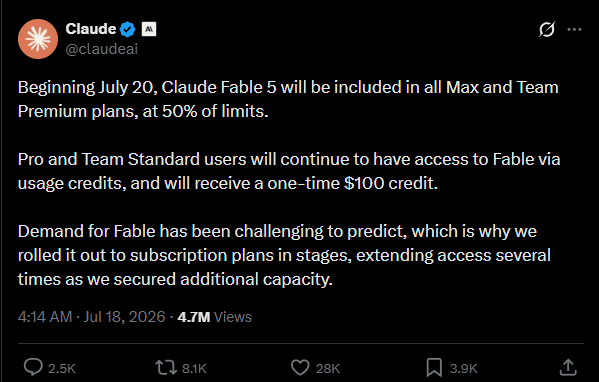
- Claude Fable 5 will be available at 50% of already-reduced limits for Max and Team Premium users starting July 20
- Pro and Team Standard subscribers lose access entirely, receiving only a $100 one-time API credit
- Anthropic reversed plans to remove Fable entirely from subscriptions, likely due to competitive pressure from OpenAI's GPT-5.6 Sol
Anthropic is cutting Claude Fable 5 usage limits in half for its Max and Team Premium subscribers starting July 20. Pro and Team Standard users get it worse: they lose access entirely, with only a $100 API credit to soften the blow. The changes mark a sharp retreat from the company's initial plans while revealing the economic strain of running frontier AI models.
What's actually changing on July 20?
The timing compounds the pain. Anthropic's bonus usage phase ends on the same day, cutting regular limits by 33 percent. Fable 5 will then be available at 50 percent of those already-reduced limits. So if you had 100 messages during the bonus period, you'll have roughly 33 after the change.
For Max and Team Premium users paying $200 or more per month, this is frustrating but survivable. For Pro subscribers at $20/month, it's effectively a cancellation notice dressed as a credit.
Why the $100 credit won't last
Anthropic is offering Pro and Team Standard subscribers a one-time $100 credit toward API usage. After that, they pay standard API rates. For context, heavy Claude users can burn through $100 in API credits within days, depending on their workload. The credit is a courtesy, not a solution.
This effectively creates a three-tier system: enterprise users who can afford API costs, premium subscribers who accept reduced access, and everyone else who loses Fable 5 entirely.
Competition forced Anthropic's hand
Anthropic originally planned to pull Fable from subscription plans entirely. The reversal tells a story about market pressure.
OpenAI released GPT-5.6 Sol with similar performance at roughly one-third the cost. Chinese AI labs continue to undercut Western pricing on everything below frontier-tier models. Anthropic couldn't afford to remove a flagship capability while competitors offer comparable alternatives at lower prices.
So instead of full removal, users get a diminished version. It's a compromise that satisfies no one completely but keeps Anthropic in the conversation.
The infrastructure problem behind the limits
Anthropic acknowledged that Fable demand has been "hard to manage and frustrating for users." The company says it's investing in more capacity, but frontier model inference is expensive. Each Fable 5 query costs significantly more to run than queries to older Claude models.
This creates an uncomfortable dynamic for subscription businesses. Flat monthly fees work when usage is predictable. They break down when a small percentage of users consume disproportionate resources. API pricing solves this by making heavy users pay for what they use.
The shift suggests Anthropic is learning what OpenAI discovered earlier: subscription models and frontier AI capabilities don't mix well at scale.
What this means for teams building on Claude
For product teams using Claude in workflows, the calculus just changed. If you're on Pro or Team Standard, you have until July 20 to decide whether to upgrade to Max, move to API billing, or explore alternatives.
Max subscribers face a different question: is 50% of Fable 5 limits worth the premium? For some workflows, the answer is yes. For teams running high-volume automated queries, API pricing may be more predictable despite higher costs.
Logicity's Take
This pricing shift reveals how unsustainable flat-rate subscriptions are for frontier AI. Anthropic is essentially asking users to subsidize infrastructure costs they can't control through either higher tiers or usage-based billing. Teams building AI-powered products should model their costs against API pricing now, not later. The subscription ceiling will likely keep dropping. If your product depends on Claude, budget for API rates as your baseline and treat subscription access as a bonus that may disappear.
Frequently Asked Questions
When do Claude Fable 5 limits change?
The new limits take effect July 20, 2026. The bonus usage phase ends the same day, and Fable 5 access drops to 50% of the reduced limits.
Can Pro subscribers still use Claude Fable 5?
Not through their subscription. Pro and Team Standard users receive a one-time $100 API credit and must pay API rates after that.
Why is Anthropic reducing Claude Fable 5 access?
The company cited demand management challenges and infrastructure costs. Fable 5 queries are expensive to run, and subscription pricing doesn't scale with heavy usage.
Is Anthropic removing Fable 5 from subscriptions entirely?
That was the original plan. Competitive pressure from OpenAI's GPT-5.6 Sol and Chinese AI pricing likely forced Anthropic to keep reduced access rather than full removal.
How long will the $100 API credit last?
It depends on usage. Heavy users may exhaust it in days. Light users could stretch it longer, but it's a bridge, not a permanent solution.
Need Help Implementing This?
If your team needs help evaluating Claude API costs or planning your AI infrastructure budget, reach out to Logicity's advisory team for a technical consultation.
Source: The Decoder / Matthias Bastian
Huma Shazia
Senior AI & Tech Writer
Produced with AI assistance and reviewed by the Logicity editorial team. Learn more in our Editorial Policy.