Key Takeaways
- Amazon commits additional $13 billion to India, raising total planned investment to $48 billion by 2030
- Delhivery's early investors including SoftBank and Nexus have sold nearly Rs 1,800 crore in shares over three months
- BHIM app pivots toward government schemes and financial services as UPI monetization remains difficult
Amazon CEO Andy Jassy met Prime Minister Narendra Modi in New Delhi on Thursday and announced the company will invest an additional $13 billion in India by 2030. The commitment raises Amazon's total planned India outlay to $48 billion, up from the $35 billion announced earlier. Separately, Delhivery's early backers have started cashing out as the logistics company's stock recovers toward its IPO price.

What did Amazon announce during Jassy's India visit?
The fresh $13 billion will go toward expanding Amazon's artificial intelligence and cloud infrastructure in India. The company also plans to open more than 20 fulfillment centers and over 100 last-mile delivery stations this year as it scales its quick commerce operations.
Amazon said its cumulative India investment has reached about $40 billion, including FDI and reinvested earnings from local operations. Jassy outlined ambitious targets in a post on X: supporting 3.8 million jobs by 2030, enabling $80 billion in e-commerce exports, and bringing AI tools to 15 million small businesses and 4 million government school students.
Before meeting Modi, Jassy met Maharashtra Chief Minister Devendra Fadnavis earlier this week. He also held discussions with other business leaders during the trip. The visit comes as Amazon competes fiercely with Flipkart and Reliance Retail for dominance in India's e-commerce market, while navigating the country's complex regulatory environment.
Why are Delhivery's early investors selling now?

As Delhivery's stock climbs back toward its May 2022 IPO price, institutional investors who waited years for a rebound are monetizing their holdings. SoftBank, Nexus Venture Partners, and Alpha Wave Global have collectively offloaded nearly Rs 1,800 crore worth of shares over the past three months.
SoftBank sold stake worth around Rs 180 to 200 crore. Nexus cashed out approximately Rs 924 crore. Alpha Wave Global, which entered Delhivery's cap table before the IPO, sold Rs 665 crore worth of stock this quarter for a complete exit.
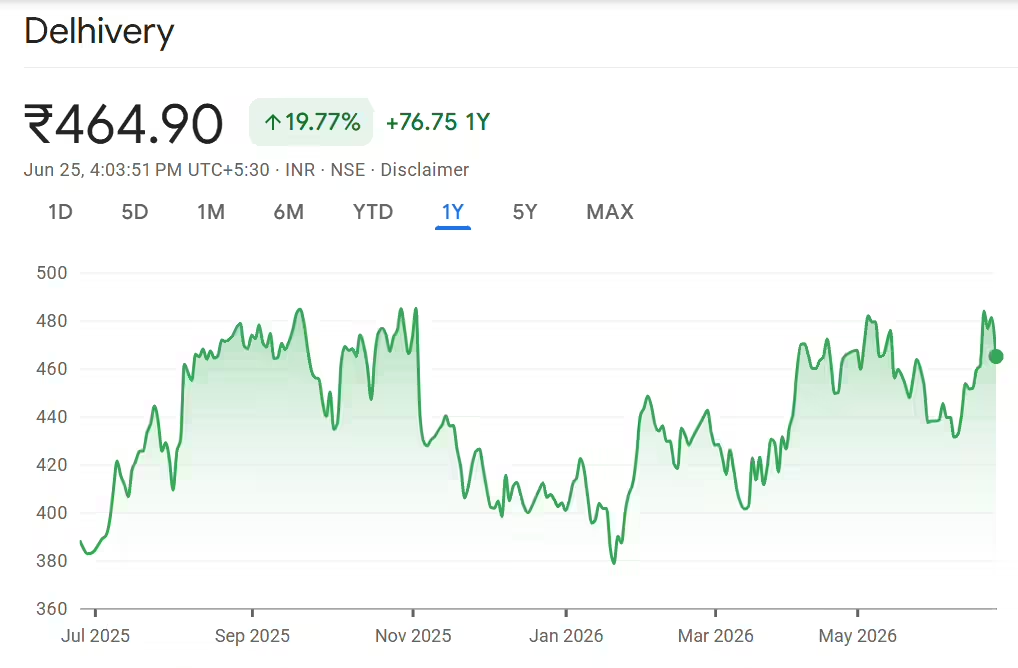
The numbers tell a compelling return story. Nexus has realized around Rs 2,300 to 2,400 crore from Delhivery since the IPO and still holds shares worth about Rs 850 crore. That translates to an estimated 12 to 14x return on its original investment of Rs 200 to 250 crore.
Despite these sales, major investors still retain meaningful holdings. This looks like portfolio rebalancing rather than a rush for the exits from India's largest listed new-age logistics company. Delhivery's January to March operating revenue jumped 30%, though net profit stayed flat at Rs 72 crore.
How is BHIM trying to grow beyond UPI?

Government-backed payments app BHIM is looking past UPI transactions toward government schemes and financial services. NPCI BHIM Services Ltd is targeting underserved users beyond major cities. Monthly transactions rose to 244 million in May 2025 from 79.64 million a year earlier. The app processed Rs 26,952 crore worth of transactions last month.
BHIM CEO Lalitha Nataraj told ET that the government wants to enable direct benefit transfers on the app. The company is also working on pension schemes and exploring digitization for self-help groups, including digital loan disbursements and repayments.
The pivot makes sense given UPI's monetization problem. Bank-to-bank transactions do not attract processing charges. BHIM posted a loss of Rs 68 crore on revenues of Rs 3.7 crore in fiscal 2025. Nataraj expects losses to continue for at least three years.
Anthropic accuses Alibaba of extracting Claude capabilities

Anthropic has accused Alibaba of attempting to extract its AI capabilities in what it called the largest such incident detected so far. The technique in question is called distillation, where one party tries to train a smaller model by extracting knowledge from a more capable one. The accusation adds another layer of tension to US-China tech competition, particularly in AI.

Frequently Asked Questions
How much has Amazon invested in India so far?
Amazon said its cumulative India investment has reached approximately $40 billion, including FDI and reinvested earnings from local operations. The company plans to invest $48 billion total by 2030.
Why are Delhivery investors selling their shares?
Delhivery's stock has recovered toward its IPO price after years of underperformance. Early institutional investors like SoftBank, Nexus, and Alpha Wave Global are using this recovery to monetize their holdings and lock in returns.
What returns did Nexus make on Delhivery?
Nexus has realized around Rs 2,300 to 2,400 crore from Delhivery since its IPO and still holds shares worth about Rs 850 crore. This represents an estimated 12 to 14x return on its original investment of Rs 200 to 250 crore.
Why is BHIM losing money despite transaction growth?
UPI bank-to-bank transactions do not attract processing charges, making monetization difficult. BHIM posted Rs 68 crore in losses on just Rs 3.7 crore in revenue in FY2025, and expects to remain unprofitable for at least three more years.
Logicity's Take
Amazon's $48 billion commitment sounds massive, but the real story is the quick commerce push. Opening 20+ fulfillment centers and 100+ delivery stations in one year signals Amazon is done watching Zepto, Blinkit (Zomato), and Swiggy Instamart capture the instant delivery market. For CTOs at logistics and e-commerce companies, this means increased competition for warehouse talent and last-mile capacity. Delhivery's investor exits, meanwhile, suggest the smart money sees the stock fairly valued at current levels rather than expecting another 2x run. If you're building logistics infrastructure, watch Amazon's expansion footprint closely, as it will define where capacity gets tight.
Need Help Implementing This?
If your organization needs guidance on e-commerce logistics strategy, cloud infrastructure planning, or understanding India's tech investment landscape, reach out to Logicity's consulting partners for tailored analysis and implementation support.
Source: Tech-Economic Times
Manaal Khan
Tech & Innovation Writer
Produced with AI assistance and reviewed by the Logicity editorial team. Learn more in our Editorial Policy.