Key Takeaways
- Altman claims a generation of researchers slowed AI by underestimating scaling
- OpenAI says an LLM recently disproved a long-standing mathematical conjecture
- Altman admits LLMs still struggle with long-horizon, high-judgment tasks
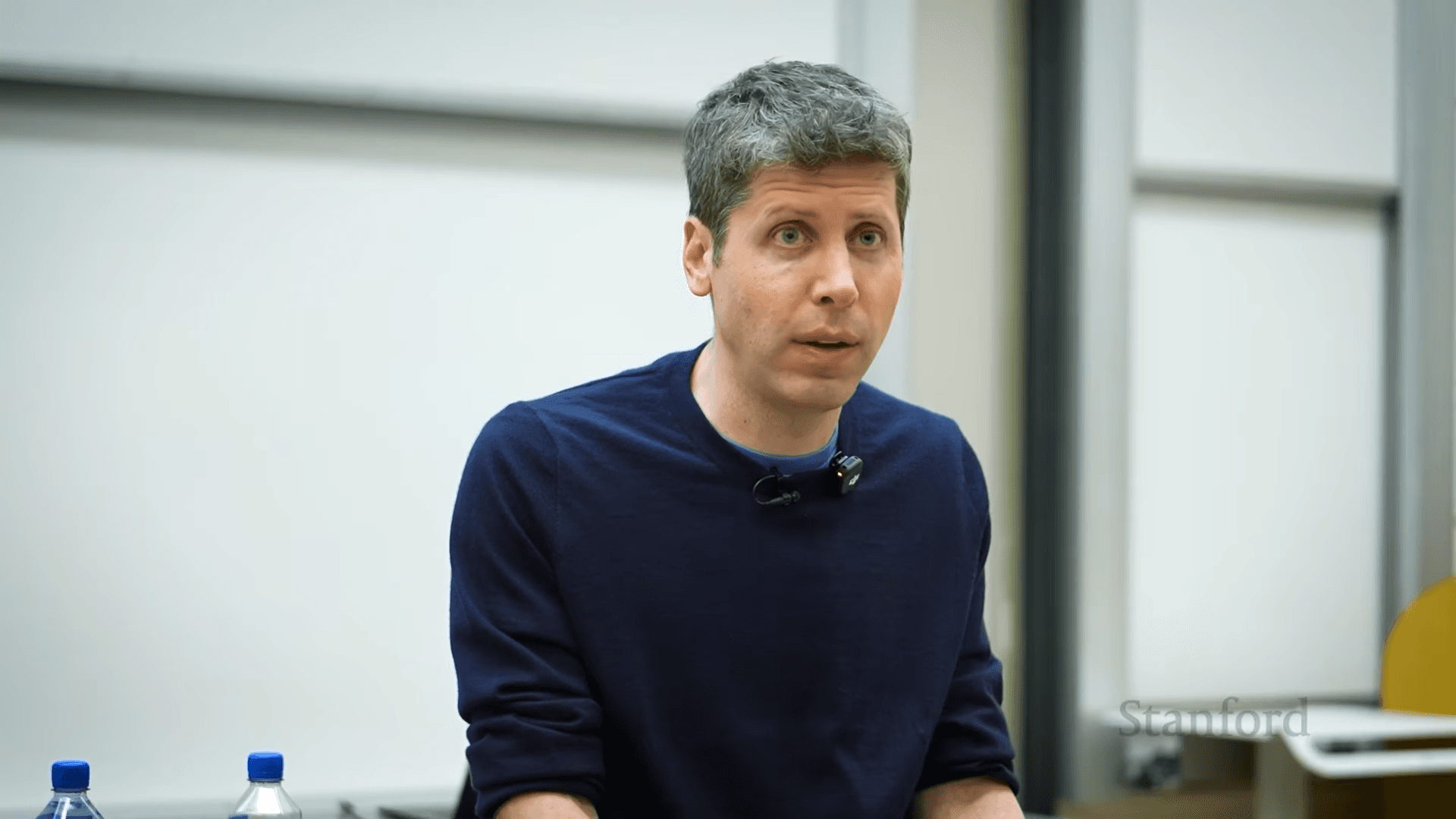
Sam Altman thinks AI researchers who doubted scaling laws cost the field years of progress. Speaking at Stanford, the OpenAI CEO argued that skeptics who bet against larger models were proven wrong by the data, and that some still refuse to update their views.
"Betting against LLMs scaling at this point feels quite misguided to me," Altman said. He named no specific researchers by title, but the target was clear: critics like Meta's Yann LeCun, who has repeatedly called large language models a "dead end" incapable of true understanding.
Why Altman says the skeptics got it wrong
Altman's argument is straightforward. Every time OpenAI added more compute and data, the models got smarter in ways skeptics said wouldn't happen. The scaling laws first documented in 2020 predicted roughly 10x capability improvement for every 10x increase in compute. GPT-3 had 175 billion parameters. GPT-4, by most estimates, sits around 1.76 trillion. The pattern held.
"Some people tie their identity to a position and can't let go, even when the data proves them wrong," Altman said. He dismissed critics on X (formerly Twitter) who've predicted OpenAI's failure for years. The company's $100 billion-plus valuation and ChatGPT's 100 million users in two months suggest the market disagrees with the doomsayers.
The math proof that changed the debate
Altman pointed to a recent example: an OpenAI model disproved a mathematical conjecture that had stumped human mathematicians for years. He didn't name the specific conjecture, but the claim is significant. If true, it suggests LLMs can produce genuinely novel knowledge, not just remix their training data.
"Clearly, LLMs are capable of figuring out new knowledge," Altman said. Mathematicians are now asking what this means for their field. If a model can find proofs humans missed, the role of human intuition in research shifts.
Anthropic CEO Dario Amodei has made similar arguments recently. Both leaders run companies betting billions on the same thesis: scale works, and we haven't hit the ceiling yet.
Where LLMs still fail
Altman isn't claiming LLMs solve everything. He acknowledged a clear gap: tasks requiring extended reasoning and high-judgment decisions over long time horizons. "LLMs seem much worse than people" at these, he said.
This matters for applications like robotics, strategic planning, and any workflow where mistakes compound over days or weeks. LeCun's argument for "world models" instead of pure language models remains relevant here. Even Altman concedes the point, noting that world models matter for things like robotics.
The question is whether these limitations are fundamental or just the next wall that more scale will break through. Altman's betting on the latter.
What this means for product teams
If Altman is right, the implication for builders is simple: assume models will keep getting better at roughly predictable rates. Design systems that can swap in more capable models without architectural rewrites. The features that seem impossible today may be table stakes in 18 months.
If the skeptics are right, the current generation of LLMs represents a local maximum. Teams should hedge by investing in hybrid approaches, combining language models with structured reasoning systems or symbolic AI.
The safe bet is probably somewhere in between. Scale has worked so far. It may not work forever.
Logicity's Take
Altman's framing is self-serving but not wrong. OpenAI did bet on scaling when others didn't, and that bet paid off. But his dismissal of critics as identity-attached ignores that LeCun raised legitimate concerns about reasoning and planning. For AI product teams, the practical takeaway: build for capability growth, but don't ignore the documented failure modes. Long-horizon tasks still need human oversight. The math proof claim deserves scrutiny. If verified, it's a genuine inflection point. If not, it's another hype cycle.
Frequently Asked Questions
What are AI scaling laws?
Scaling laws describe the relationship between model size, training data, compute, and performance. Research from 2020 showed that language models improve predictably as these inputs increase, roughly 10x better for every 10x more compute.
Why does Yann LeCun think LLMs are a dead end?
LeCun argues that language models lack true understanding of the physical world. He advocates for 'world models' that learn from observation and can reason about cause and effect, rather than predicting text patterns.
What mathematical conjecture did OpenAI's model disprove?
Altman didn't specify the conjecture. The claim requires independent verification. If true, it would demonstrate that LLMs can generate novel proofs, not just recombine existing knowledge.
Where do LLMs currently underperform humans?
According to Altman, LLMs struggle with long-horizon tasks requiring sustained judgment over time. This includes complex planning, multi-step reasoning with delayed feedback, and decisions where early errors cascade.
Need Help Implementing This?
Building AI products that adapt to rapid capability improvements? Logicity's consulting team helps product teams design LLM architectures that scale with the models. Contact us at consulting@logicity.in.
Source: The Decoder / Matthias Bastian
Manaal Khan
Tech & Innovation Writer
Produced with AI assistance and reviewed by the Logicity editorial team. Learn more in our Editorial Policy.