Key Takeaways
Overview of Altera’s FPGA AI Suite Software
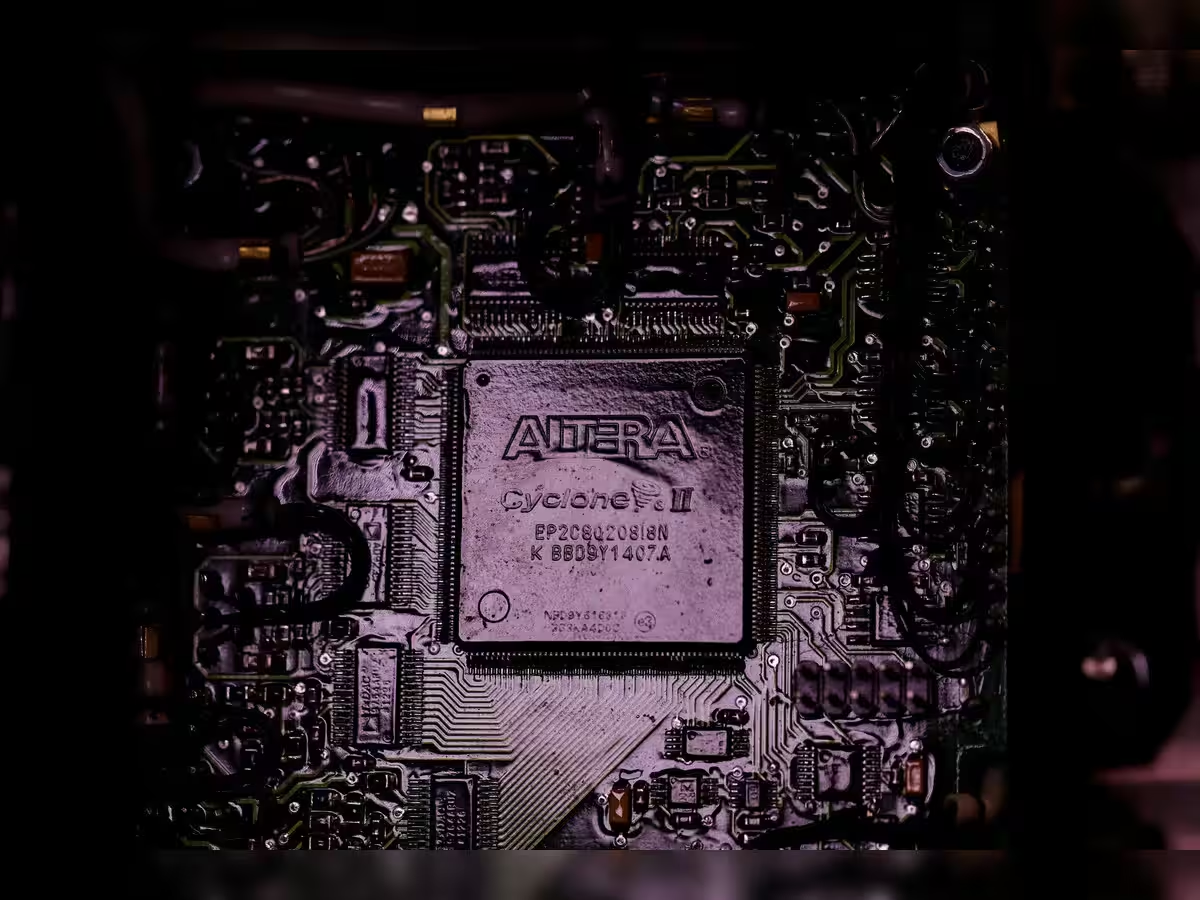
- Altera reports roughly 20% annual revenue growth and more than doubled operating income since becoming independent from Intel
- CEO Raghib Hussain projects the FPGA market for robotics alone could reach $100 billion to several hundred billion dollars over a decade
- The company has reduced its Intel dependency from 125 transition service agreements to 15 and now manufactures with both Intel Foundry and TSMC
Altera, the programmable chip maker that Intel spun off last September, is growing roughly 20% annually and has more than doubled its operating income, according to CEO Raghib Hussain. In a Reuters interview, Hussain said the company is preparing for an eventual public listing while positioning its field-programmable gate arrays (FPGAs) as critical infrastructure for AI and robotics applications.
The numbers mark a turnaround. Under Intel's ownership, Altera's revenue fell sharply from $2.9 billion in 2023 to $1.5 billion in 2024. Hussain attributes the decline to two factors: buyers shifted budget toward GPUs for AI training, and Altera lost market share to AMD-owned Xilinx. Now independent, the company expects mid-20% growth this year.
What drove the revenue collapse under Intel?
The 2023-2024 drop was brutal. Nearly half of Altera's revenue evaporated in a single year. Part of this was industry-wide: when ChatGPT triggered an AI spending frenzy, data center budgets pivoted hard toward Nvidia GPUs. FPGAs, which excel at inference and edge tasks rather than massive parallel training, got squeezed.
But Altera also had a Xilinx problem. AMD acquired Xilinx for $49 billion in 2022 and invested heavily in its product roadmap. Intel, meanwhile, was fighting fires across its own foundry and CPU businesses. Altera got less attention than it needed. The Silver Lake deal, which valued Altera at $8.75 billion, gave the company breathing room and an independent board.
How is Hussain positioning FPGAs for AI?
Hussain's pitch is straightforward: GPUs handle the heavy compute, but FPGAs handle everything around it. Connectivity, data preprocessing, sensor fusion. In robotics, that means processing camera feeds, lidar, and motor controls in real time with low latency.
“If GPU is the brain, the FPGAs are the nervous system.”
— Raghib Hussain, CEO of Altera
He projects FPGA content of $100 to several hundred dollars per robot. Multiply that across millions of industrial and consumer robots, and Hussain sees a market worth "100 billion to several hundred billion dollars" over a decade. The range is wide, but even the low end represents significant growth for a company that just booked $1.5 billion in revenue.
What has Altera done to separate from Intel?
Independence from a parent company is not just legal paperwork. It requires untangling IT systems, supply chains, customer contracts, and engineering resources. Hussain said Altera has reduced its Intel transition service agreements from 125 to 15. That is faster than most spinoffs achieve in their first year.
The company now manufactures with both Intel Foundry and TSMC. Hussain confirmed that Altera is developing products on TSMC's 2-nanometer and 3-nanometer process technologies. Using TSMC gives Altera access to the world's most advanced chip manufacturing, reducing dependence on Intel's troubled foundry operations.
On memory, Altera claims to be the only programmable chip supplier in full production with DDR5 for mid- to high-end chips. The company also built a memory stockpile that Hussain says insulates it from current shortages affecting the broader semiconductor industry.
Is an IPO coming?
Hussain confirmed Altera is preparing for an "eventual public listing" but did not give a timeline. Silver Lake typically holds investments for four to seven years before exiting. Given that the deal closed in September 2024, a 2027 or 2028 IPO would fit that pattern. The mid-20% growth rate and doubled operating income will look good in an S-1 filing, assuming the company can sustain them.
The $8.75 billion valuation from the Silver Lake deal provides a baseline. If Altera hits its growth targets, that number could rise substantially by the time it goes public. But the FPGA market remains competitive. AMD's Xilinx, Lattice Semiconductor, and a growing roster of Chinese competitors all want the same AI and robotics wins.
What is Hussain's management approach?
Hussain, a former Marvell Technology executive, emphasized a technical culture. "I believe in an engineer-to-engineer type of discussion," he told Reuters. "We have brought engineering very close to the customers, so that actually already is showing up in our customer engagement."
The company produced working prototypes of six new chips last year. For a team rebuilding its operations post-spinoff, that suggests the engineering pipeline is functioning. Whether those prototypes convert to volume production and revenue is the next test.
Logicity's Take
Altera's turnaround story is plausible but unproven. The 20% growth claim cannot be verified since Altera is private, and the $100-$300 billion robotics TAM projection spans such a wide range that it tells us little. What is clear: FPGAs have a real role in AI systems beyond GPUs, and Altera's move to TSMC manufacturing is strategically smart given Intel Foundry's struggles. For engineering teams evaluating FPGA vendors, Xilinx remains the default choice, but Altera's DDR5 support and aggressive chip cadence make it worth a fresh look. Watch the IPO filing for real numbers.
Frequently Asked Questions
What does Altera make?
Altera manufactures field-programmable gate arrays (FPGAs), chips that can be reprogrammed after manufacturing for applications like AI inference, robotics, telecommunications, and data centers.
Why did Intel sell Altera?
Intel sold a 51% stake to Silver Lake for $4.46 billion as part of broader cost-cutting efforts. Intel retains a 49% stake and Altera now operates independently.
Who is Altera's main competitor?
Xilinx, owned by AMD since 2022, is Altera's largest competitor in the FPGA market. Lattice Semiconductor and several Chinese firms also compete in specific segments.
When will Altera go public?
Altera has not announced an IPO date. CEO Raghib Hussain confirmed the company is preparing for an eventual listing, which based on typical private equity timelines could occur around 2027-2028.
How do FPGAs fit into AI systems?
FPGAs handle tasks around the GPU like data preprocessing, connectivity, and sensor fusion. In robotics, they process real-time inputs from cameras and sensors with low latency.
Need Help Implementing This?
If you're evaluating FPGA solutions for AI or robotics projects and need help navigating vendor options, reach out to our team at Logicity for technical guidance and vendor comparisons.
Source: Tech-Economic Times / ET
Huma Shazia
Senior AI & Tech Writer
Produced with AI assistance and reviewed by the Logicity editorial team. Learn more in our Editorial Policy.




