Key Takeaways
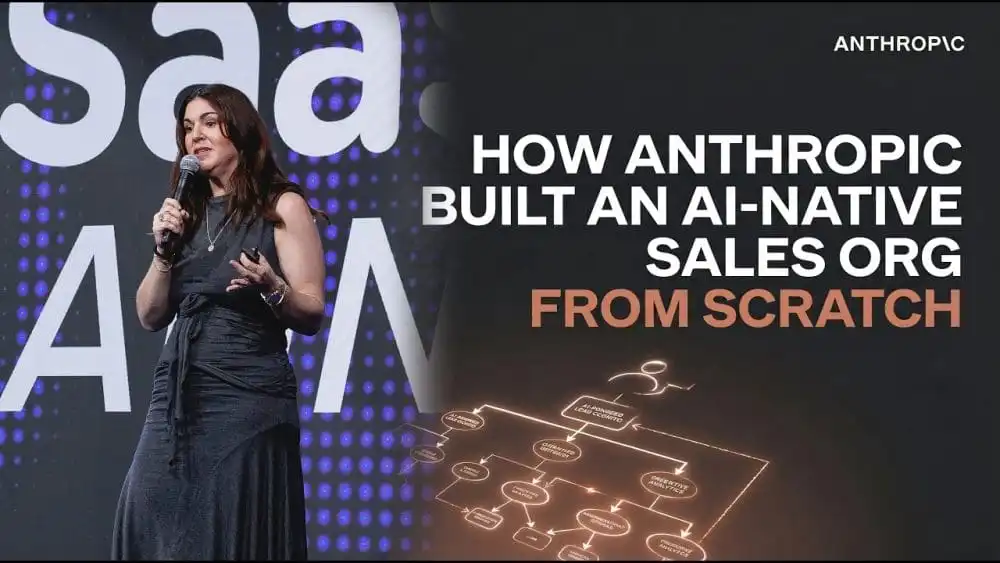
- Anthropic now closes 54% of enterprise logos through self-serve after rebuilding around AI instead of hiring more reps
- Owner.com reps produce $2M+ ARR each at 20x their OTE, resetting the benchmark for AI-native sales teams
- Gamma hit $100M ARR with 50 people but regrets waiting too long to add sales—even when inbound was carrying them
SaaStr AI 2026 in San Mateo delivered what the best B2B events should: operators sharing what broke. The GTM sessions featured Anthropic, Gamma, Stripe, Owner.com, Salesforce, Vercel, Replit, and Monaco. Nobody debated whether to put AI agents in the revenue org. They had already done it. The question was what to do differently next time.
Disclosure
Some links in this post are affiliate links — Logicity earns a commission if you sign up, at no extra cost to you. We only link products we have used or actively recommend.
The lineup included Eleanor Dorfman (Anthropic), Grant Lee (Gamma), Kyle Norton (Owner.com), Jeanne DeWitt Grosser (Vercel), Kody from Replit, Adam Alfano (Salesforce), Eitan Saban (PayPal), Sam Blond (Monaco), and Maia Josebachvili (Stripe). Here are the twelve lessons that stood out.
1. When demand spikes, open self-serve instead of hiring
Eleanor Dorfman, Anthropic's Head of Industries, drew one of the event's biggest crowds. She walked through what her team did when a new Claude release sent enterprise demand vertical. The obvious move was to hire reps three to five times faster. Dorfman argued you cannot do that without wrecking the buying experience.
Instead, Anthropic rebuilt the enterprise motion around AI. Four months after the rebuild, 54% of new enterprise logos were closing through self-serve. Not trials. Not small accounts. Real enterprise logos with real ACV, contract terms, and invoicing. No rep gating the front door.
The reps who used to run those deals got pointed at accounts where a human actually changes the outcome. This sits in direct tension with the next lesson, and both are right. The way to hold both: treat human selling as expensive and scarce. Spend it only where it moves the deal. Let everyone else buy without waiting on a calendar.
2. Add sales earlier than feels necessary
Gamma is the single best argument in B2B for skipping a sales team. Grant Lee, co-founder and CEO, stood on stage and told founders not to skip it. Gamma hit $100M ARR with roughly 50 people. Profitably. 50 million users, 600,000 paying subscribers, almost all driven by word of mouth.
His biggest regret was waiting too long to add sales. A world-class inbound motion still leaves enterprise deals, expansion revenue, and larger accounts sitting on the table. You only find out how much after you hire the people who go get them. If the company with the strongest excuse to wait wishes it had moved sooner, most founders riding inbound are later than they think.
3. The new bar for a rep is 20x their OTE
Kyle Norton, CRO at Owner.com, put up the most concrete rep economics of the event. Owner is approaching $100M ARR selling roughly $10K ACV software to independent restaurants. Small businesses that supposedly don't buy software.
The numbers on his AI-native team: $2M+ in ARR per rep per year as the average, not the top performer. That's 20x close-won to OTE, meaning a $150K rep brings in multiples of their comp. Outbound BDRs close $100K+ in revenue per month. Not pipeline. Closed revenue. Owner runs at 4x the ARR per rep of their direct SMB competitors.
If your reps are running at 3x or 4x their comp and you think that's healthy, the ceiling just moved. AI-augmented reps at a well-run org produce at a level that makes old benchmarks look outdated.
4. Point agents at leads no human was ever going to call
The PayPal and Salesforce session tackled SMB selling with agents. Adam Alfano (Salesforce) and Eitan Saban (PayPal) made the case that the highest-leverage use of AI agents isn't replacing reps on good leads. It's working the leads your team ignores.
Every sales org has a long tail of leads that never get touched. Too small. Too cold. Too much effort for too little expected return. Agents can work that tail 24/7 without burning out. The incremental revenue costs almost nothing to pursue. For SMB-heavy orgs, this is where the first deployment should go.
5. The lead agent that replaced a 10-person function
Jeanne DeWitt Grosser, COO at Vercel, shared a case study that will make ops leaders uncomfortable. Vercel built a lead qualification and routing agent that took a 10-person function down to 1. Not 10 to 5. Not 10 to 3. One person overseeing what ten used to do.
The implication: if your lead routing, qualification, or handoff process runs on human judgment that can be codified, agents will do it faster and cheaper. The question isn't whether this is possible. It's whether your competitors do it before you do.
Deploying AI agents at scale requires infrastructure that doesn't break under load
6. Rep-level AI usage predicts quota attainment
Kody from Replit presented data showing that individual rep AI usage correlates with quota attainment. Reps who adopted AI tools heavily outperformed those who didn't. Not by a little. By enough to show up in the forecast.
The implication for sales leaders: if you're not tracking AI tool adoption at the rep level, you're missing a leading indicator of performance. This isn't about mandating tool usage. It's about understanding which behaviors drive results.
7. Comp, headcount, and margin math when agents deliver
Sam Blond, co-founder and CEO of Monaco, tackled the hardest question: what happens to comp plans and headcount when agents start delivering outcomes that used to require humans? If an agent closes deals, who gets the commission? If agent-assisted reps produce 4x more, do you pay them more or hire fewer?
Blond didn't offer a single answer because there isn't one yet. But he walked through the margin math that forces the conversation. When agents reduce the cost of revenue, someone captures that margin. Whether it's the company, the rep, or split depends on how you structure comp. The companies that figure this out first will attract the best reps.
8. The four patterns behind the fastest-growing AI companies
Maia Josebachvili, GM of Enterprise Product at Stripe, presented patterns from the fastest-growing AI companies in Stripe's portfolio. She identified four recurring motifs: usage-based pricing that scales with customer success, self-serve paths that convert without sales touch, expansion revenue built into the product, and land-and-expand as the default motion.
None of these are new in isolation. The insight is that the fastest AI companies do all four simultaneously. They don't pick one GTM motion. They layer them.
How these lessons fit together
The sessions seem to contradict each other. Anthropic says build self-serve. Gamma says add sales earlier. Owner says reps should produce 20x OTE. Vercel says one person can do what ten used to do.
The through-line: AI changes where human effort is valuable, not whether it's valuable. Self-serve handles the accounts that don't need a human. Sales catches the enterprise deals that inbound misses. Agents work the tail. Reps focus on accounts where they actually change the outcome.
The companies winning this transition aren't replacing humans wholesale. They're getting precise about where humans add value and ruthless about where they don't.
| Company | Key Metric Shared | Takeaway |
|---|---|---|
| Anthropic | 54% enterprise logos self-serve | Build self-serve before hiring when demand spikes |
| Gamma | $100M ARR with ~50 people | Add sales earlier than feels necessary |
| Owner.com | $2M+ ARR per rep (20x OTE) | Reset benchmarks for AI-native teams |
| Vercel | 10-person function to 1 | Agents replace codifiable human judgment |
| Replit | AI usage predicts quota attainment | Track adoption at rep level |
AI company fundraising dynamics affect the competitive landscape for sales tools
What CROs should do this quarter
First, audit where your reps spend time on activities that could be codified. Lead routing, qualification, follow-up sequences, meeting scheduling. If a rule or pattern governs the decision, an agent can make it.
Second, measure rep-level AI adoption. If Replit's data generalizes, you'll find a correlation with performance. Track it. Third, recalculate your benchmarks. If 20x OTE is achievable at Owner, 3x to 5x isn't good anymore. It's underperformance waiting to be exposed by a competitor who figured this out.
CRM platforms like Salesforce, HubSpot, and Pipedrive are all racing to add agent capabilities. The tooling gap is closing fast. The strategy gap between companies that deploy well and those that don't will widen.
Logicity's Take
The most surprising data point: Gamma's $100M ARR with 50 people, yet still wishing they'd added sales sooner. It suggests inbound ceilings are higher than expected but also that they're still ceilings. For operators choosing CRM infrastructure, the question is whether your platform handles both self-serve and assisted motions. Salesforce Agentforce, HubSpot's new AI tools, and Pipedrive's automation features all target this. Expect pricing to shift toward usage-based models as agent actions become measurable. The winner won't be the cheapest CRM. It'll be the one that lets you deploy agents fastest.
Frequently asked questions
Frequently Asked Questions
What percentage of Anthropic's enterprise deals now close through self-serve?
54% of new enterprise logos at Anthropic now close through self-serve, four months after they rebuilt their enterprise motion around AI instead of hiring more reps.
What is the new benchmark for rep productivity in AI-native sales orgs?
Owner.com reported $2M+ ARR per rep per year as the average, representing 20x their on-target earnings, compared to the traditional 3x to 5x benchmark.
How did Gamma reach $100M ARR with such a small team?
Gamma hit $100M ARR with roughly 50 people through word-of-mouth growth, 50 million users, and 600,000 paying subscribers—almost entirely without a traditional sales org.
Should SaaS companies replace sales teams with AI agents?
No. The consensus from SaaStr AI 2026 is to use agents for leads and activities that humans weren't reaching anyway, while focusing reps on accounts where human judgment changes outcomes.
When should a product-led company add its first sales hire?
Gamma's Grant Lee, whose company had every reason to delay, said his biggest regret was waiting too long. The advice: hire ahead of the pain, not after it shows up in the forecast.
Need Help Implementing This?
If you're a SaaS founder or revenue leader trying to figure out where AI agents fit in your GTM motion, Logicity covers the tools, strategies, and case studies that matter. Subscribe to our newsletter for weekly analysis on what's working.
Source: SaaStrAI
Manaal Khan
Tech & Innovation Writer
Produced with AI assistance and reviewed by the Logicity editorial team. Learn more in our Editorial Policy.