Mistral pitches open-source AI after Anthropic export ban
Key Takeaways
- Mistral AI is positioning itself as Europe's sovereign alternative after Anthropic was forced to suspend access to frontier models for foreign nationals
- The French startup is reportedly raising €3bn at a €20bn valuation while running at $400 million annualized revenue
- Mistral's open-source approach lets customers run AI on their own infrastructure, avoiding dependency on US providers
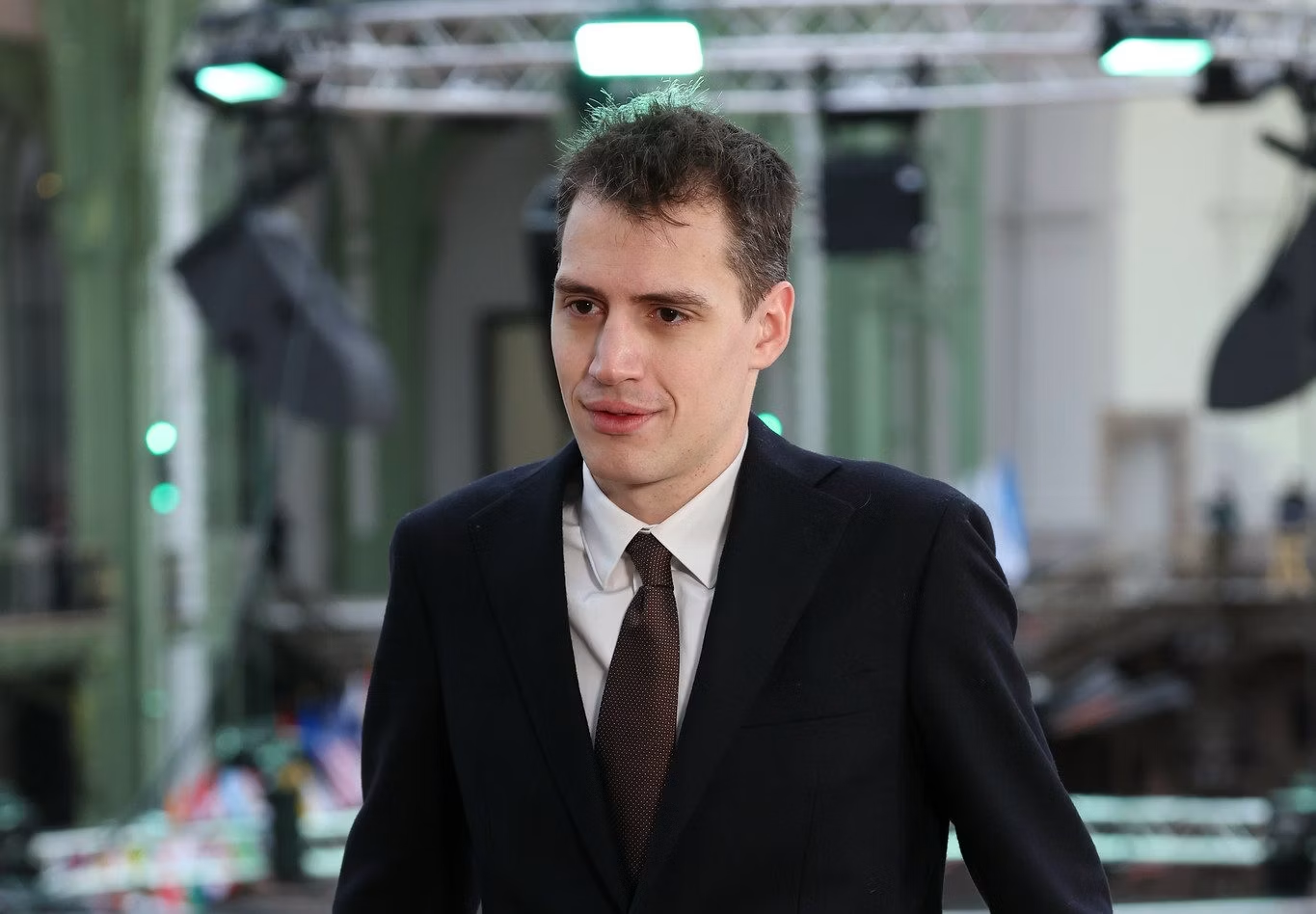
Mistral AI CEO Arthur Mensch is making his move. Days after the US government forced Anthropic to cut access to its Mythos 5 and Fable 5 models for foreign nationals, the French startup founder posted a pointed message on LinkedIn: "We exist to make sure that everyone gets access to the best AI systems, outside of centralised control exercised by states or corporations."
He didn't name Anthropic directly. He didn't need to. European companies that built on Anthropic's models found themselves locked out overnight last week. Mistral wants to be where they land.
What happened with Anthropic?
The US government imposed export controls on Anthropic's frontier models in June 2026, citing national security. The order was swift. Organizations outside the US that relied on Anthropic's top-tier AI suddenly lost access, with no transition period and limited recourse.
This is exactly the scenario European policymakers have warned about for years. When your critical AI infrastructure depends on a single US provider, you're one executive order away from disruption. Anthropic did not respond to requests for comment on the restrictions.
Why Mistral sees an opening
Paris-based Mistral launched in 2023 with a specific pitch: a European alternative to OpenAI, Anthropic, and Meta. Three years later, that positioning looks prescient. The company offers open-source AI models, which means customers can inspect the code, modify it, and run everything on their own servers.
This matters because it severs the dependency chain. If Mistral's investors or the French government turned hostile tomorrow, customers who downloaded the models could keep running them. The same isn't true for API-dependent services.
"States and organizations need to have sovereignty over this technology," Mensch wrote. "They should own and control the systems that are specifically embedding their IP and tacit knowledge, and will end up running their most critical processes."
How big is Mistral compared to US rivals?
Not close. Anthropic reached a $965 billion valuation. OpenAI sits at $852 billion. Mistral, despite being Europe's strongest AI contender, is reportedly raising at a €20 billion ($23.1 billion) valuation.
Mensch is blunt about the gap. He acknowledged that Mistral started "later than others" and has spent "a few percent of the deployment of some of our competitors." The company, he said, does "not yet own the best language models."
That's an unusual admission from a CEO. It's also a strategic reframe. If you can't win on raw capability, win on reliability and control. Mensch is betting that enterprises will pay for AI they can't be cut off from, even if it's not the absolute best on benchmarks.
The infrastructure play
Mistral has expanded beyond models into AI infrastructure. The company is building data centers across Europe to increase the region's compute capacity. This addresses a persistent European weakness: the continent has talent and capital but lacks the massive GPU clusters concentrated in the US.
The funding trajectory reflects the ambition. Mistral has raised €3.5 billion in debt and equity to date. The reported €3 billion new round would push total financing above €6.5 billion. ASML Holding, the Dutch semiconductor equipment giant, holds an 11% stake, making it the largest shareholder.
"We're building under the premise that AI technology is a commodity technology that every organisation needs a secured and affordable supply of," Mensch said.
Will enterprises actually switch?
The Anthropic ban creates immediate pain, but switching AI providers isn't simple. Companies have fine-tuned prompts, built integrations, and trained teams on specific model behaviors. Migration costs money and time.
Mistral's pitch works best for new projects and for organizations that got burned by the Anthropic cutoff. For the latter, the argument writes itself: this just happened once, it can happen again.
The open-source angle adds a twist. Even if Mistral as a company disappeared, the models would remain available. That's a form of vendor risk mitigation that closed-source providers can't match by definition.
Another European AI startup navigating sovereignty concerns in a sensitive sector
The sovereignty question gets louder
Mensch's timing is opportunistic, but the underlying issue is real. AI is becoming infrastructure. When your customer service, code generation, document processing, and analysis tools all run through one provider's API, that provider has leverage over your business.
For years, this felt theoretical. The Anthropic export controls made it concrete. European regulators have pushed for digital sovereignty in data, semiconductors, and cloud computing. AI is the next frontier.
Whether Mistral can actually deliver competitive models while maintaining its open-source philosophy remains the open question. The company has a target of $1 billion revenue by the end of 2026. Hitting that would prove the business model works. Missing it would suggest sovereignty concerns alone aren't enough to close deals.
A look at how AI startups are competing for capital and strategic positioning
Logicity's Take
Mensch is playing a long game that just got a lot shorter. The Anthropic ban did more for Mistral's pitch than any marketing campaign could. But there's a harder question lurking: can open-source AI stay competitive as frontier models require billions in training compute? Mistral needs to prove the capability gap is closeable, or its sovereignty pitch becomes a consolation prize for organizations that can't access the best tools.
Frequently Asked Questions
Why did Anthropic cut off access to its AI models?
The US government imposed export controls on Anthropic's Mythos 5 and Fable 5 models in June 2026, citing national security concerns. This forced Anthropic to suspend access for foreign nationals.
What is Mistral AI's valuation?
Mistral is reportedly raising a new round at approximately €20 billion ($23.1 billion) valuation. The company has raised €3.5 billion in debt and equity to date.
How does Mistral's open-source approach differ from Anthropic?
Mistral offers open-source AI models that customers can inspect, modify, and run on their own infrastructure. Anthropic provides closed-source models accessible only through APIs, which means access can be revoked.
Is Mistral's AI as good as Anthropic's or OpenAI's?
Mistral CEO Arthur Mensch admits the company does "not yet own the best language models" but says Mistral is working to close the capability gap with US competitors.
Who is Mistral AI's largest shareholder?
ASML Holding, the Dutch semiconductor equipment company, holds an 11% equity stake in Mistral, making it the largest shareholder.
Need Help Implementing This?
If your organization is evaluating AI providers after the Anthropic disruption, or considering a move to open-source models, contact the Logicity team. We can connect you with experts who specialize in AI infrastructure migration and sovereignty strategy.
Source: Sifted
Manaal Khan
Tech & Innovation Writer
اقرأ أيضاً
كيف تستخدم JavaScript Fetch API: إرسال الطلبات ومعالجة الأخطاء وإلغاء الاتصالات
تُعدّ JavaScript Fetch API الأداة المدمجة لإجراء طلبات HTTP في المتصفحات الحديثة وبيئة Node.js بدءاً من الإصدار 18. تعتمد هذه الواجهة على Promises، مما يُتيح لك استخدام سلسلة .then() أو صيغة async/awa

دليل إعداد PHP-FPM مع Nginx على Ubuntu خطوة بخطوة
يُعدّ الجمع بين PHP-FPM مع Nginx الطريقة المعيارية لتشغيل تطبيقات PHP على خوادم Nginx، إذ لا يمتلك Nginx وحدة PHP مدمجة كما هو الحال مع mod_php في Apache. بدلاً من ذلك، يتولى Nginx تقديم الملفات الثاب
مستثمرون صينيون اشتروا سراً حصصاً في SpaceX قبل الطرح العام
كشفت وثائق محكمة أمريكية أن مستثمرين صينيين وروس استحوذوا سراً على حصص في شركة SpaceX قبل سنوات من طرحها العام، وذلك عبر شركة وسيطة مقرها الولايات المتحدة، في وقت تبني فيه شركة إيلون ماسك أقماراً تجسس