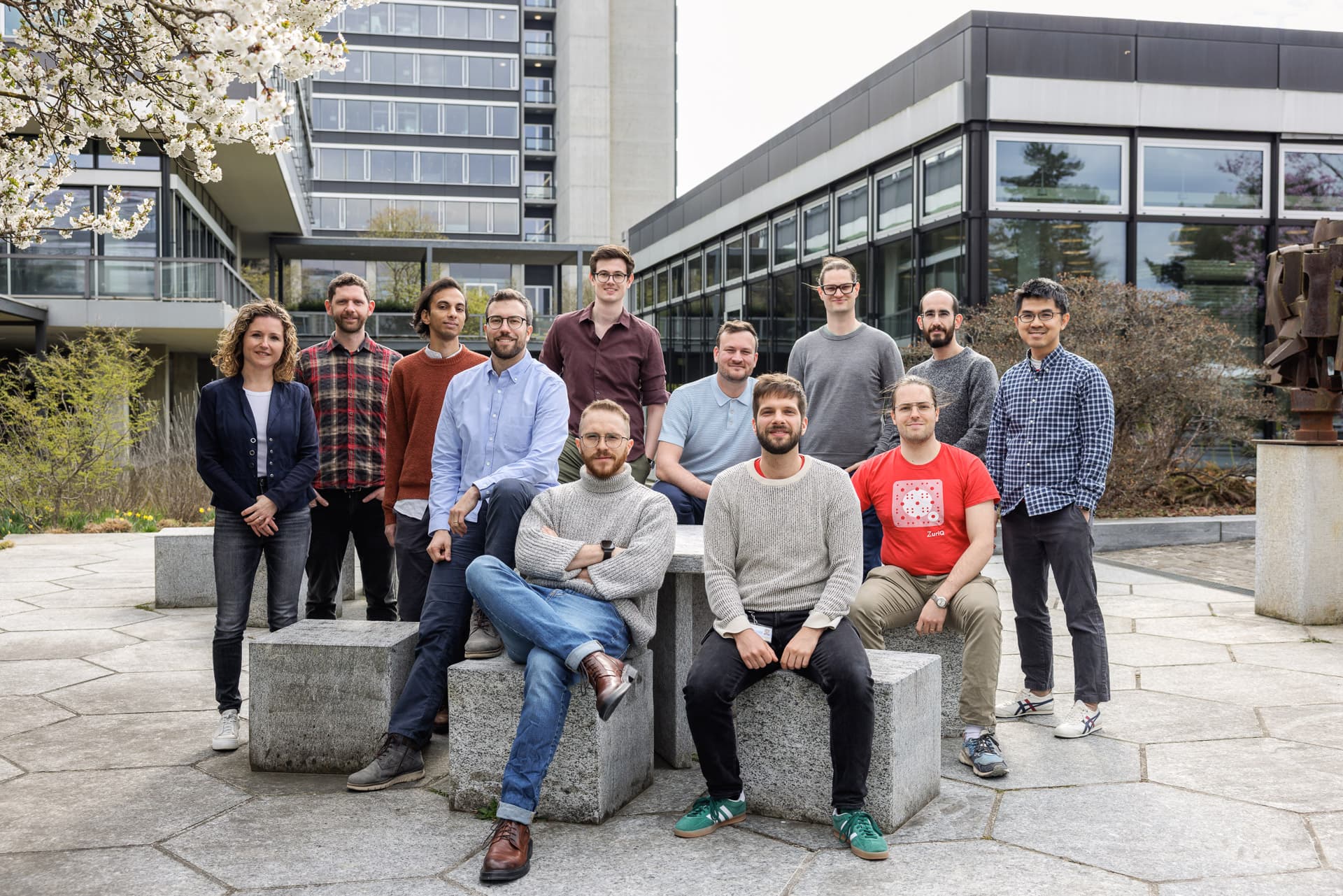
ZuriQ, an ETH Zurich spinout developing a new architecture for quantum chips, has closed a $25.5 million seed round. The Swiss startup claims its approach is more scalable than existing quantum computing methods, which remain stuck at experimental qubit counts.
The round was led by Wingspossible, a Swiss-based VC focused on deeptech investments. Participation came from Salesforce Ventures subsidiary Obvious.vc and Helvetica, along with additional strategic backers including US-based investor US Aether Ventures. The raise follows a $9.1 million pre-seed round from last year.
Why existing quantum chips hit a wall
Today's quantum processors face a fundamental scaling problem. Companies like IBM and Google have built chips with over 1,000 qubits, but error rates climb as qubit counts increase. More qubits packed onto a 2D chip means more interference, more heat, and more errors that destroy the quantum states needed for computation.
ZuriQ's bet: move to three dimensions. The company is building what it calls a 3D chip architecture, where qubits are stacked vertically rather than spread across a flat surface. This reduces the physical distance signals must travel and, ZuriQ claims, makes error correction more manageable.
"Most approaches have this simple way for you to scale their chips," said Klaus Haas, cofounder and CEO of ZuriQ. "They just double something in surface, like we have more GPUs. For the first time, we have built early proofs across two directions with a modular model and a third across. And we want to build upon that on the basis of a quantum system to help our next and total processor come out differently."
How ZuriQ's 3D approach differs
Most quantum hardware startups, including US-based IonQ and Rigetti, have raised more than $200 million each. Both rely on 2D chip layouts. European efforts remain smaller: IQM raised funding last year, but the continent lacks a clear leader in fault-tolerant quantum hardware.
ZuriQ has demonstrated its architecture on a proof-of-concept device with qubits arranged in a 3D grid. For context, Rigetti's largest processor has 84 qubits in a 2D layout. IBM announced a 1,121-qubit chip in 2023. But qubit count alone does not determine usefulness. Error rates and connectivity matter more for running real algorithms.
"The standard 3D scaling that has demonstrated approach is optimised fast to very sensitive," said Haas. "We see a tremendous technical challenge that allows us to potentially avoid 3D array expansion. That is achievable as there already has more work to rely."
Where the money goes
ZuriQ plans to use the funding to scale its prototype toward a larger qubit count over the next 18 months. The company also intends to expand its engineering team, currently around 30 people, and open discussions with potential enterprise customers in pharmaceuticals and financial services.
The startup is not pre-revenue. Haas said ZuriQ is targeting partnerships rather than selling hardware outright, offering access to its quantum systems via cloud-based interfaces.
Logicity's Take
A $25.5m seed is substantial for European quantum hardware, but the real test is whether ZuriQ's 3D approach survives the jump from lab demo to production. IBM and Google have billions behind their efforts and still struggle with error rates. For founders watching quantum computing as a long-term bet, ZuriQ is worth tracking, but enterprise applications remain years away.
Another recent European tech seed round with strategic implications
The bigger quantum investment picture
Quantum computing funding cooled in 2025 after a frothy 2021-2022 cycle. Investors have grown more skeptical of timelines, with fault-tolerant machines still a decade or more away by most estimates. ZuriQ's raise suggests that well-differentiated hardware approaches can still attract capital, even in a tighter market.
The company's ETH Zurich pedigree helps. The university has produced multiple successful deeptech spinouts, and its quantum physics program ranks among Europe's best. Whether that academic credibility translates to commercial viability is the open question.
Need Help Implementing This?
If you're exploring quantum computing partnerships or evaluating deeptech investments, reach out to our team at Logicity for a briefing on the European landscape.
Source: Sifted
Huma Shazia
Senior AI & Tech Writer
Produced with AI assistance and reviewed by the Logicity editorial team. Learn more in our Editorial Policy.