Key Takeaways
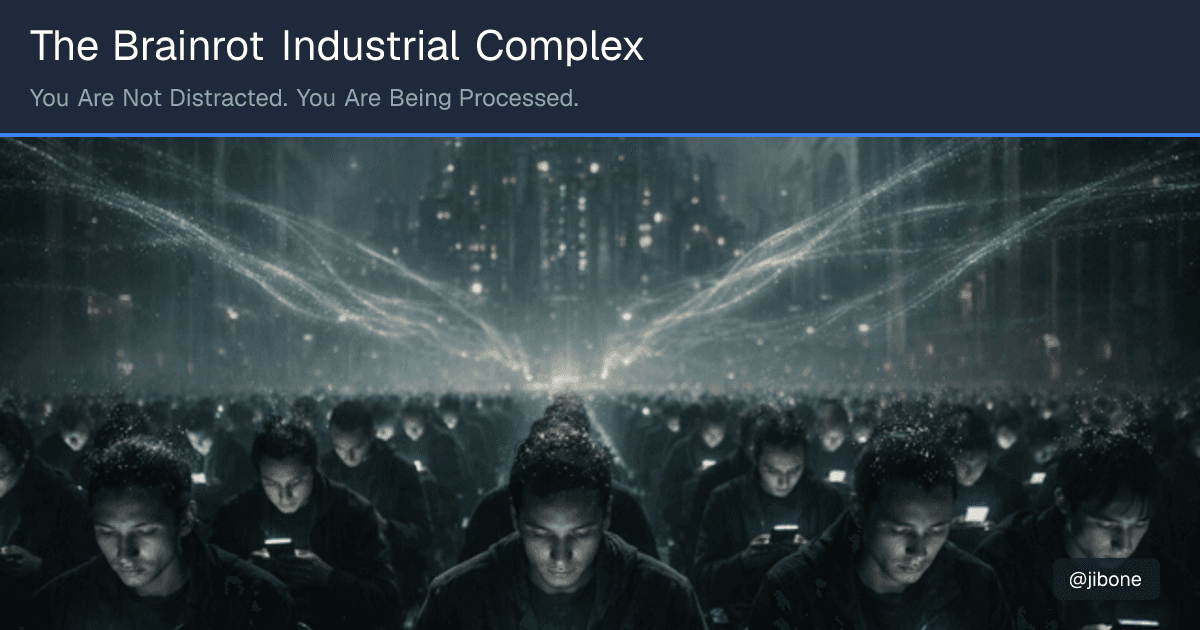

- 'Brainrot' isn't a joke — it's a self-diagnosis from the generation experiencing the worst of attention exploitation
- 14 days offline can reverse 10 years of cognitive decline, according to a recent PNAS Nexus study
- The attention economy costs US employers nearly $1 trillion annually in lost productivity
Read in Short
A new essay argues that 'brainrot' — the internet's jokey term for feeling mentally fried — is actually an industrialized system designed to hijack your attention for profit. With 210 million people addicted to social media and attention spans dropping to 8 seconds, the data backs it up. The good news? Two weeks offline can reverse a decade of cognitive damage.
You're Not Lazy. You're Being Processed.
Here's a thought experiment: Try to remember the last time you sat with your own thoughts for more than five minutes without reaching for your phone. Difficult, right? A new essay making waves on Hacker News argues this isn't a personal failing — it's the intended outcome of a system the author calls the 'Brainrot Industrial Complex.'
The term 'brainrot' didn't come from concerned parents or academic researchers clutching their pearls. It emerged organically from Gen Z — the very generation drowning in infinite scroll feeds. It's a kind of self-aware diagnosis. They know something is wrong, even if they can't quite articulate what.
“Brainrot is the gradual erosion of one's ability to think, focus, and reflect, caused by continuous exposure to high-stimulation, low-substance digital input.”
— J. Shamsul, Author of 'The Brainrot Industrial Complex'
The Numbers Are Genuinely Terrifying
Let's put some data behind the vibes. The scale of what's happening to human attention isn't subtle — it's a full-blown crisis hiding in plain sight.
That's not a typo. Nearly a trillion dollars evaporates every year because our brains have been rewired to crave the next dopamine hit instead of finishing a spreadsheet. Gen Z averages just 6.5 seconds of attention per social media post. We're exposed to over 5,000 pieces of content daily — up from 1,400 in 2012.
Why 'Industrial Complex'?
The author borrows from Eisenhower's famous 'Military-Industrial Complex' warning. Just as that system created self-sustaining demand for weapons, the Brainrot Industrial Complex creates self-sustaining demand for attention extraction. It's not an accident. It's a business model.
Distraction Used to Mean Something Darker
Here's a linguistic rabbit hole that changes everything: the word 'distraction' used to be way more sinister. In older English, being 'distracted' didn't mean you checked Twitter during a Zoom call. It meant being mentally disturbed — a mind torn apart, unable to hold itself together.
The Latin root 'distrahere' literally means 'to tear in different directions.' When your phone buzzes and pulls you away from deep work, what exactly are you being torn from? What was once considered a disorder has become the baseline state of modern existence.
“Platform features exploit the same dopamine-driven reward pathways as slot machines.”
— Dr. Kara Bagot, Psychiatrist specializing in adolescent addiction
But Here's the Plot Twist — Your Brain Can Heal
Before you spiral into existential dread (ironic, I know), there's genuinely hopeful research. A major study published in PNAS Nexus found something remarkable: just 14 days without smartphone internet access produced attention improvements equivalent to reversing 10 years of age-related cognitive decline.
Let that sink in. Two weeks of digital detox can functionally make your brain a decade younger in terms of focus. That's not self-help fluff — that's peer-reviewed science.
- Harvard researchers found one week of reduced phone use led to a 24.8% reduction in depression symptoms
- The same study showed a 16.1% drop in anxiety
- 82% of Gen Z adults believe they're addicted to social media — awareness is the first step
If your attention is being hijacked, these AI tools can help you reclaim focus and automate the busywork
The Playbook for Taking Your Mind Back
The essay doesn't just diagnose the problem — it offers a practical framework for individual resistance. You might not be able to dismantle trillion-dollar attention extraction machines overnight, but you can navigate them with intention.
- Awareness first: Start noticing the pulls on your attention. What triggers your scroll reflex? Boredom? Anxiety? That vague existential itch? These are the entry points the system exploits.
- Pause before you scroll: That millisecond of conscious intervention creates space between stimulus and response. It's tiny, but it's yours.
- Curate ruthlessly: Stop letting algorithms decide what enters your mind. Subscribe to newsletters. Bookmark specific sites. Choose consciously.
- Reframe the narrative: You're not bored and weak-willed. You're in a machine optimized for brainrot. That's not excuse-making — it's accurate diagnosis.
For the Builders Reading This
The essay has a pointed message for developers and designers: these systems are not inevitable. Feeds, loops, infinite scroll — these are choices, not laws of physics. It's possible to build tools that respect attention rather than exploit it. A different internet isn't fantasy. It's a matter of intention.
The Romans Worried About This Too
Lest you think this is purely a 2026 problem, the author reminds us that distraction anxiety is ancient. Romans fretted about the spectacle of the Coliseum rotting moral character. Victorians panicked about novels stealing attention from 'serious pursuits.'
What's different now isn't human vulnerability — we've always been susceptible to shiny distractions. What's different is scale, intensity, and intent. The Brainrot Industrial Complex didn't create a new weakness. It weaponized one that's been with us for millennia.
| Era | Distraction Concern | Scale |
|---|---|---|
| Ancient Rome | Gladiator spectacles, gossip | Thousands at a time |
| Victorian England | Novels, penny dreadfuls | Millions (literacy dependent) |
| 2026 | Infinite scroll, algorithmic feeds | Billions, 24/7, personalized |
Understanding the broader tech landscape helps contextualize how attention exploitation became industrialized
The Uncomfortable Question
Here's what I keep coming back to: if 210 million people are addicted to something, and that something is generating trillions in revenue, who exactly is incentivized to fix it? The platforms profit from your fractured attention. Advertisers pay more when you can't look away. The entire economic engine runs on your inability to focus.
That's why the essay's framing matters. It's not 'social media is bad' — a tired take that bounces off everyone. It's 'you are being processed by an industrial system designed to extract value from your attention.' That's a different conversation entirely.
Frequently Asked Questions
Is 'brainrot' a real medical condition?
Not clinically — it's internet slang. But the underlying symptoms (reduced attention span, difficulty focusing, compulsive checking) map closely to behavioral addiction patterns that are well-documented.
Can I really reverse the damage in two weeks?
The PNAS Nexus study showed significant attention improvements in 14 days. However, researchers like Dr. Poppy Watson caution that individual results vary, and more research is needed on long-term effects.
What if my job requires me to be online constantly?
The essay emphasizes intentional consumption, not total abstinence. Use specific apps for specific purposes. Disable notifications. Schedule checking times. The goal is agency, not hermitage.
Stay Glitched, Stay Human
The essay closes with a phrase that's stuck with me: 'Stay glitched, stay human.' It's a call to embrace the friction, the awkwardness of resisting systems optimized for frictionless extraction. Being a little bit broken, a little bit resistant to the machine — that might be the most human thing you can do in 2026.
Your brain isn't weak. It's under siege by some of the most sophisticated psychological manipulation ever deployed at scale. Knowing that doesn't fix everything, but it does change the game. You're not fighting your own laziness. You're navigating an industrial complex.
And navigation, unlike brute-force discipline, is something you can actually learn.
Sources & Credits
Originally reported by Hacker News: Front Page
Huma Shazia
Senior AI & Tech Writer
Produced with AI assistance and reviewed by the Logicity editorial team. Learn more in our Editorial Policy.