Key Takeaways

- Stripe's 2025 revenue hit $6.8 billion, up 33% YoY, its fastest growth since 2021
- Free cash flow reached $3.2 billion, a 47% margin, enabling a reported $53B bid for PayPal
- Stripe's non-payments software business is now a $1 billion run-rate company inside the larger payments operation
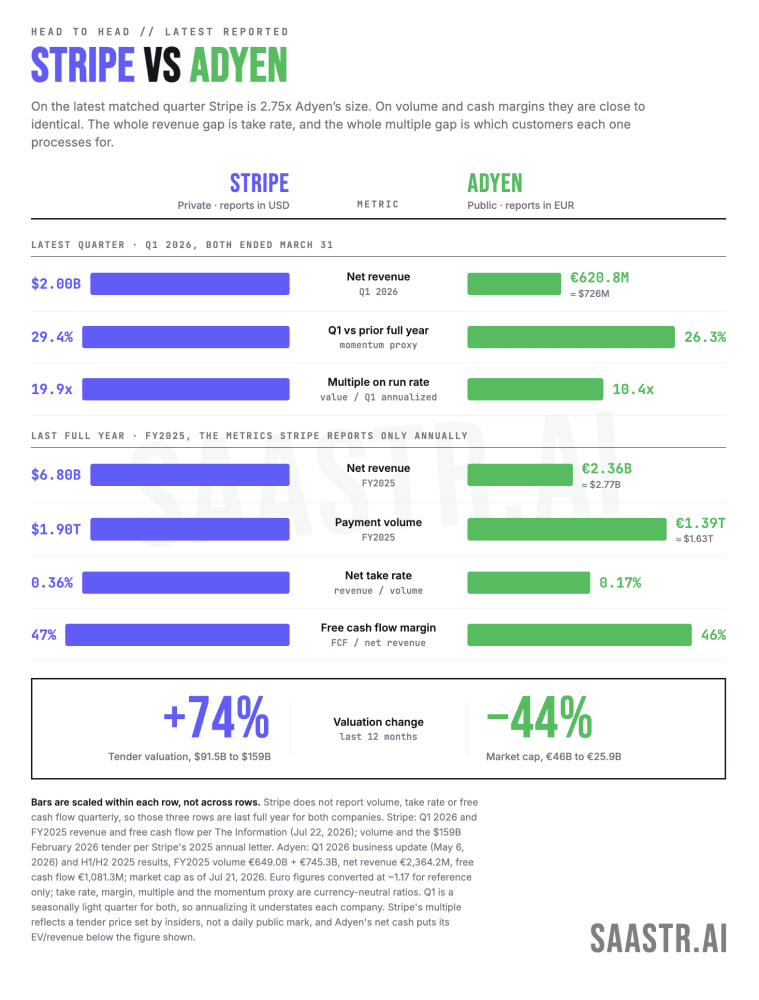
Stripe's 2025 financial results show something unusual for a company at its scale: acceleration. According to The Information, the payments company posted $6.8 billion in revenue last year, up roughly 33% from 2024. Free cash flow hit $3.2 billion, a 47% margin. And Q1 2026 alone delivered $2 billion in revenue. These numbers, combined with Stripe's February annual letter reporting $1.9 trillion in total payment volume and a $159 billion tender valuation, give the clearest picture of Stripe's business anyone outside the company has seen.
The headline that grabbed attention this week: Stripe reportedly bid $53 billion for PayPal. That's what happens when you generate $3.2 billion in annual cash flow. You can make moves that require no one's permission.
Why did Stripe's growth accelerate at this scale?
Most companies decelerate as they grow. The math works against you. Stripe went the other direction: 2025 was its fastest revenue growth year since 2021, on a revenue base more than 4x larger than it was in 2021.
AI is the reason. Stripe processes payments for OpenAI, Anthropic, and the long tail of AI-native companies: Replit, Cursor, Midjourney, Vercel. These businesses are growing faster than anything in software history. Stripe takes a percentage of every transaction. It isn't selling to the AI boom. It's taxing it.
This matters for founders thinking about pricing models. Companies with consumption-linked or revenue-share pricing are re-accelerating right now. The ones on flat per-seat contracts are watching net revenue retention drift toward 100%. Stripe's take-rate model is doing work no sales team could replicate.
What do 47% free cash flow margins mean at 33% growth?
The combination is rare. $3.2 billion of free cash flow on $6.8 billion of revenue is a 47% FCF margin. That's up from roughly 41% in 2024. Free cash flow grew 52% while revenue grew 33%, meaning margins expanded about 6 points in a single year.
Add growth and margin together and you get a Rule of 80 company at $6.8 billion in revenue. The median public B2B company runs a Rule of 30 to Rule of 40. Companies in the 30s are getting punished for it. Stripe is roughly double the best public comps while growing faster than nearly all of them.
The mechanic is straightforward: payments is a fixed-cost infrastructure business with a variable-revenue top line. Volume went up 34%, and the incremental cost of processing that volume was a rounding error relative to the incremental revenue. That's why margins expanded instead of holding flat.
How big is Stripe's non-payments business?
Stripe's Revenue suite, which includes Billing, Invoicing, Tax, and the newly acquired Metronome, is on track for a $1 billion annual run rate in 2026. That's roughly 15% of total revenue coming from software attach rather than payment processing.
This line deserves more attention than it gets. Stripe's net take rate on $1.9 trillion of volume is about 0.36%, and that number faces permanent pressure. Early customers like Shopify, Lyft, and DoorDash grew up, gained leverage, and started negotiating rates down. Some added second processors like Braintree, Adyen, or Worldpay.
So Stripe built and bought a software business on top of payments. It paid a reported $1 billion for Metronome, the usage-based billing infrastructure behind OpenAI, Anthropic, Confluent, and NVIDIA. Billing for AI is hard. What a customer owes changes constantly. Pricing tiers stack. Stripe called usage-based models "the defining feature of the next decade" and paid a billion dollars to say so.
Stripe's software attach strategy shows how payment companies are expanding into adjacent SaaS businesses
Why stay private with these numbers?
Stripe's February tender valued the company at $159 billion, up about 74% from $91.5 billion a year earlier. On $6.8 billion of 2025 revenue, that's roughly 23x. On the Q1 2026 run rate of $8 billion, it's about 20x.
Public B2B companies with similar growth would be lucky to trade at 15x. The private market is giving Stripe a premium that public investors probably wouldn't. And with $3.2 billion in annual free cash flow, Stripe doesn't need public market capital. It can fund acquisitions, including a $53 billion PayPal bid, from operating cash and debt.
Staying private also means Stripe doesn't have to explain quarterly fluctuations to public shareholders. Given the volatility in fintech valuations over the past three years, that's worth something.
The $53 billion PayPal question
The reported PayPal bid is the most surprising detail in this week's news. PayPal is a very different business: consumer-facing, older infrastructure, lower growth. But it has scale Stripe doesn't: 400+ million accounts, a checkout presence on millions of merchant sites, Venmo.
A combined company would control an enormous share of online payments. Whether regulators would allow it is another question. But the fact that Stripe can plausibly make a $53 billion acquisition offer tells you everything about what 47% FCF margins buy.
| Metric | Stripe (2025) | PayPal (TTM est.) |
|---|---|---|
| Revenue | $6.8 billion | ~$30 billion |
| Growth Rate | 33% YoY | ~5% YoY |
| FCF Margin | 47% | ~20% |
| Total Payment Volume | $1.9 trillion | ~$1.5 trillion |
| Private Valuation / Market Cap | $159 billion | ~$65 billion |
Logicity's Take
The real story isn't Stripe's size. It's the margin expansion at scale. Most fintech companies trade take rate for volume as they grow. Stripe found a second revenue line, billing software, that has completely different economics. For SaaS founders, the lesson is structural: if your core pricing model faces compression, build a software attach business with better unit economics before you need it. Metronome competed with Chargebee, Recurly, and billing tools from payment platforms themselves. Stripe paid $1 billion for it. That's the value of owning the usage-based billing layer when AI companies are your customers.
Frequently Asked Questions
What is Stripe's 2025 revenue?
Stripe reported $6.8 billion in 2025 revenue according to The Information, up 33% from approximately $5.1 billion in 2024.
What is Stripe's current valuation?
Stripe's February 2026 tender offer valued the company at $159 billion, up 74% from $91.5 billion a year earlier.
Did Stripe bid for PayPal?
Reports indicate Stripe made a $53 billion acquisition bid for PayPal. The company's $3.2 billion annual free cash flow gives it capacity for large acquisitions without raising external capital.
How much does Stripe make from non-payments products?
Stripe's Revenue suite including Billing, Invoicing, Tax, and Metronome is on track for $1 billion in annual revenue in 2026, roughly 15% of total company revenue.
Why is Stripe growing faster now than in previous years?
AI companies are driving Stripe's growth. The company processes payments for OpenAI, Anthropic, and many AI-native startups, taking a percentage of transactions from the fastest-growing segment in software.
Need Help Implementing This?
If you're building usage-based billing for your SaaS product or evaluating payment infrastructure for AI-driven pricing models, Logicity's consulting team can help you design and implement the right architecture. Reach out at consulting@logicity.in.
Source: SaaStrAI
Manaal Khan
Tech & Innovation Writer
Produced with AI assistance and reviewed by the Logicity editorial team. Learn more in our Editorial Policy.