Key Takeaways
SK Hynix Raises $26.5B in Top Foreign Debut in US | The Asia Trade 7/10/2026
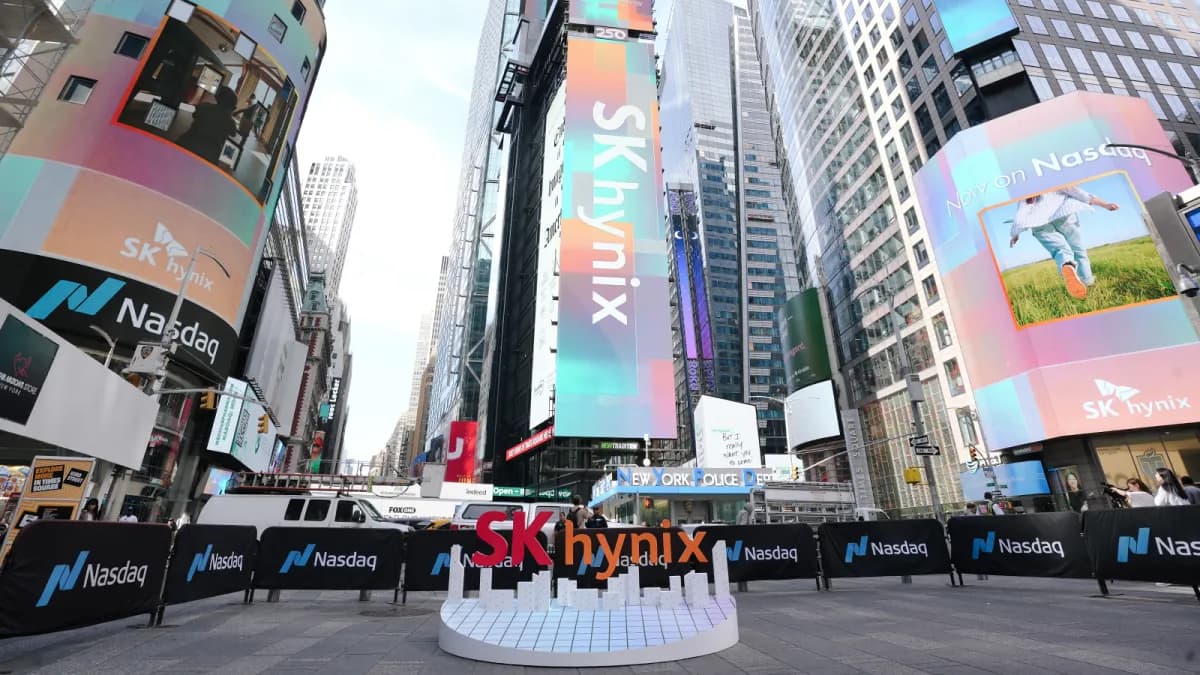
- SK Hynix raised $26.5 billion in its US market debut, surpassing Alibaba's $25B record from 2014
- The stock opened 14% above its $149 IPO price with demand exceeding available shares by 7x
- US Commerce Secretary Howard Lutnick is pushing SK Hynix and Samsung to build new fabs on American soil
SK Hynix just pulled off the largest US IPO by a foreign company in history. The South Korean memory chipmaker raised $26.5 billion on Friday, selling 177.9 million American depositary shares at $149 each. That beats Alibaba's $25 billion debut from 2014. The company trades on Nasdaq under the temporary ticker SKHYV, switching to SKHY when regular trading opens Monday.
Investors didn't blink at the price. SK Hynix set its ADR price at a 2.7% premium to its three-day average on the Korea Stock Exchange. Demand still exceeded supply by more than seven times. The stock opened 14% above IPO price and kept climbing in early Friday trading.
Why is SK Hynix defying the Korea Discount?
Korean companies have historically traded at lower valuations than global peers. Analysts call it the Korea Discount, pointing to complex corporate governance, low shareholder returns, regulatory uncertainty, and North Korea risk. SK Hynix is shrugging that off.
The reason is three letters: HBM. High-bandwidth memory is the bottleneck component in AI GPUs. Nvidia relies on SK Hynix as a primary supplier. When your product is the limiting factor in the AI infrastructure buildout, investors stop worrying about geopolitics.
Where the $26.5 billion goes
According to SK Hynix's filing, the capital splits three ways. First, a new fab in South Korea already under construction to address the worldwide AI-driven memory shortage. Second, a packaging facility in the same country. Third, EUV scanners, the lithography machines that make next-generation chips possible.
Notice what's missing: no US manufacturing. At least not yet.
Lutnick's message to Korean chipmakers
US Commerce Secretary Howard Lutnick showed up at a Micron event Thursday with a pointed message for the memory industry. He's already talking to Samsung and SK Hynix about building factories in the United States. The goal is obvious: stop letting South Korea dominate memory production the way Taiwan dominates logic chips.
Micron, the American memory maker competing directly with SK Hynix and Samsung, announced plans to invest $250 billion in new US manufacturing. The company claims that commitment will create more than 90,000 jobs.
The timing makes Lutnick's request awkward. Both SK Hynix and Samsung just pledged over $550 billion combined for new manufacturing in South Korea. Redirecting that investment to US soil would require significant incentives, and likely a shift in CHIPS Act priorities toward memory rather than logic chips.
The competitive landscape
Memory chips are a three-player market. Samsung leads in DRAM, SK Hynix sits second, Micron third. In HBM specifically, SK Hynix has technical advantages that have made it Nvidia's preferred supplier. Samsung has struggled with yields on its competing HBM products.
For startups building AI applications, this matters. Memory availability and pricing directly affect the cost of inference infrastructure. If you're planning hardware purchases or cloud capacity for the next 18 months, the SK Hynix CEO's prediction of a severe memory shortage in 2027 should inform your roadmap.
Logicity's Take
This IPO tells us where the AI hardware value chain is shifting. For the past three years, Nvidia captured most of the margin. Now memory is becoming the constraint, and SK Hynix's valuation reflects that. Founders building AI products should watch memory pricing closely. If the 2027 shortage materializes, cloud compute costs will spike regardless of what GPU prices do. The founders who locked in long-term cloud contracts or built efficient inference architectures will have a cost advantage over those who assumed prices only go down.
What this means for US chip policy
The CHIPS Act focused heavily on logic chip manufacturing. Intel, TSMC, and Samsung have all announced US fab projects for processors. Memory got less attention. Lutnick's comments suggest the administration now sees that as a gap.
Building memory fabs in the US faces different economics than logic fabs. Memory is more commoditized, margins are thinner, and Korean companies already operate at massive scale. Convincing SK Hynix to build here when they just raised $26.5 billion for Korean facilities will require either very large subsidies or policy measures that make Korean production less attractive.
Frequently Asked Questions
How much did SK Hynix raise in its US IPO?
SK Hynix raised $26.5 billion (KRW 40 trillion) by selling 177.9 million American depositary shares at $149 each.
What is the Korea Discount?
The Korea Discount refers to the tendency of Korean companies to trade at lower valuations than global peers due to complex governance structures, low shareholder returns, regulatory uncertainty, and North Korea-related geopolitical risk.
Why is SK Hynix valuable to AI companies?
SK Hynix manufactures high-bandwidth memory (HBM), a critical component in AI GPUs. Nvidia relies on SK Hynix as a primary HBM supplier.
What will SK Hynix do with the IPO proceeds?
The company plans to invest in a new South Korean fab, a packaging facility, and EUV lithography scanners for next-generation chip production.
Is SK Hynix building US factories?
Not currently announced. US Commerce Secretary Howard Lutnick is reportedly in talks with SK Hynix about future US manufacturing, but the IPO proceeds are earmarked for South Korean facilities.
Context on the supply constraints driving SK Hynix's expansion plans
Related coverage of global tech investment trends
Need Help Implementing This?
Building AI infrastructure and need help planning around hardware constraints? Logicity covers the supply chain dynamics that affect your compute costs. Subscribe for weekly analysis of the technologies shaping startup economics.
Source: Enterprise News | TechCrunch / Kate Park
Huma Shazia
Senior AI & Tech Writer
Produced with AI assistance and reviewed by the Logicity editorial team. Learn more in our Editorial Policy.