Key Takeaways
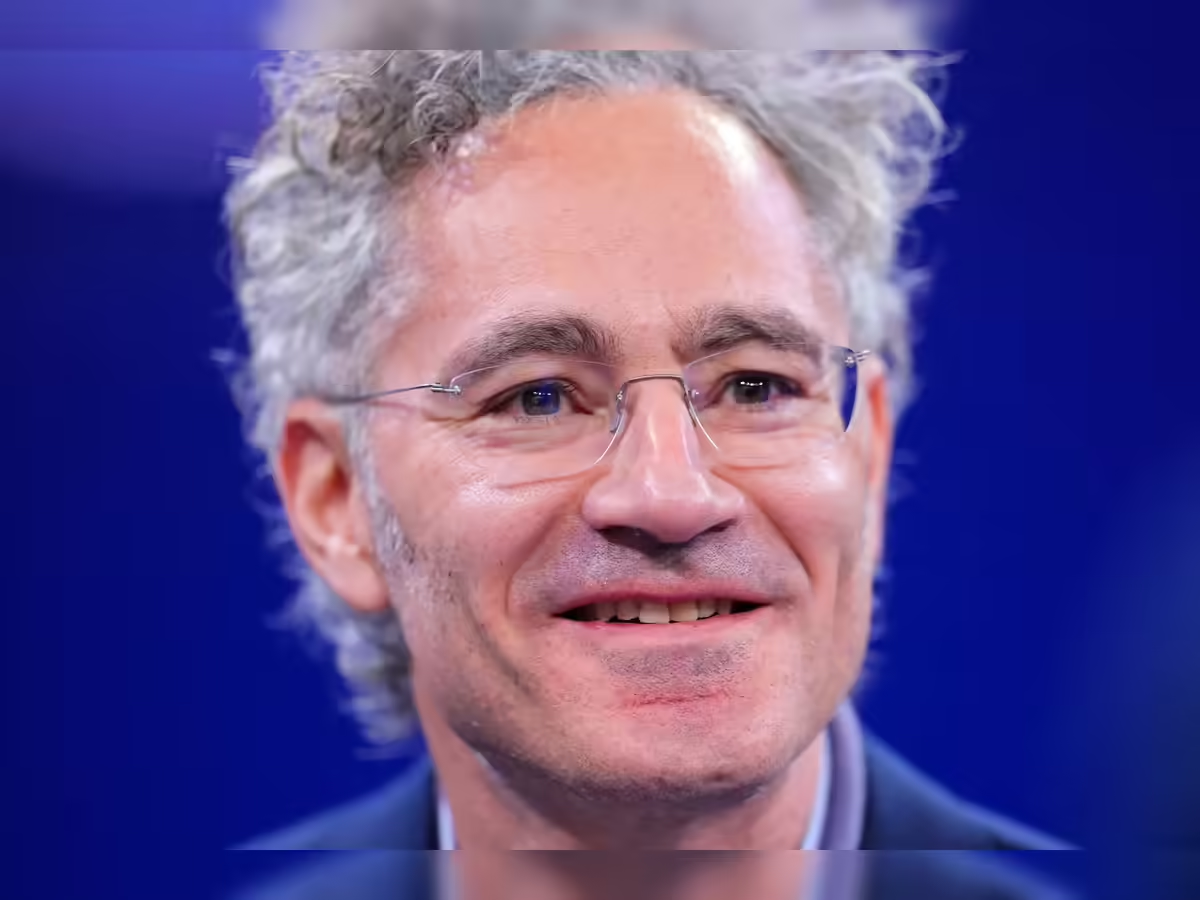
- Alex Karp argued that token-based AI pricing incentivizes consumption over business outcomes
- Palantir positions itself as selling 'outcomes, not tokens' through its Nvidia partnership for sovereign AI
- The comments sparked debate about enterprise AI ROI measurement and vendor lock-in risks
Palantir CEO Alex Karp used a July 1 CNBC Squawk Box appearance to attack the token-based pricing models used by OpenAI and Anthropic, declaring that "something has gone completely wrong" in enterprise AI. His nearly 20-minute segment, which some observers called a 'televised nervous breakdown,' argued that companies are burning through AI budgets without asking what they're actually getting in return.
What is tokenmaxxing and why does Karp hate it?
The term "tokenmaxxing" blends AI jargon with internet fitness culture. Tokens are the small units of text that large language models process. OpenAI, Anthropic, and similar providers charge enterprises per token consumed. Karp's critique: this model rewards usage volume, not business results.
“Companies are stuck in a 'chillax and waste my time with tokens' mindset instead of asking what they're actually getting for their expenditure.”
— Alex Karp, CEO of Palantir Technologies
The pricing math matters. OpenAI reportedly generates $6.6 billion in annualized revenue, much of it from token fees. GPT-4 Turbo charges $10 per million input tokens and $30 per million output tokens. Enterprise customers running AI across thousands of employees can rack up six-figure monthly bills without clear metrics on whether those tokens produced anything useful.
Palantir's alternative pitch
Karp used the interview to promote Palantir's Nvidia partnership for "sovereign" AI environments. The model lets firms control their own data, models, and outputs instead of relying on external APIs. Palantir positions this as selling outcomes, not tokens.
The company's $2.87 billion in 2024 revenue comes largely from deploying AI for specific operational results: military logistics, fraud detection, supply chain optimization. Palantir charges for the deployment and the platform, not per API call. Whether this model scales better depends on the use case. A legal team summarizing contracts might prefer pay-per-token flexibility. A manufacturer optimizing a production line probably wants fixed-cost outcomes.
Social media response: praise and pushback
Marc Andreessen shared the video on X with a two-word endorsement: "Self recommending." Other investors praised Karp for exposing AI hype.
But the segment also drew criticism. Some commenters pointed to Palantir's defense contracts and Karp's public pro-Israel stance as reasons to distrust his framing. Others noted the obvious self-interest: Palantir competes with OpenAI and Anthropic for enterprise budgets. Of course he wants to reframe the conversation around outcomes where Palantir claims an advantage.
The real question: how should enterprises measure AI ROI?
Karp's critique lands because many enterprises genuinely don't know what they're getting from AI spending. A 2024 Gartner survey found that 54% of AI pilots never reach production. Token consumption is easy to track. Business impact is harder.
Token pricing has one advantage: transparency. You can audit exactly what you're paying for. Outcome-based pricing requires trusting the vendor's definition of an "outcome." Palantir's model may work for defense contracts with clear mission parameters. It's less obvious how you'd price outcomes for a marketing team experimenting with content generation.
The enterprise AI market, estimated at over $150 billion by 2025, probably needs both models. Some workloads suit metered APIs. Others need embedded solutions with fixed pricing. Karp's contribution was forcing the conversation about which is which.
Logicity's Take
Karp raises a valid point buried under self-promotion. Token pricing does obscure ROI, but outcome-based pricing creates vendor lock-in and opacity about what you're actually buying. The winning approach for most enterprises is hybrid: use token-based APIs for experimentation and well-defined tasks, then build or buy outcome-focused solutions for production workloads where you can define clear success metrics. Don't let any vendor, whether OpenAI or Palantir, define your AI strategy around their billing model.
Frequently Asked Questions
What is tokenmaxxing in AI?
Tokenmaxxing refers to the tendency of enterprises to consume large volumes of AI tokens without measuring whether that usage produces business value. Alex Karp coined the term to criticize pay-per-token pricing models.
How do OpenAI and Anthropic charge for AI usage?
Both companies charge by tokens, small units of text processed by their models. GPT-4 Turbo charges $10 per million input tokens and $30 per million output tokens. Anthropic's Claude has similar per-token pricing tiers.
What is Palantir's alternative to token pricing?
Palantir charges for platform deployments and outcomes rather than per-API-call usage. Its Nvidia partnership enables 'sovereign' AI environments where enterprises control their own models and data.
Why did Alex Karp's CNBC appearance go viral?
The nearly 20-minute segment featured unusually blunt criticism of competitors and passionate delivery that some described as a 'televised nervous breakdown.' Investor Marc Andreessen amplified it by sharing the clip with an endorsement.
Need Help Implementing This?
Evaluating AI pricing models for your enterprise? Logicity can help you map workloads to the right pricing structure, whether token-based, outcome-based, or self-hosted. Contact our team for a consultation.
Source: Tech-Economic Times / ET
Manaal Khan
Tech & Innovation Writer
Produced with AI assistance and reviewed by the Logicity editorial team. Learn more in our Editorial Policy.




