Key Takeaways

- Ode with Anthropic combines Anthropic's Claude models with forward-deployed engineers embedded directly in enterprise clients
- The joint venture is backed by Blackstone, Goldman Sachs, and Hellman & Friedman, signaling both investment and potential customer interest
- The model bets that small AI-native engineering teams can outperform large consulting armies on enterprise AI deployments
Anthropic has launched Ode with Anthropic, a joint venture that embeds AI engineers directly inside enterprise clients rather than selling them software licenses. The venture acquired Fractional AI earlier this year and counts Blackstone, Goldman Sachs, and Hellman & Friedman among its backers. The bet: a handful of AI-native engineers can deliver more production AI than an army of traditional consultants.
What is Ode with Anthropic actually doing?
Ode deploys what it calls forward-deployed engineers. These aren't consultants who hand over a deck and leave. They're embedded technical staff who build custom AI solutions using Anthropic's Claude models inside client organizations. The model borrows heavily from Palantir's playbook, which proved that high-touch engineering services can scale into a multi-billion dollar business.
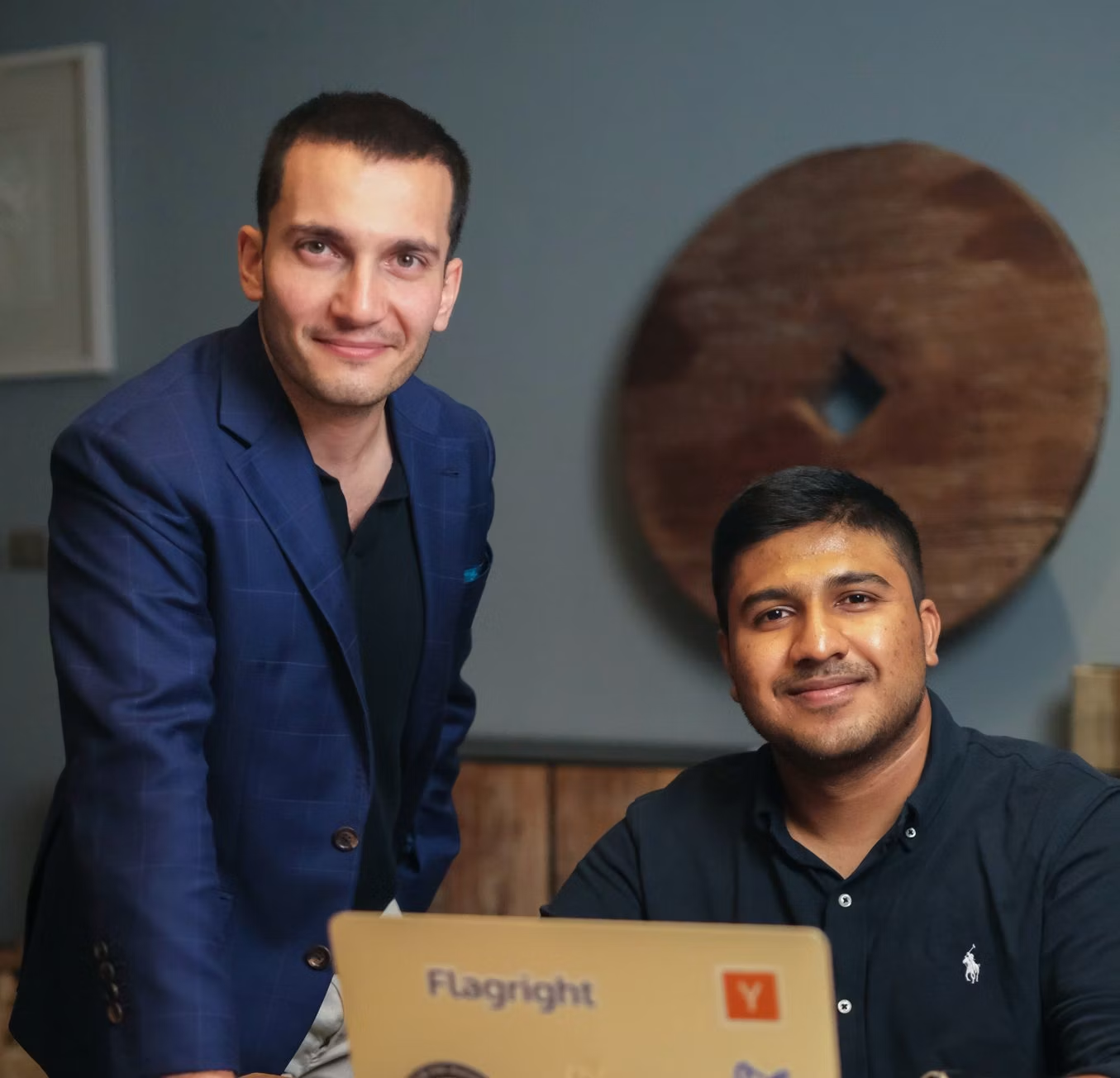
Chris Taylor and Eddie Siegel, who founded Fractional AI before the acquisition, now lead the venture. In a recent TechCrunch Equity podcast, they argued that most enterprise AI pilots fail to reach production because companies lack the in-house talent to move from proof-of-concept to deployment. Ode fills that gap.
Why financial heavyweights are backing this
The investor list tells a story. Blackstone, Goldman Sachs, and Hellman & Friedman aren't typical early-stage tech investors. They're financial institutions that themselves spend billions on technology services. Their involvement suggests they may become customers as much as investors, using Ode to transform their own operations with AI.
This dual role creates a powerful flywheel. The investors have direct insight into what works at enterprise scale. Ode gets reference customers with deep pockets and complex problems. The risk? The venture could end up too focused on financial services while other industries go elsewhere.
The case against traditional AI consulting
Traditional consulting firms like McKinsey, Accenture, and Deloitte have rushed into AI services. But Taylor and Siegel argue these firms have a structural disadvantage: their business model depends on billable hours from large teams. An AI-native approach that automates significant portions of the work threatens that model.
Ode's pitch is that a small team of engineers using Claude can ship production AI faster than a 50-person consulting engagement. If true, the economics flip. Clients pay less. Engineers earn more. Consultants scramble to compete.
The open question is whether this scales. Palantir struggled for years to move beyond a handful of government and enterprise clients because forward-deployed engineers don't replicate like software. Ode will face the same constraint unless Claude itself handles more of the work over time.
Why this matters for startup founders
If AI-native services become a dominant category, founders building enterprise software face a choice. Do you sell self-serve tools, or do you embed with customers? The SaaS playbook assumes low-touch distribution. Ode's bet assumes that for complex AI deployments, high-touch wins.
Founders targeting enterprise buyers should watch Ode closely. If the model works, you'll see more AI companies staffing up services teams. If it struggles to scale, the SaaS-first approach remains the default. Either way, enterprise buyers now have a third option beyond building in-house or hiring legacy consultants.
Logicity's Take
Ode with Anthropic is testing whether AI services can be venture-scale businesses, not just lifestyle consultancies. For founders, the real signal isn't the launch itself but who the first customers are. If Blackstone and Goldman deploy Ode internally and expand the engagement, other enterprises will follow. Watch for case studies within 12 months. Competitors like Palantir AIP ($2B+ annual revenue), and newer entrants building on OpenAI or Google models, will respond. The winners will be whoever proves fastest time-to-production, not whoever has the best demo.
The risk nobody's talking about
Ode depends on Anthropic's models staying competitive. Claude is excellent today, but OpenAI, Google, and open-source alternatives are closing gaps fast. If a client's preferred model shifts, does Ode adapt or does the relationship fray? The joint venture structure with Anthropic creates alignment but also lock-in. Competitors offering model-agnostic services could pick off clients who want flexibility.
The enterprise AI services market could hit $500 billion by 2027 according to various analyst estimates. Ode is positioning for a slice of that, but the market is fragmented and fast-moving. First-mover advantage matters less than execution.
Frequently Asked Questions
What is Ode with Anthropic?
Ode with Anthropic is a joint venture that embeds AI engineers inside enterprise clients to build custom solutions using Anthropic's Claude models. It acquired Fractional AI to serve as its core team.
Who are the investors behind Ode with Anthropic?
Blackstone, Goldman Sachs, Hellman & Friedman, and Anthropic itself back the venture. These financial institutions may also become customers.
How does Ode differ from traditional AI consulting?
Ode uses small teams of AI-native engineers rather than large consulting armies. The model bets that embedded engineers using advanced AI tools can ship production systems faster and cheaper.
Why do most enterprise AI pilots fail?
According to Ode's founders, most pilots fail because companies lack the in-house talent to move from proof-of-concept to production deployment. Forward-deployed engineers fill that gap.
Another example of AI companies building specialized tools on top of foundation models
Need Help Implementing This?
If you're a founder evaluating enterprise AI services or building your own AI-powered product, Logicity covers the tools, trends, and playbooks that matter. Subscribe for weekly insights on what's actually working in AI deployment.
Source: Startups | TechCrunch
Huma Shazia
Senior AI & Tech Writer
Produced with AI assistance and reviewed by the Logicity editorial team. Learn more in our Editorial Policy.