Key Takeaways
- AI companies are abandoning per-seat pricing, but their billing stacks can't keep up with consumption and outcome-based models
- Nue consolidates CPQ, billing, usage metering, and revenue recognition into one platform built for hybrid pricing
- Pricing changes become configuration, not multi-quarter engineering projects
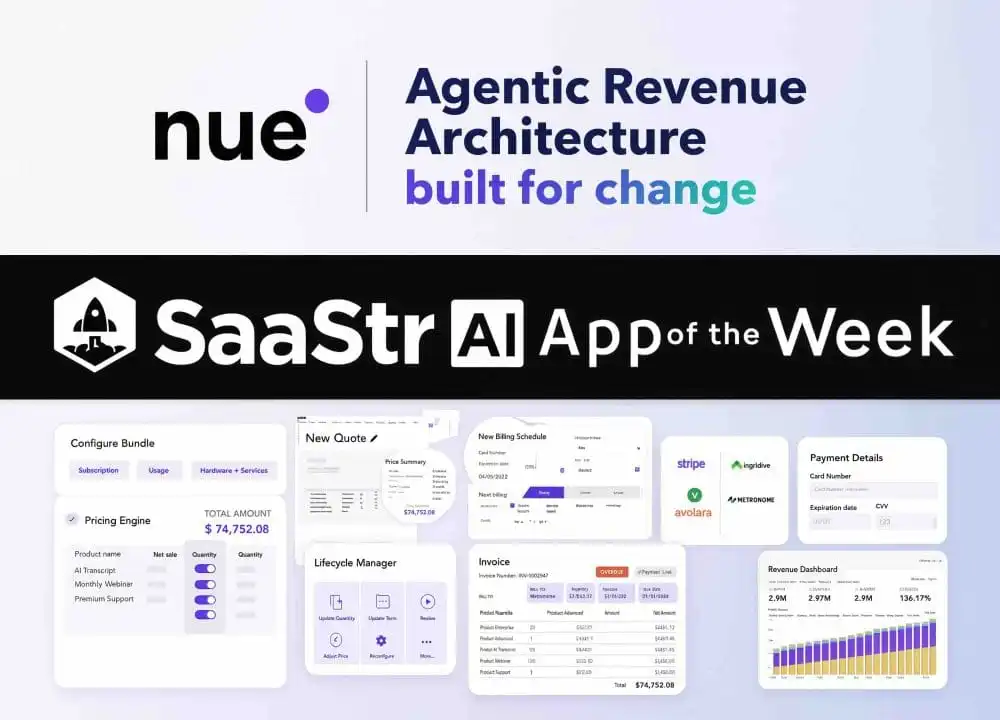
SaaStr named Nue its AI App of the Week, spotlighting a revenue platform purpose-built for the pricing chaos AI companies face. The core problem: per-seat subscriptions make no sense when your user is an AI agent, but the quote-to-revenue stack most companies run was designed for exactly that model.
"The hardest problem in B2B + AI right now is not building the product. It's pricing it," wrote Jason Lemkin, SaaStr's founder. He's right. Every AI startup is walking away from per-seat toward consumption, credits, and outcome-based models. The tooling they inherited assumes you set pricing once and leave it alone for years.
Why the current revenue stack breaks
Most B2B companies run a fragmented setup: CPQ in one system, billing in another, usage metering duct-taped from a third vendor, and revenue recognition locked in a finance silo. Each tool has its own data model. They don't agree on numbers.
When a founder wants to test a new pricing model, say per-agent, per-outcome, or a credit pack, they touch all of it. Sales can't cleanly quote a hybrid deal. Billing can't invoice without manual fixes. Finance can't recognize revenue without a spreadsheet. Nobody has a clean read on which pricing model actually drives revenue because the data lives in four places.
For companies iterating pricing every quarter, and in AI that's now most of them, this stack is the bottleneck. The pricing idea takes an afternoon. Shipping it through the systems takes a quarter.
What Nue does differently
Nue's bet is that the individual slices were never the problem. The seams between them were. The platform unifies CPQ, billing, usage metering, and revenue recognition on a single data model. When quoting, billing, and usage share one source of truth, the manual reconciliation that eats RevOps and finance disappears.
The architecture matters here. Legacy systems like Salesforce CPQ or Zuora are subscription engines with usage bolted on as an afterthought. That's why usage billing in them is painful. Nue was built usage-first and hybrid-first, so consumption, credits, and outcome-based models aren't edge cases. They're the default.
Disclosure
Some links in this post are affiliate links — Logicity earns a commission if you sign up, at no extra cost to you. We only link products we have used or actively recommend.
Pricing changes become configuration, not code. Launching or modifying a pricing model takes days, not quarters. That's what lets a company actually run pricing experiments instead of just talking about them.
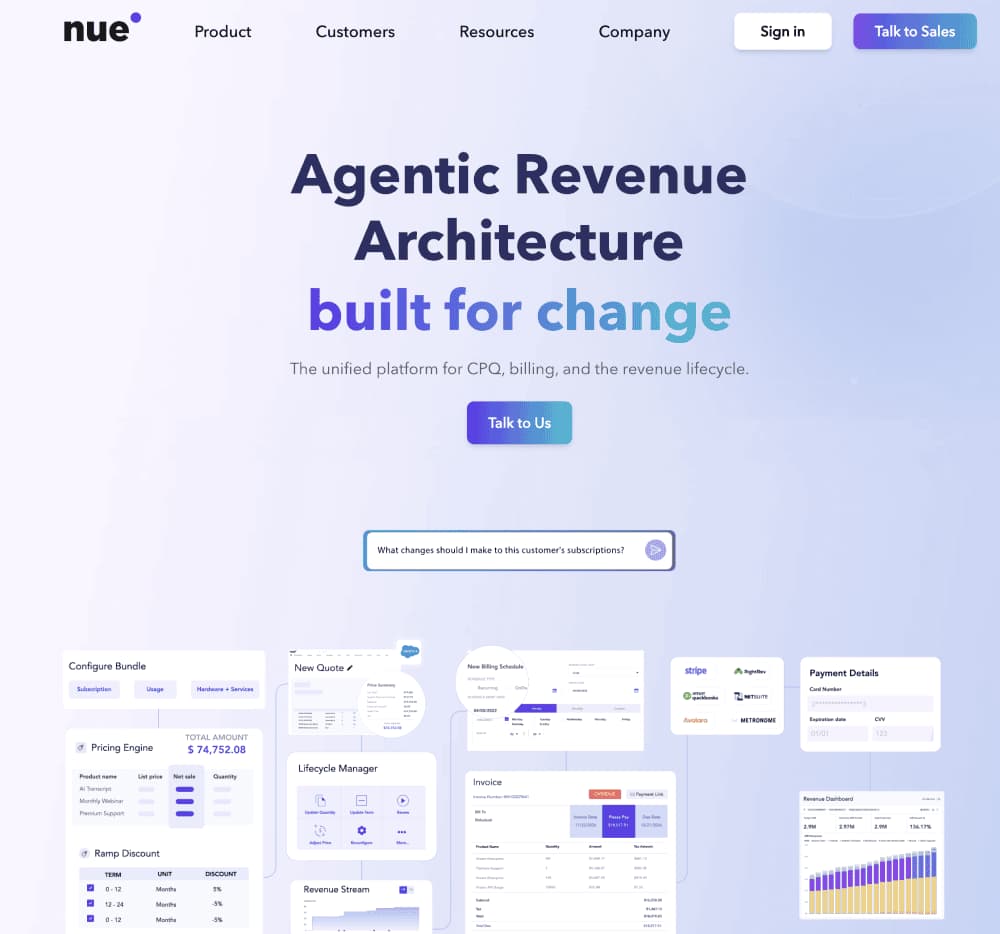
Nue sits native to the Salesforce data model, so RevOps teams aren't rebuilding their world to adopt it. But it doesn't force you into a single ecosystem either. For companies already running HubSpot or Pipedrive for sales, the integration story matters less than the billing flexibility.
Why this matters for AI companies specifically
Per-seat pricing assumed a human at a keyboard. AI agents break that assumption. If your software does the work a person used to do, charging per person is charging for the wrong thing. Your customers will eventually notice the math.
The market is converging on consumption and outcome-based pricing, where you charge for what the software actually does or produces. The catch: this is operationally hard. You have to meter accurately, quote it in a way sales can sell, bill it in a way customers accept, and recognize it in a way finance and auditors sign off on.
That operational load is exactly why so many AI companies stick with per-seat even when it doesn't fit. The pricing idea isn't the blocker. The systems are.
The competitive landscape
Nue competes in a market with established players. Zuora dominates subscription billing for enterprises. Chargebee targets mid-market SaaS. Salesforce CPQ owns the quoting layer for Salesforce-native companies. Each solves a slice well.
Nue's pitch is that AI companies don't need better slices. They need one platform that handles the full motion, from quote to invoice to revenue recognition, without the seams. The company was founded by Chris Saboredo, a former Zuora executive who saw the gaps firsthand.
Logicity's Take
Nue is solving a real pain point, but the timing matters more than the product. Two years ago, usage-based billing was a nice-to-have. Now, with AI agents replacing per-seat logic, it's table stakes. The question isn't whether Nue's approach is right. It's whether they can capture the market before Zuora and Chargebee retrofit their platforms. For founders evaluating this, the decision hinges on how often you expect to change pricing. If the answer is 'quarterly,' legacy tools will slow you down. If you're set on a model for years, the switching cost may not be worth it.
What this signals for SaaS pricing broadly
The SaaStr pick reflects a broader shift. Pricing flexibility is becoming infrastructure, not strategy. Companies that treat pricing as a configurable layer will iterate faster than those who treat it as a locked decision.
For SaaS founders watching this space, the takeaway is less about Nue specifically and more about the direction. If your billing stack can't handle a pricing change in under a week, you're already behind the companies that can.
Frequently Asked Questions
What is Nue and what does it do?
Nue is a revenue platform that unifies CPQ, billing, usage metering, and revenue recognition on a single data model. It's designed for B2B and AI companies that need to change pricing models quickly without multi-quarter engineering projects.
How is Nue different from Salesforce CPQ or Zuora?
Salesforce CPQ handles quoting; Zuora handles subscription billing. Both were built for per-seat models with usage added later. Nue was architected usage-first and handles the full quote-to-revenue motion in one platform.
Why are AI companies moving away from per-seat pricing?
When the 'user' is an AI agent rather than a human, per-seat pricing doesn't reflect value delivered. AI companies are shifting to consumption, credits, and outcome-based models that charge for what the software actually does.
Does Nue work with Salesforce?
Yes. Nue is native to the Salesforce data model, so RevOps teams already in that ecosystem don't need to rebuild their workflows. It also works standalone for companies using other CRMs.
How long does it take to implement a new pricing model with Nue?
Nue claims pricing changes are configuration, not code, allowing companies to launch or modify pricing models in days rather than quarters.
Another look at how AI is forcing operational changes in unexpected places
Need Help Implementing This?
If you're evaluating revenue platforms or rethinking your pricing model, reach out to our consulting partners at Logicity. We help SaaS founders navigate the quote-to-revenue stack without the quarter-long implementation cycles.
Source: SaaStrAI
Huma Shazia
Senior AI & Tech Writer
Produced with AI assistance and reviewed by the Logicity editorial team. Learn more in our Editorial Policy.