Key Takeaways

- Neko Health raised $700M Series C co-led by Lightspeed Venture Partners and G.W. Barker Portfolio
- The company reports 100,000 members and profitability at the clinic level
- Expansion targets include the US, Germany, and UK markets in the near term
Neko Health, the Swedish preventive healthcare company co-founded by Spotify's Daniel Ek, has closed a $700 million Series C at a $4.6 billion valuation. The company says it now has 100,000 members and is profitable at the clinic level, a rare claim for a healthtech startup burning through expansion capital.
The round was co-led by Lightspeed Venture Partners and G.W. Barker Portfolio. Existing investors Atomico, General Atlantic, and Lakestar also participated, alongside new backers Baillie Gifford, Founders Fund, Coatue, and KKR & Co.
How did Neko reach clinic-level profitability?
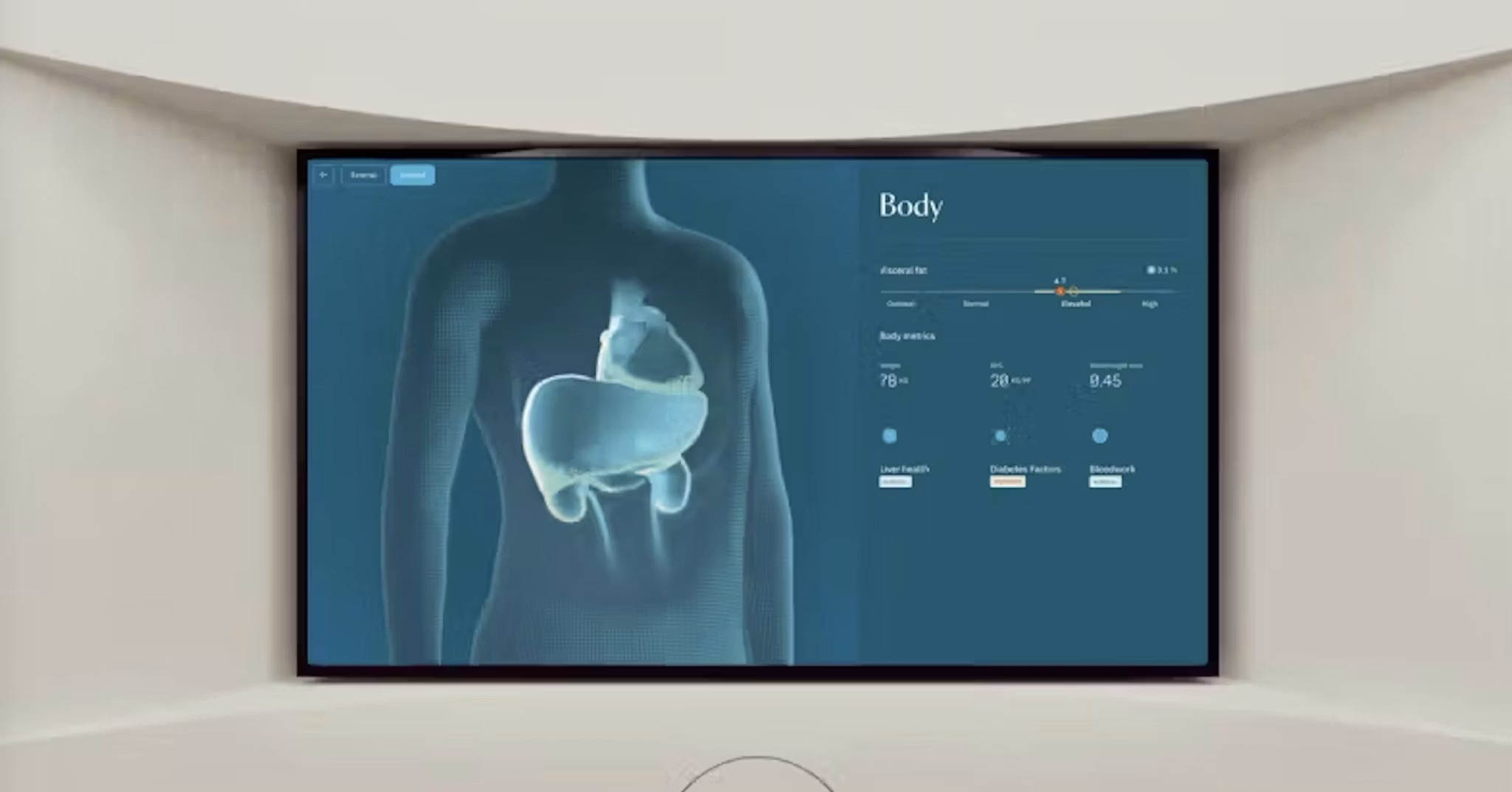
Neko operates high-tech clinics that perform full-body scans using AI-powered imaging, bloodwork, and other diagnostics. Each visit takes roughly 15 minutes and checks around 50 health markers. The model bets on catching problems early, before they become expensive to treat.
Revenue jumped from SEK 43.6 million (€3.9 million) in 2023 to SEK 123.4 million (€11.0 million) last year. Operating losses also grew, from SEK 231 million (€21 million) to SEK 536 million (€48 million), but CEO Hjalmar Nilsonne frames this as deliberate investment in expansion infrastructure.
"Individually, each clinic gets better and better as we gain more data and improve our technology," Nilsonne told Sifted. "We want to be an amazing alternative for consumers and insurers, and we're also working on getting reimbursed in the EU and beyond."
What's the expansion plan?
Neko has clinics in the UK, Sweden, and Germany. It opened a location in New York in the past year. The US remains the priority market.
"The US is going to be important," Nilsonne said. "But we are not in any way, in any case, going to build a bunch of really self-standing independent clinics that aren't comparable to a clinic or market you're doing now or before, you're going to do this in a direct share basis you're in."
Last year, the UK became Neko's most active clinic with revenue reaching SEK 54.6 million (€5 million), compared with SEK 78 million (€7.0 million) in peak months in Sweden. Management expects this year to bring stronger growth as new clinics mature.
The 100,000 member milestone
Reaching 100,000 paying members matters because preventive health startups typically struggle with retention. Customers sign up for a scan, get results, then churn. Neko's model depends on repeat visits. Annual check-ups. Ongoing monitoring.
The company charges £290 (€350) per scan in the UK and SEK 2,495 (€224) in Sweden. At those price points, the economics work only if customers see enough value to return.
"For now we are focused on doing this right rather than fast, to have a strong proof of concept everywhere," Nilsonne said. "The most important thing is that we have the best technology in a sub-market space that works [...] we have now at one level achieved unprecedented profitability."
Who's competing in preventive health?
Neko isn't alone. Forward, the US primary care startup backed by Khosla Ventures, shut down earlier this year after burning through $300 million. Prenetics acquired CircleDNA. Grail, owned by Illumina, focuses on early cancer detection through blood tests.
What distinguishes Neko is the full-body hardware approach. Most competitors rely on bloodwork alone. Neko combines imaging, AI analysis, and clinical diagnostics in a single visit.
"In every country you see this, what we call the shift from sickcare to healthcare, where people actually want their health trajectory to be proactive," Nilsonne said, "we have a much better cost structure than others on a per-market basis."
Logicity's Take
Neko's claim of clinic-level profitability deserves scrutiny. The company's operating losses more than doubled last year even as revenue tripled, which suggests headquarters costs are absorbing the gains. Still, the $700M raise at $4.6B signals serious investor confidence in the unit economics. For founders watching this space: the real test comes when Neko tries to replicate Swedish retention rates in the US, where consumer healthcare spending is fragmented across employer plans, HSAs, and out-of-pocket budgets. If they crack that, the model exports. If not, this becomes another cautionary tale about European healthtech scaling stateside.
What does a $4.6B valuation imply?
At $4.6 billion, Neko is valued at roughly 37x trailing revenue. That's aggressive for healthtech, where public comparables like Teladoc trade at 1-2x sales. The valuation assumes Neko can scale rapidly and maintain margins as it enters new markets.
The investor roster suggests some believe that's possible. Founders Fund typically backs companies with monopoly potential. Baillie Gifford has a track record with Spotify itself. Coatue has been aggressive in growth-stage healthtech.
Whether the bet pays off depends on execution. Neko needs to prove it can open clinics profitably outside Scandinavia, retain members across multiple years, and eventually win reimbursement from insurers and national health systems.
Frequently Asked Questions
How much did Neko Health raise in Series C?
Neko Health raised $700 million in its Series C round, valuing the company at $4.6 billion. The round was co-led by Lightspeed Venture Partners and G.W. Barker Portfolio.
Is Neko Health profitable?
Neko claims profitability at the clinic level, meaning individual locations generate more revenue than their direct costs. However, the company's overall operating losses grew from SEK 231 million to SEK 536 million last year due to expansion investments.
How many members does Neko Health have?
Neko Health reports 100,000 members across its clinics in the UK, Sweden, Germany, and the US.
Who founded Neko Health?
Neko Health was co-founded by Hjalmar Nilsonne (CEO) and Daniel Ek, the co-founder and CEO of Spotify.
How much does a Neko Health scan cost?
Pricing varies by market: £290 (€350) per scan in the UK and SEK 2,495 (€224) in Sweden.
Another aggressive Series valuation in a fast-moving technology sector
Need Help Implementing This?
Building a healthtech startup or scaling operations across markets? Logicity covers funding rounds, expansion strategies, and operational playbooks for founders. Subscribe to our newsletter for weekly insights on what's working in tech.
Source: Sifted
Huma Shazia
Senior AI & Tech Writer
Produced with AI assistance and reviewed by the Logicity editorial team. Learn more in our Editorial Policy.