Key Takeaways
- Microagi raised $55M in Germany's largest-ever seed round, led by Hummingbird with participation from Northzone, LocalGlobe, Village Global, and Redalpine
- The startup sends camera-equipped humans into factories and homes to collect training data for humanoid robots
- CEO Bercan Kilic predicts humanoid robots will perform 10 routine tasks autonomously within a year
Munich-based Microagi has closed a $55 million seed round, the largest in German startup history. The company, founded just 10 months ago by former Formula 1 engineers, collects factory and household data to train the next generation of humanoid robots. Hummingbird led the round, with Northzone, LocalGlobe, Village Global, and Redalpine joining.
CEO Bercan Kilic, formerly of Red Bull Racing, isn't celebrating. Asked about the milestone, he told Sifted: "It's one-billionth of what Europe needs."
Why Kilic thinks European manufacturing is in trouble
Kilic frames the investment against a stark backdrop. He argues Europe's manufacturing industry will crumble without massive investment in robot automation. The company's website makes the point visually: a humanoid pushing a boulder up a mountain, a nod to Sisyphus and the scale of the task ahead.
"In the last 60 years, we've offshored a lot to the east, so there are many skills we never mastered in Europe," Kilic said. "We've fallen behind in our ability to do things in-house, and we've lost price-competitiveness."
The argument has weight. European manufacturing faces labor shortages, rising costs, and competition from Asia. Robots that can work alongside humans, or replace them for routine tasks, offer one path forward. But building those robots requires something the industry still lacks: enough training data.
How Microagi collects training data
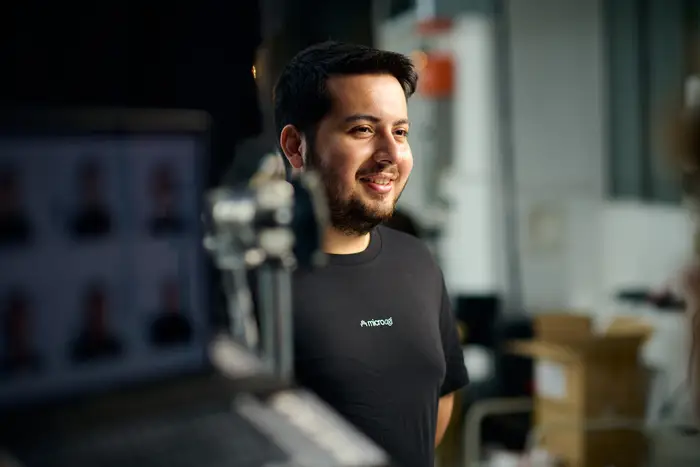
Microagi's approach is hands-on. The company sends humans wearing head-mounted cameras into factories and to people's homes. These workers perform tasks like sorting items and cleaning dishes while the cameras capture everything. The footage becomes training data for robot AI models.
CTO Nico Nussbaum explained the process: "We put our engineers on site with each customer, and the system learns from their real operations and feeds that back into the next run. So every month we're there they pull a little further ahead of their competitors."
This creates a feedback loop. The more data Microagi collects from a client's operations, the better its models become at those specific tasks. Clients who start early accumulate advantages that compound over time.
The global race for robot training data
Nobody knows exactly how much data you need to train a competent humanoid robot. But startups are betting the answer is "a lot," and investors are responding. Billions of euros are flowing into companies working on the problem.
Kilic sees a geographic split in the industry. Training models, he says, are more advanced in the Western world, while China leads on robot hardware. This creates opportunities for companies like Microagi to specialize in the software and data side while potentially partnering with or competing against Asian hardware manufacturers.
At Machina, the robotics conference held in Paris last week, opinions varied wildly on timelines. One investor predicted it would take 10 years before a robot can iron a shirt without human help. Kilic is more optimistic. He expects a humanoid to handle roughly 10 routine tasks autonomously within a year.
"A robot that is able to do something more complex, like plumbing, will take a lot longer," he added.
What the investor lineup signals
The round's participants read like a who's who of European and US venture capital. Hummingbird, the lead investor, is a London-based firm known for early-stage European tech bets. Northzone backed Spotify early. LocalGlobe is a prominent London seed fund. Village Global counts Jeff Bezos and Bill Gates among its backers. Redalpine brings Swiss early-stage expertise.
This investor mix suggests confidence that Microagi's data-collection approach can scale. It also reflects broader VC enthusiasm for robotics as a category. The question is whether Microagi can convert investor confidence into market position before competitors catch up.
The Formula 1 engineering connection
Microagi's founding team came from Formula 1, where precision engineering and rapid iteration are table stakes. Kilic worked at Red Bull Racing, where margins are measured in milliseconds and small improvements compound into race wins.
That background may explain the company's speed. Raising $55 million just 10 months after founding is unusual, even by startup standards. It suggests a team that knows how to move fast, communicate a vision, and attract capital.
Logicity's Take
Microagi's $55M seed round is impressive, but the more interesting question is whether its data-collection model creates defensible moats. Sending camera-wearing engineers into factories is labor-intensive and expensive. That's a barrier to entry, but also a scaling challenge. Competitors like Covariant, Figure, and 1X Technologies are pursuing different approaches to the same problem. Founders watching this space should note that the training-data bottleneck may be temporary. If synthetic data or simulation-based training catches up, Microagi's real-world collection advantage could erode. The bet here is that real-world data remains essential, and that first-movers accumulate enough of it to stay ahead.
Frequently Asked Questions
How much did Microagi raise in its seed round?
Microagi raised $55 million, making it Germany's largest-ever seed round. The round was led by Hummingbird with participation from Northzone, LocalGlobe, Village Global, and Redalpine.
What does Microagi do?
Microagi collects training data for humanoid robots by sending camera-equipped engineers into factories and homes. The data is used to train AI models that help robots perform routine tasks autonomously.
When will humanoid robots be able to work autonomously?
Predictions vary widely. Microagi CEO Bercan Kilic expects humanoids to perform about 10 routine tasks autonomously within a year. More complex tasks like plumbing will take significantly longer.
Who founded Microagi?
Microagi was founded by former Formula 1 engineers, including CEO Bercan Kilic, who previously worked at Red Bull Racing. The company was founded approximately 10 months before the seed round closed.
Why does Europe need robotics investment?
According to Kilic, Europe has offshored manufacturing skills for 60 years and lost price-competitiveness. He argues the continent's manufacturing industry will decline without heavy investment in robot automation.
For more on major tech funding rounds shaping the hardware industry
Need Help Implementing This?
Building a startup in robotics, AI, or deep tech? Logicity covers funding rounds, technical breakthroughs, and market shifts that matter to founders. Subscribe to our newsletter for weekly updates, or reach out directly if you have a story to share.
Source: Sifted
Huma Shazia
Senior AI & Tech Writer
Produced with AI assistance and reviewed by the Logicity editorial team. Learn more in our Editorial Policy.