Key Takeaways
Genome Editing with CRISPR-Cas9
- Mandrake Bio raised ₹16 crore in pre-seed funding led by Activate and Antler India to build generative AI-designed gene-editing enzymes
- The startup claims its AI platform can design new enzymes in 2-3 weeks versus years using traditional methods
- Target applications include reducing crop development timelines from 7-8 years to 2 years, and lowering gene therapy costs from $2 million to ₹50-60 lakh
Bengaluru-based Mandrake Bio has raised ₹16 crore in a pre-seed round co-led by Activate and Antler India to develop programmable gene-editing enzymes using generative AI. The funding will expand the company's AI and biophysics teams while accelerating laboratory validation of its platform.
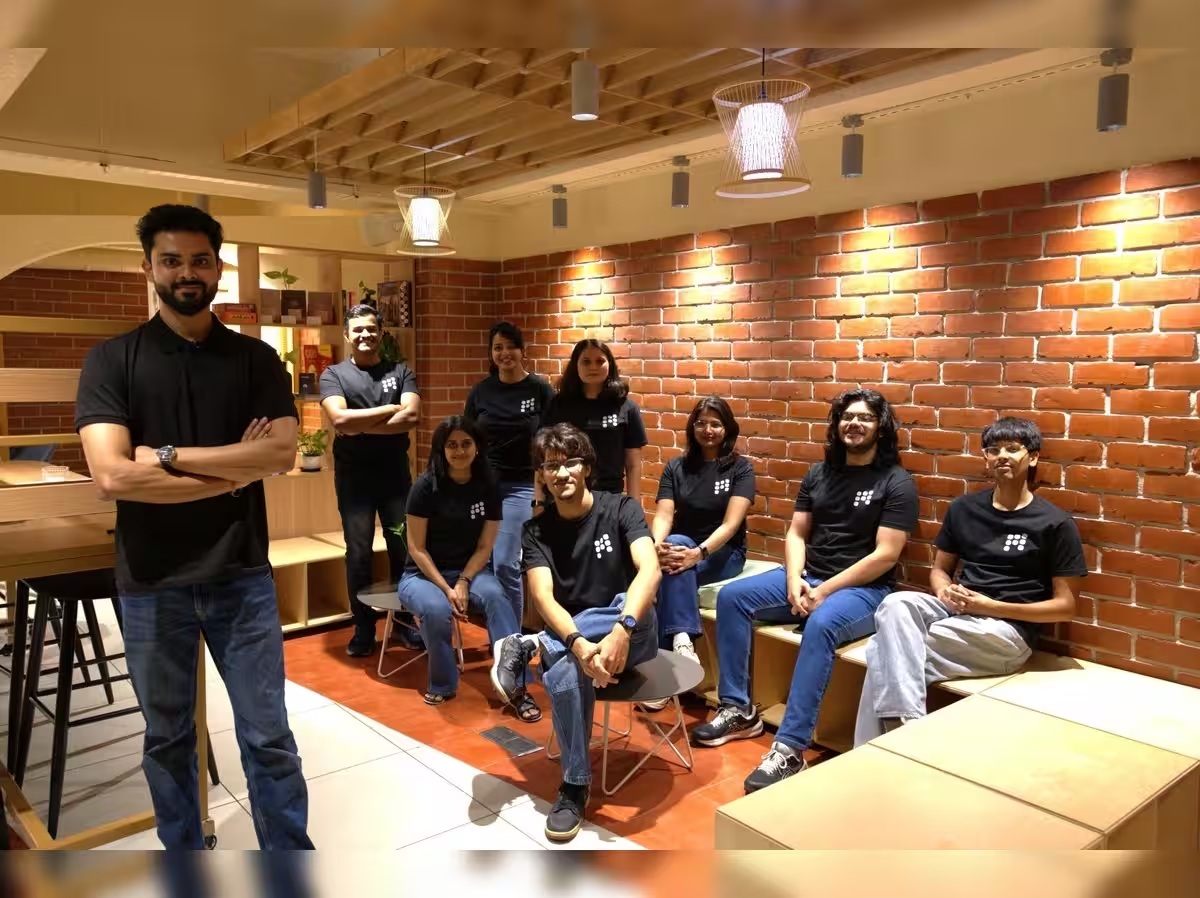
The round included Spectrum Impact, DeVC, and angel investors such as biotech veteran Vijay Chandru (co-founder of Strand Life Sciences), entrepreneur Paras Chopra, Sanjiv Rangrass, and Vatsal Dusad. Founded in 2025 by Tanay Lohia and ICAR scientist Kutubuddin Molla, the startup operates with a 10-member team of AI researchers, computational biologists, and molecular scientists.
What problem is Mandrake Bio solving?
Gene editing has long promised climate-resistant crops and therapies for genetic diseases. But scientists still rely on naturally occurring DNA-editing enzymes, which are expensive, difficult to modify, and limited in precision. Even CRISPR-Cas9, the breakthrough tool that won its inventors a Nobel Prize, has off-target effects that limit its applications.
Mandrake Bio's pitch: use AI to design entirely new enzymes rather than adapting what nature provides. The startup uses open-source protein language models trained on biological sequences, then fine-tunes them against its own metagenomic database. The AI narrows thousands of protein candidates before wet-lab validation, cutting the number of expensive experiments required.
“Until two years ago, researchers had to search for enzymes in nature and spend years trying to improve them. Generative AI now allows us to design entirely new enzymes in two to three weeks and then validate them in the lab.”
— Tanay Lohia, CEO, Mandrake Bio
Why investors are betting on this approach
Pratyush Choudhury, co-founder of Activate, framed the investment as a bet on AI-biology convergence. "The next wave of AI breakthroughs won't come from software alone. They'll come from applying AI to disciplines such as biology, chemistry and materials science," he said. "We believe India has the talent to build companies at that frontier."
Nitin Sharma, partner at Antler India, pointed to the startup's contrarian approach: redesigning the gene-editing enzymes themselves rather than building applications on top of existing CRISPR systems. This positions Mandrake as a platform company that could license its enzymes to agricultural biotech firms and pharmaceutical companies alike.
Target markets: agriculture first, then medicine
Mandrake Bio is initially targeting agriculture, where current gene-editing workflows take 7-8 years to develop an improved crop variety. The company claims purpose-built enzymes could shrink that timeline to around 2 years. Given India's vulnerability to climate-driven crop failures, faster development of drought-resistant and pest-resistant varieties has obvious appeal.
The medical opportunity is larger but harder. Existing gene therapies cost between $2 million and $2.5 million for a single gene edit. Lohia claims better-designed enzymes could eventually bring those costs down to ₹50-60 lakh (roughly $60,000-$70,000) while also reducing treatment timelines. That's an aggressive projection, and the company has yet to publish validation data.
The startup expects its first wet-lab validation results within two months. Until then, investor enthusiasm rests on the technical credentials of the team and the broader promise of generative AI in drug and enzyme design.
How does Mandrake Bio compare to global competitors?
Mandrake enters a competitive space. U.S.-based Generate Biomedicines and Insilico Medicine already use AI for protein and drug design, though they focus on therapeutic molecules rather than gene-editing tools. In the gene-editing space specifically, Beam Therapeutics and Prime Medicine are developing next-generation CRISPR variants with improved precision.
What distinguishes Mandrake is its India-first positioning and dual focus on agriculture and medicine. India's regulatory path for agricultural gene editing is more permissive than the EU's, and the country has a large addressable market for climate-resilient crops. Whether that translates to a sustainable business depends on whether the company's AI-designed enzymes actually outperform existing tools in wet-lab tests.
Logicity's Take
Mandrake Bio's thesis is sound: if you can computationally design better gene-editing enzymes, you unlock value across agriculture and medicine simultaneously. But this is a high-risk, high-conviction bet. The company has no published validation data, operates in a capital-intensive field requiring significant wet-lab infrastructure, and competes against well-funded global players with multi-year head starts. The ₹16 crore raise is modest for biotech. Lohia's background at agri-biotech firm Absolute and AI lab Lossfunk provides relevant domain exposure, but the real test comes when those first wet-lab results arrive. For biotech-curious investors and potential enterprise partners, this is one to watch rather than act on immediately.
Frequently Asked Questions
What is Mandrake Bio?
Mandrake Bio is a Bengaluru-based startup founded in 2025 that uses generative AI to design novel gene-editing enzymes for agriculture and medical applications.
How much funding has Mandrake Bio raised?
The company raised ₹16 crore (approximately $1.9 million) in a pre-seed round co-led by Activate and Antler India.
How does Mandrake Bio's technology differ from CRISPR?
While CRISPR-based tools use naturally occurring enzymes that scientists adapt, Mandrake Bio uses AI to design entirely new enzymes computationally before validating them in the lab.
What are the potential applications of Mandrake Bio's platform?
The platform targets two markets: developing climate-resistant crop varieties faster, and reducing the cost of gene therapies for genetic diseases.
When will Mandrake Bio have validation data?
The company expects its first wet-lab validation results within two months of the funding announcement.
Another example of AI-adjacent infrastructure attracting significant capital
Need Help Implementing This?
If you're a biotech founder or enterprise innovation team exploring AI applications in life sciences, reach out to our editorial team for introductions to relevant experts and investors in the space.
Source: Tech-Economic Times / ET
Huma Shazia
Senior AI & Tech Writer
Produced with AI assistance and reviewed by the Logicity editorial team. Learn more in our Editorial Policy.




