Memory prices have jumped 50% to 200% since early 2026, pushing PC costs up 35% to 45% and some server prices above 125%. Lead times that once ran 30 to 45 days now stretch to six, 12, or even 18 months. Gartner expects no price stabilization until late 2027.

The root cause is not a factory fire or a pandemic. It is the AI wave. Hyperscalers are buying memory at a pace that starves everyone else in the supply chain, and unlike past disruptions, this one is not going away soon.
How bad is the shortage right now?
"It's pretty bad," says Matt Kimball, vice president and principal analyst at Moor Insights & Strategy. Companies accustomed to quick turnarounds are now planning nearly two years ahead. "It's real, and I'm hearing it from companies of all sizes, from the 1,000-server to the 10,000-server shops."
Jon Forest, VP analyst at Gartner, puts numbers to the pain. Memory will reach up to 25% of network hardware expenses by the end of 2027. Enterprise network equipment pricing is projected to climb over 20% in 2026, then rise another 3% to 5% entering 2027.
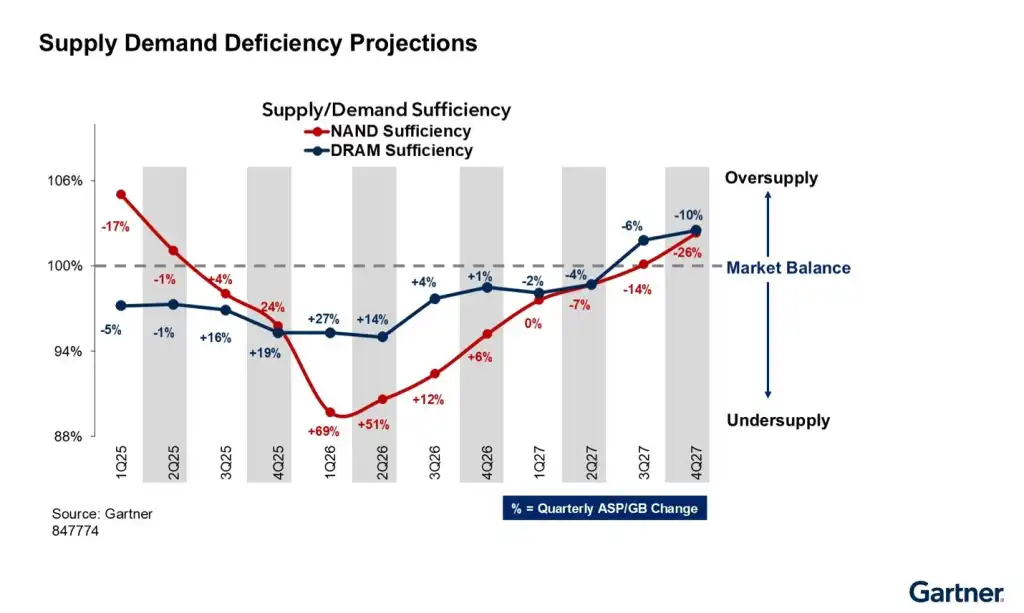
The chart above shows Gartner's timeline for memory prices. Forest notes that the same timing applies across networking, storage, and compute infrastructure. In short, every layer of the stack is affected.
Phillip Privett, senior vice president of vendor management at global distributor TD SYNNEX, warns that "reduction" will look more like "stabilization." A price that rose 40% might drop 5%. It will not return to 2025 levels.
Why AI demand makes this shortage different
Past supply chain crises had endpoints. A fire gets contained. A pandemic recedes. The AI wave does not have an obvious ceiling.
"This AI inference wave we're hitting is just beginning. It's going to be longer and bigger than the training wave," Kimball says. "It's impacting everything, from AI infrastructure to the traditional stuff that's standing up your virtualization and cloud infrastructure."
Training large language models consumed enormous GPU and memory capacity over the past two years. Inference, running those models at scale for millions of users, will demand even more. Every chatbot, every copilot, every embedded AI feature adds load. Hyperscalers are locking in supply years in advance, leaving enterprises to compete for whatever remains.
No vendor is immune
Even Cisco, which designs its own Silicon One chips, cannot escape the bottleneck. Those chips are fabricated by Taiwan Semiconductor Manufacturing Company (TSMC), the same foundry building chips for nearly every major AI and networking vendor. A switch contains many components beyond the main silicon, and each has its own supply chain.
Cisco does have one advantage: enterprise sales carry margins around 66%, according to its latest quarterly report. That gives Cisco incentive to prioritize enterprise customers over hyperscalers, who typically buy hardware without the high-margin software and services bundles. But incentive does not eliminate the shortage.
“I wouldn't say any company is faring better than others. There may be nuances that some suppliers are employing to balance it to some extent, but I fail to recognize a supplier that's not having almost the same issue.”
— Neil Anderson, VP and CTO for cloud, infrastructure, and AI solutions at World Wide Technology
Cloud storage vendor Backblaze is one company facing the squeeze directly. James Rowell, senior vice president of operations, describes "different types of shortages occurring in multiple places, all driven by unusual market demands, really by just a handful of very large buyers." Backblaze now forecasts and monitors demand triggers constantly, aligning closely with its sales teams to anticipate needs.
What enterprises can do now
Industry insiders offer consistent advice. None of it is glamorous.
First, squeeze more from existing infrastructure. Virtualization, containerization, and workload optimization can defer hardware purchases. Tools like DigitalOcean, Cloudflare, and Vercel help offload edge and CDN workloads without buying more servers.
Disclosure
Some links in this post are affiliate links — Logicity earns a commission if you sign up, at no extra cost to you. We only link products we have used or actively recommend.
Second, expand your vendor roster. If your usual supplier quotes 12 months, a secondary or tertiary vendor might quote eight. This is not a time for single-source loyalty.
Third, plan with finance early. A server that cost $50,000 last year may cost $70,000 or more today, and budgets approved before the price spike will not stretch far enough. CFOs need to understand that this is not procurement failure. It is market reality.
Finally, extend planning horizons. If lead times run 12 to 18 months, you cannot start the procurement process when a project kicks off. You start a year before the project even has a name.
Logicity's Take
The practical takeaway for CIOs: treat infrastructure planning like you treat headcount planning. Budget for 2028 hardware in 2026, not because you know what you will need, but because you know you will not get it on short notice. Cloud providers are not immune either. AWS, Azure, and GCP face the same memory constraints, which is why reserved instances and committed-use discounts are tightening. If your strategy was "we'll burst to the cloud when on-prem runs out," revisit that assumption.
When will relief arrive?
Gartner's timeline points to late 2027 for price stabilization. Not reduction. Stabilization. The memory capacity coming online over the next 18 months will go largely to AI workloads. Enterprise customers will get what is left.
That means the 2026-2027 budget cycle is the crunch. Projects that cannot secure hardware in the next year may slip into 2028. The organizations that come through cleanly will be those that locked in orders early, diversified vendors, and got finance on board before the sticker shock.
The AI boom is real, and so are its second-order effects. Infrastructure teams just became a lot more strategic, whether they wanted the attention or not.
Need Help Implementing This?
If your team is navigating procurement delays or rethinking infrastructure strategy, Logicity's consulting partners can help. Reach out at consulting@logicity.in for a vendor-neutral assessment.
Source: Computerworld
Huma Shazia
Senior AI & Tech Writer
Produced with AI assistance and reviewed by the Logicity editorial team. Learn more in our Editorial Policy.