NASA's Artemis II mission has made history with a flawless splashdown in the Pacific Ocean, bringing four astronauts safely home after traveling farther from Earth than any humans ever have. The crew orbited the Moon, witnessed a rare solar eclipse from space, and even named a newly discovered crater — marking America's triumphant return to lunar exploration.
Key Takeaways
- Four astronauts successfully completed a 10-day journey around the Moon, traveling over 700,000 miles total
- The crew broke Apollo 13's record by reaching 252,760 miles from Earth — farther than any humans in history
- This marks the first crewed lunar mission since 1972, signaling a new era of Moon exploration
In This Article
- A Perfect Landing Caps Off a Historic Journey
- Meet the Fearless Four Who Made History
- Farther Than Any Human Has Ever Gone
- What They Saw: Eclipses, Craters, and Never-Before-Seen Terrain
- This Is Just the Beginning: Moon Bases and Beyond
- Why This Mission Matters for Everyone
A Perfect Landing Caps Off a Historic Journey
At exactly 5:07 p.m. Pacific Time on April 10, 2026, the Orion spacecraft — affectionately named 'Integrity' by its crew — touched down in the Pacific Ocean near San Diego, California. After roughly nine days hurtling through space, four astronauts emerged in 'green' status, meaning they were healthy and safe. For NASA and space enthusiasts worldwide, it was the culmination of decades of anticipation.
- The spacecraft hit its target landing zone with remarkable precision — less than one mile from the planned splashdown point
- Entry Flight Director Rick Henfling reported the crew achieved a peak velocity of 24,664 miles per hour during re-entry
- Navy divers quickly secured the capsule and brought the astronauts aboard the USS John P. Murtha for medical evaluations
And splashdown!
— NASA Administrator Jared Isaacman (@NASAAdmin) April 11, 2026
America is back in the business of sending astronauts to the Moon and bringing them home safely.
Reid, Victor, Christina, and Jeremy did an outstanding job. These talented astronauts inspired the world and represented their space agencies and nations as… pic.twitter.com/wOioBBvGhX
Meet the Fearless Four Who Made History
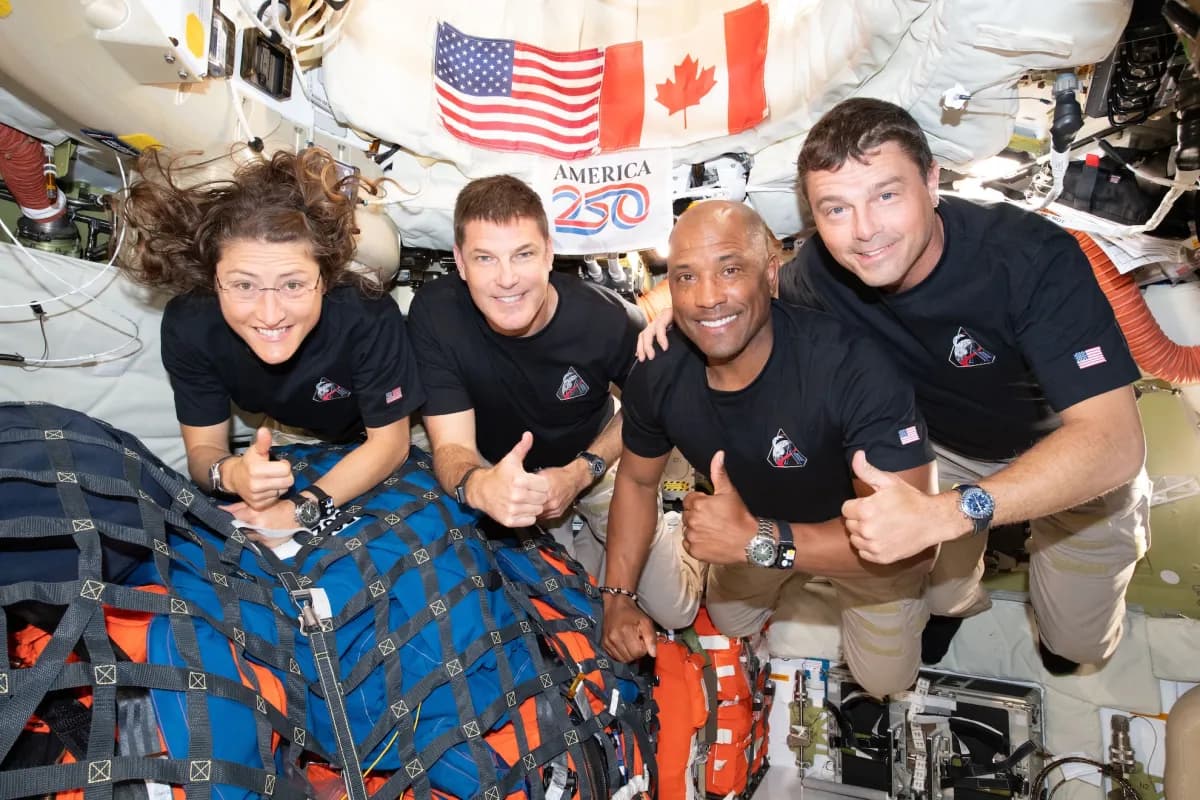
This wasn't just any crew — it was a carefully selected team of veteran astronauts who had trained together for three years since their selection in April 2023. Commander Reid Wiseman led the mission alongside pilot Victor Glover, with Christina Koch and Canadian astronaut Jeremy Hansen serving as mission specialists. Together, they became the first humans to venture beyond low Earth orbit since the Apollo era.
- Victor Glover made history as a pilot on this mission, adding to his impressive resume of space achievements
- Christina Koch brought invaluable experience, having previously held the record for longest continuous spaceflight by a woman
- Jeremy Hansen represented Canada, making this mission an international collaboration and a proud moment for the Canadian Space Agency
Farther Than Any Human Has Ever Gone
Here's where things get truly mind-blowing. On April 6, just six days into the mission, the Artemis II crew shattered a record that had stood for over 50 years. They traveled 252,760 miles from our planet — roughly 4,105 miles beyond what the Apollo 13 astronauts achieved in 1970. In total, the mission covered an astonishing 700,237 miles from liftoff to splashdown.
- The spacecraft passed within 4,070 miles of the lunar surface at its closest approach
- This was the first crewed flight of both NASA's Space Launch System rocket and the Orion spacecraft
- The crew underwent rigorous testing of spacecraft systems throughout the journey, evaluating everything from life support to navigation
What They Saw: Eclipses, Craters, and Never-Before-Seen Terrain
The mission wasn't just about getting to the Moon and back — it was about discovery. During a seven-hour flyby of the lunar far side on April 6, the crew captured photographs of regions no human eyes had ever witnessed directly. They even observed a total solar eclipse from their unique vantage point in deep space, a genuinely once-in-a-lifetime (or once-in-a-civilization) experience.
- The astronauts identified and documented new craters on the Moon's surface during their orbital pass
- Commander Wiseman honored his late wife Carroll, who passed away from cancer in 2020, by naming one of the newly discovered craters after her
- These first-ever crewed images of the lunar far side provide invaluable data for future Artemis landing missions
This Is Just the Beginning: Moon Bases and Beyond
NASA Administrator Jared Isaacman — himself a commercial astronaut with two private orbital missions under his belt — couldn't contain his excitement after the successful splashdown. His message was clear: this test flight opens the door to even more ambitious endeavors, including permanent human presence on the Moon.
- Artemis III will aim to land astronauts on the lunar surface, building on everything learned from this mission
- Long-term plans include establishing a Moon base that could serve as a stepping stone for Mars exploration
- The successful performance of SLS and Orion validates years of engineering work and proves these systems are ready for even more challenging missions
Why This Mission Matters for Everyone
It's easy to get caught up in the technical details and miss the bigger picture. Artemis II represents humanity's renewed commitment to exploring beyond our planet. For over five decades, no one had ventured this far from Earth. Now, with a proven spacecraft and a growing international partnership, the path to the Moon — and eventually Mars — is clearer than ever.
- The mission demonstrates that crewed deep-space travel is not only possible but can be executed with remarkable precision
- International collaboration, exemplified by Canadian astronaut Jeremy Hansen's participation, shows that space exploration unites nations
- Young people watching this mission unfold may one day walk on the Moon themselves, inspired by what they witnessed today
“These were the ambassadors to the stars that we sent out there. I can't imagine a better crew. It was a perfect mission.”
— Jared Isaacman, NASA Administrator
“America is back in the business of sending astronauts to the Moon and bringing them home safely.”
— Jared Isaacman, NASA Administrator (via X)
“This was a test mission, the first crewed flight of SLS and Orion, pushing farther into the unforgiving environment of space than ever before, and it carried real risk. They accepted that risk for all we stood to learn and for the exciting missions that follow.”
— Jared Isaacman, NASA Administrator
Final Thoughts
As the Artemis II crew underwent their post-flight medical evaluations before heading to NASA's Johnson Space Center in Houston, one thing became crystal clear: the age of lunar exploration has returned. What seemed like science fiction just a few years ago is now reality. With plans for Moon landings, lunar outposts, and eventually crewed missions to Mars, Artemis II isn't just a historic achievement — it's the first chapter in humanity's next great adventure among the stars. The four astronauts who splashed down in the Pacific Ocean have shown us that the impossible is merely the untried, and the cosmos awaits our return.
Sources & Credits
Originally reported by TechCrunch — Graham Starr
Huma Shazia
Senior AI & Tech Writer
Produced with AI assistance and reviewed by the Logicity editorial team. Learn more in our Editorial Policy.