Key Takeaways
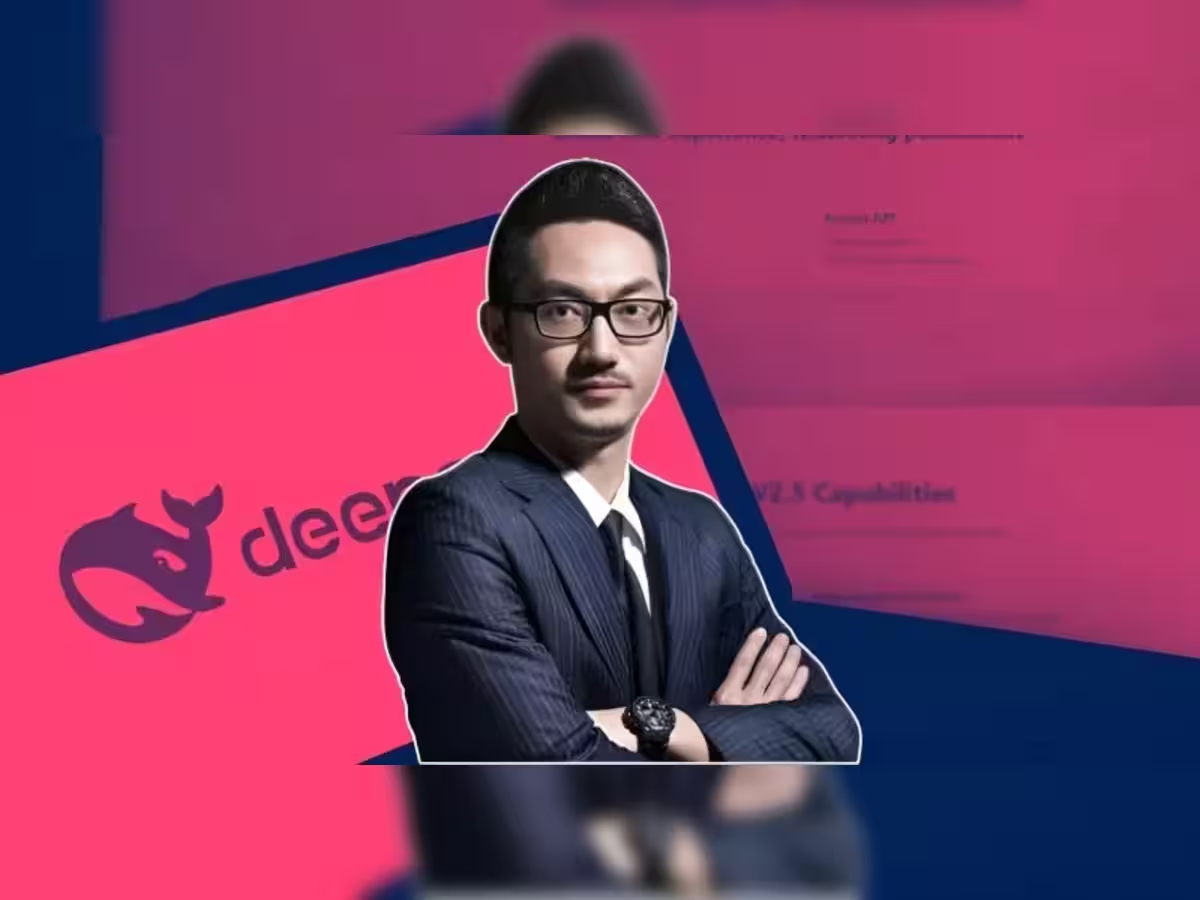
- Liang Wenfeng's net worth jumped from $16.7B to $36B after DeepSeek's June 2026 funding round valued the company at $50 billion
- Liang retains approximately 78% equity in DeepSeek, far higher than US AI founders who typically dilute heavily through venture rounds
- DeepSeek's rise marks a shift in China's tech wealth from consumer internet tycoons to state-backed AI companies
Liang Wenfeng, founder of DeepSeek, is now the world's wealthiest AI model creator. His net worth more than doubled to $36 billion following the Chinese startup's latest funding round, according to the Bloomberg Billionaires Index. That puts the 40-year-old hedge fund trader turned AI entrepreneur well ahead of Anthropic's Dario Amodei and OpenAI's Greg Brockman.
The wealth surge stems from DeepSeek's June 2026 funding round. The company raised $7.4 billion at a $50 billion valuation, roughly fivefold the $10 billion figure reported in April. Liang personally invested $3 billion in the round. Even after dilution, he retains an estimated 78% stake in the company.
Why Liang's equity retention matters
The most striking detail is not the headline number. It is how much of DeepSeek Liang still owns. Building a $50 billion frontier AI company in the US typically requires giving up enormous chunks of equity to venture capitalists, tech giants, and cloud providers. Sam Altman holds minimal equity in OpenAI. Anthropic and other American labs have fragmented cap tables across multiple institutional investors.
Liang took a different path. He bootstrapped DeepSeek's early compute needs using profits from his quantitative hedge fund, High-Flyer, which he co-founded with two university classmates. The trio stockpiled Nvidia GPUs before US export restrictions tightened, giving DeepSeek the training infrastructure to reach frontier performance without the typical VC dependency.
That 78% stake translates directly to personal wealth and control. Liang is now China's eighth-richest person, trailing only Chen Tianshi, co-founder of AI chip maker Cambricon Technologies.
How DeepSeek changed the AI cost equation
DeepSeek grabbed global attention in early 2025 when it released a model matching GPT-4 class performance at a reported training cost of $6 million, a fraction of what US labs spend. The announcement briefly rattled tech stocks and forced competitors to revisit assumptions about how much compute frontier AI actually requires.
The company has maintained momentum. Its latest V4 model, showcased recently, emphasizes compatibility with chips from Huawei, signaling a path around continued US export controls. For Chinese enterprises and government agencies seeking domestic AI capabilities, that compatibility matters.
A shift in China's tech wealth
For years, consumer internet founders defined tech wealth in China. Jack Ma, Pony Ma, and the leaders of ByteDance built fortunes on e-commerce, gaming, and social apps. That era is giving way to state-backed artificial intelligence. The influx of government and corporate capital into DeepSeek's latest round marks its transition from a private software experiment into what Bloomberg describes as a critical national asset.
Liang's background is unusual for an AI founder. He studied electronic engineering at Zhejiang University in Hangzhou, where he also earned a master's in information and communication engineering. He and his co-founders started trading during the global financial crisis while still students. High-Flyer became one of China's largest quant funds before spinning out DeepSeek in 2023.
Where this leaves US AI labs
OpenAI and Anthropic command valuations approaching $1 trillion, but their equity is spread across large investor bases and multiple co-founders. That structure gives them access to capital but limits individual founder wealth and control. Liang's concentrated ownership is the opposite model, and it has produced the richest individual in the frontier AI race.
Bloomberg's ranking excludes diversified conglomerates like Alibaba and Tencent, as well as companies in the AI supply chain such as data centers and chip makers. The comparison focuses specifically on founders whose primary business is building AI models. By that measure, Liang now leads the field by a wide margin.
Logicity's Take
The $36 billion figure is less about Liang's personal spending power than what it signals about capital flows in AI. DeepSeek raised at a $50 billion valuation without the hyperscaler cloud deals that define US AI funding. If that model proves repeatable, we will see more AI founders retain control rather than become minority shareholders in their own companies. For CTOs evaluating AI partners, the implication is straightforward: DeepSeek's open-source models, combined with Huawei chip compatibility, offer a credible alternative to US providers for organizations operating in or aligned with Chinese markets.
Frequently Asked Questions
How much is DeepSeek founder Liang Wenfeng worth?
Liang Wenfeng's net worth is $36 billion as of June 2026, according to the Bloomberg Billionaires Index. This more than doubled from his previous estimated wealth of $16.7 billion.
What is DeepSeek's current valuation?
DeepSeek is valued at $50 billion following its June 2026 funding round, in which it raised $7.4 billion. The valuation increased roughly fivefold from the $10 billion reported in April.
How does Liang Wenfeng compare to other AI founders?
Liang is now the richest AI model founder, surpassing Anthropic's Dario Amodei and OpenAI's Greg Brockman. His 78% stake in DeepSeek is unusually high compared to US AI founders who typically dilute through multiple funding rounds.
How did DeepSeek fund its AI development without venture capital?
Liang used profits from his hedge fund High-Flyer to stockpile Nvidia GPUs before US export restrictions tightened. This gave DeepSeek the computing power to build frontier models without early reliance on traditional venture capital.
How enterprise AI spending is scaling beyond experiments
Need Help Implementing This?
Logicity helps technology leaders evaluate AI strategies and vendor options. Get in touch for tailored guidance on integrating frontier AI capabilities into your stack.
Source: Tech-Economic Times / ET
Manaal Khan
Tech & Innovation Writer
Produced with AI assistance and reviewed by the Logicity editorial team. Learn more in our Editorial Policy.