Key Takeaways
Paying for software is stupid… 10 free and open-source SaaS replacements
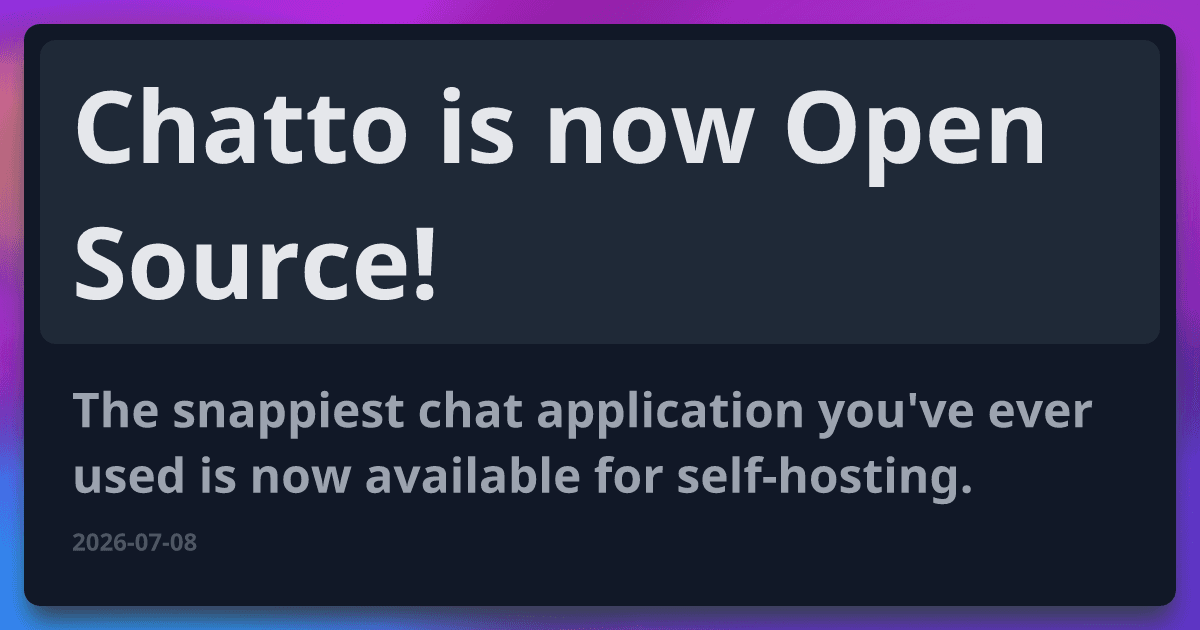
- Chatto is now fully open source and free to self-host on Linux, macOS, or Windows
- The app includes end-to-end encrypted voice and video calls with screen sharing built in
- Chatto Cloud, a managed hosting option with European infrastructure, enters public beta soon
Chatto, an open source Slack alternative built by indie developer Henrik Mans, is now available for anyone to self-host. The release positions the app as a faster, lighter option for teams frustrated with the bloat of mainstream chat tools. You can install it via Homebrew and have it running in three commands.
The pitch is direct: Chatto wants to be the group chat app you actually enjoy using. Mans doesn't name competitors explicitly, but the references are clear. There's the one that "rhymes with knack" (Slack), the one that "rhymes with beams" (Teams), and the one that "rhymes with this gourd" (Discord). Chatto aims to be snappier than all of them.
What makes Chatto different from Slack or Discord?
The core differentiator is ownership. Chatto runs as a single executable that serves its own frontend. No separate database server, no complex container orchestration. You run the binary, and it works. Each server powers one community with no federation between instances. If you want multiple communities, you spin up multiple processes.
Privacy gets first-class treatment. All personal and chat data is encrypted at rest using per-user keys. When someone deletes their account, those keys get shredded. There's no third-party tracking or analytics baked in. For startups handling sensitive client communications or operating in regulated industries, this matters.
The app includes voice and video calls with screen sharing, all end-to-end encrypted. Calls scale to whatever your infrastructure can handle. Binaries ship for Linux (x86_64 and ARM64), macOS, and Windows.
The managed hosting option
Not everyone wants to manage their own servers. Chatto Cloud, launching into public beta soon, offers managed hosting with a simple pricing model: you pay for hosting, nothing else. No premium tiers, no ads, no feature gating.
The infrastructure is European-owned and European-hosted, with additional regions planned for early 2027. Servers get automatic scaling, nightly backups, and zero-downtime upgrades. There's no lock-in either. You can export your data and move between self-hosted and Chatto Cloud freely.
Where does Chatto fit in the self-hosted chat market?
The open source team chat space already has established players. Mattermost targets enterprises with compliance requirements. Rocket.Chat offers broad feature sets for larger deployments. Element, built on the Matrix protocol, emphasizes federation and interoperability. Zulip focuses on threaded conversations for developer teams.
Chatto's angle is simplicity and performance. Mans explicitly calls out the "snappiest frontend" claim, positioning against competitors that have accumulated feature bloat over years. For small teams and indie communities, a lightweight install with minimal dependencies has real appeal.
The tradeoff is maturity. Chatto sits at version 0.4 with an estimated 6-12 months until 1.0. The roadmap still includes content moderation and reporting features. Breaking changes may still occur. Early adopters should expect to update frequently.
Why startups should pay attention
For founder teams of 5-20 people, Slack's free tier restrictions pinch quickly. Message history limits hit, integrations cap out, and suddenly you're looking at $8.75 per user per month. That's over $2,000 annually for a 20-person team.
Self-hosting Chatto on a small DigitalOcean droplet or Cloudways instance costs a fraction of that. A $12/month VPS handles light workloads easily. For bootstrapped startups watching every dollar, that math works.
Disclosure
Some links in this post are affiliate links — Logicity earns a commission if you sign up, at no extra cost to you. We only link products we have used or actively recommend.
The privacy story also matters. If you're building in healthcare, fintech, or any regulated space, keeping communication data on infrastructure you control simplifies compliance conversations. You know where the data lives. You control access. You handle deletion.
Logicity's Take
Chatto enters a market where Slack charges $8.75/user/month, Discord feels too casual for work, and self-hosted alternatives like Mattermost carry enterprise complexity. The simplicity angle is smart. But the real test comes when Chatto hits 1.0 and early adopters start filing feature requests. Every chat app eventually accumulates cruft. Whether Mans can resist that gravity while building a sustainable business through Chatto Cloud will determine if this becomes a genuine contender or another open source passion project that plateaus. For now, it's worth a test deployment if you're frustrated with your current setup.
How to try Chatto today
If you're on macOS with Homebrew installed, three commands get you running:
- brew install chattocorp/tap/chatto
- chatto init
- chatto run
For Linux and Windows, download the binary from the GitHub repository and follow the self-hosting documentation. The Chatto HQ community server offers a live demo and a support channel for self-hosters.
Frequently Asked Questions
Is Chatto really free to use?
Yes. The open source version is completely free to self-host. Chatto Cloud will be a paid managed hosting service, but the software itself has no license fees.
Can Chatto replace Slack for a remote team?
For basic chat, channels, and video calls, yes. It lacks some Slack integrations and the app ecosystem. Teams heavily dependent on Slack bots or third-party apps will need to evaluate what's missing.
How does Chatto handle data encryption?
All personal and chat data is encrypted at rest using per-user keys. Voice and video calls use end-to-end encryption. When a user deletes their account, their encryption keys are destroyed.
What's the hardware requirement for self-hosting Chatto?
Chatto is described as very light on resources. A basic VPS with 1-2GB RAM should handle small team workloads. Exact requirements depend on user count and call usage.
Is Chatto production-ready?
The developer considers it stable enough for production use at version 0.4, but warns that breaking changes may still occur before 1.0. Plan for regular updates if you deploy now.
Another bet on unconventional approaches to building tech companies
Need Help Implementing This?
Evaluating self-hosted chat for your startup? We help founders compare options, estimate infrastructure costs, and plan migrations. Reach out at hello@logicity.in.
Source: Hacker News: Best
Manaal Khan
Tech & Innovation Writer
Produced with AI assistance and reviewed by the Logicity editorial team. Learn more in our Editorial Policy.