Key Takeaways
- Boring Company is in talks to raise $4 billion at a $20 billion valuation, per WSJ
- This represents a 3.5x increase from its $5.7 billion valuation in 2022
- The company operates the Vegas Loop and recently signed a deal for the Dubai Loop
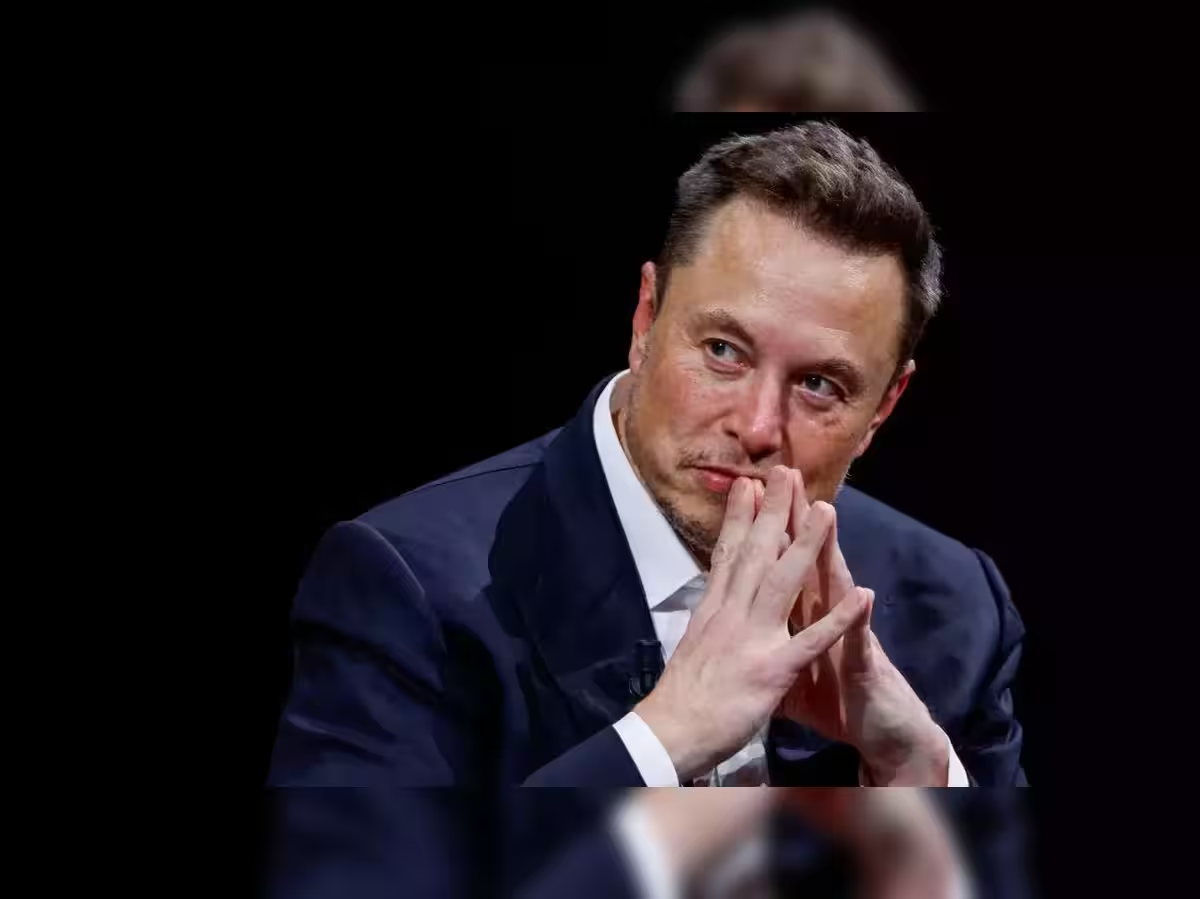
Elon Musk's tunneling startup, the Boring Company, is in talks to raise roughly $4 billion in new funding at a $20 billion valuation, the Wall Street Journal reported on July 24. If the round closes at these terms, the company will have nearly quadrupled its worth in three years.
The deal has not yet closed, and terms could still change, according to WSJ's sources. The Boring Company was last valued at $5.7 billion following a $675 million fundraising round in 2022. That makes this proposed round both larger in absolute terms and far more aggressive on valuation.
What has Boring Company built so far?
Musk founded the company to develop tunneling technology and underground transport systems. The original pitch involved low-pressure tubes that would carry passenger pods between cities at high speeds. The reality, so far, is more modest: the Vegas Loop in Las Vegas, Nevada.
The Vegas Loop began transporting passengers in 2021. According to the company's website, the system has now carried more than 3 million passengers through eight stations. It uses Tesla vehicles rather than high-speed pods, ferrying convention-goers and tourists beneath the city.
Last year, the Boring Company signed an initial pact with Dubai's Road and Transport Authority to build the Dubai Loop. The project would span 17 km (11 miles) as an underground high-speed transport network. Terms of that deal remain undisclosed.
Why does a 3.5x valuation jump make sense?
Three factors likely explain the markup. First, operational proof: the Vegas Loop now has real ridership numbers and is expanding. Eight stations with 3 million passengers is small by transit standards, but it demonstrates the concept works at a basic level.
Second, the Dubai deal signals international demand. If the Boring Company can export its tunneling model to governments willing to pay for premium infrastructure, the addressable market expands significantly.
Third, there's the Musk factor. His companies tend to command premium valuations based on long-term vision rather than near-term cash flows. SpaceX is valued at over $200 billion. Tesla trades at a multiple that prices in robotaxis and energy businesses that don't yet exist at scale. Investors betting on Boring Company are betting on a similar trajectory.
What are the risks?
The Boring Company still has not delivered on its original promise. The Vegas Loop moves people in Teslas through tunnels. It's not the Hyperloop. It's not revolutionary transport infrastructure. It's an underground shuttle service.
Scaling tunneling is notoriously difficult. Construction costs, permitting, and geological surprises have killed infrastructure projects far less ambitious than city-spanning underground networks. The Dubai Loop will test whether the company can execute outside the relatively permissive regulatory environment of Las Vegas.
There's also the question of Musk's bandwidth. He runs Tesla, SpaceX, Neuralink, and xAI. He owns X. Each of these companies demands executive attention. The Boring Company has historically operated as a side project, and it's unclear whether $20 billion investors expect that to change.
Another story about infrastructure handling massive scale
How does this compare to other Musk funding rounds?
| Company | Last Reported Valuation | Year | Primary Business |
|---|---|---|---|
| SpaceX | $200B+ | 2024 | Rockets, Starlink |
| Tesla (market cap) | $~800B | 2024 | EVs, energy, autonomy |
| Boring Company | $20B (proposed) | 2026 | Tunneling, transport |
| Neuralink | $5B | 2023 | Brain-computer interfaces |
| xAI | $24B | 2024 | AI research |
The Boring Company's proposed valuation would place it between Neuralink and xAI in Musk's portfolio. That's notable given how little revenue tunneling generates compared to AI or space launch services. Investors are clearly pricing in future government contracts, not current operations.
Logicity's Take
The $20 billion valuation prices the Boring Company as a serious infrastructure play, not a side project. That's a bet on two things: that the Dubai deal leads to more international contracts, and that Musk can eventually deliver something closer to the original Hyperloop vision. For enterprise leaders watching this space, the relevant question is whether tunneling tech becomes a viable urban mobility solution in the next decade. If it does, first-mover advantages could be substantial. If it doesn't, this valuation looks like peak hype. The Vegas Loop works. Whether it can work at scale, across jurisdictions, remains unproven.
What happens next?
The funding round has not closed. Terms could shift before it does. If the round succeeds at or near $20 billion, expect announcements about new projects. The Dubai Loop will likely be the next major test of the company's capabilities.
For now, the Boring Company remains a small operation with big ambitions and an even bigger backer. Whether that justifies a valuation nearly 4x what it commanded three years ago depends entirely on what gets built next.
Related coverage on major tech companies and funding
Frequently Asked Questions
What is the Boring Company's proposed valuation in 2026?
According to the Wall Street Journal, the Boring Company is in talks to raise funding at approximately $20 billion valuation, up from $5.7 billion in 2022.
How much funding is the Boring Company seeking?
The company is reportedly seeking to raise about $4 billion in this funding round, though terms have not been finalized.
What is the Vegas Loop and how many passengers has it served?
The Vegas Loop is an underground Tesla shuttle system in Las Vegas that began operations in 2021. According to the company, it has transported over 3 million passengers through eight stations.
What is the Dubai Loop project?
The Dubai Loop is a planned 17-kilometer underground high-speed transport network in Dubai. The Boring Company signed an initial agreement with Dubai's Road and Transport Authority in 2025.
Who founded the Boring Company?
Elon Musk founded the Boring Company to develop tunneling technology and underground transport systems. He also leads Tesla, SpaceX, Neuralink, and xAI.
Need Help Implementing This?
Tracking major tech investments and infrastructure plays? Subscribe to Logicity's newsletter for weekly briefings on the funding rounds and deals that matter to tech decision-makers.
Source: Tech-Economic Times / ET
Huma Shazia
Senior AI & Tech Writer
Produced with AI assistance and reviewed by the Logicity editorial team. Learn more in our Editorial Policy.