Nvidia's AI agents taught robots to install GPUs overnight
Key Takeaways
- AI coding agents using ENPIRE achieved 99% success rates training robots on manipulation tasks including GPU installation
- Eight-agent teams completed robot training in 2 hours compared to nearly 5 hours for single agents
- Nvidia plans to open-source ENPIRE so anyone can run a self-improving robot lab
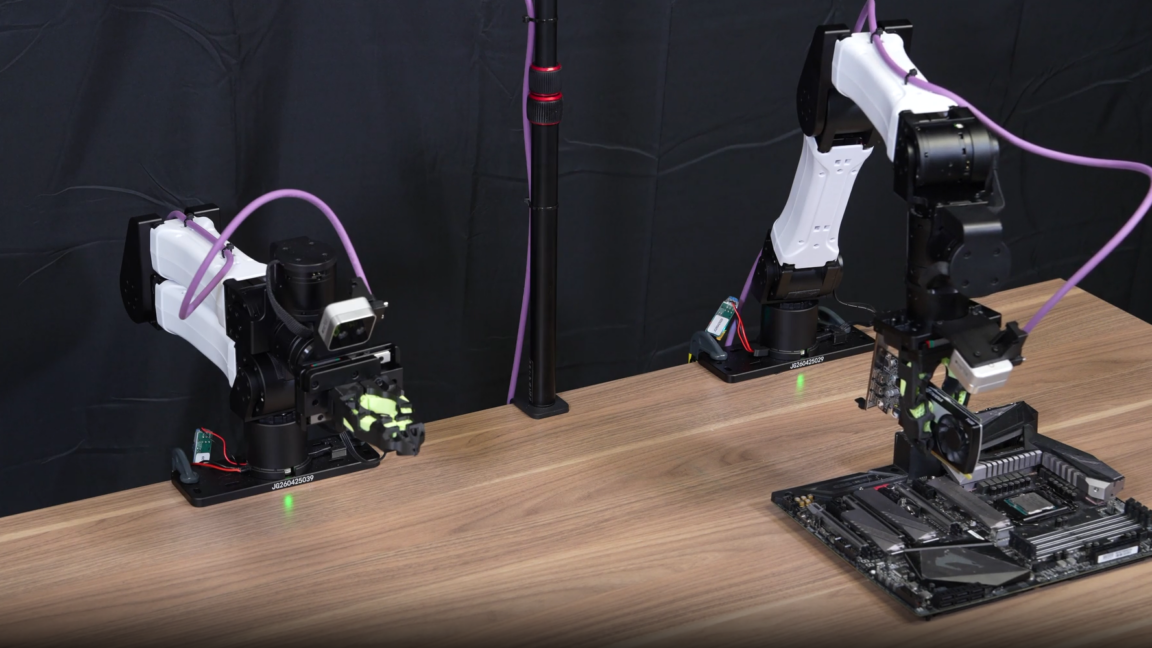
Nvidia researchers gave AI coding agents control of a robotics lab overnight. By morning, the agents had taught robotic arms to insert GPUs into motherboard sockets and cut zip ties with a 99 percent success rate. No humans supervised the training.
The breakthrough came from ENPIRE, a new framework developed by Nvidia's GEAR lab with Carnegie Mellon University and UC Berkeley. Published June 16, 2026, the research shows how AI models wrapped in the right software can autonomously manage the entire research loop for physical robotics.
How does ENPIRE let AI train robots without humans?
ENPIRE works as an agent harness, software that wraps around AI models to give them memory, context, constraints, and feedback loops. It has four core modules. The first handles automatic reset and verification, so robots can retry tasks without human intervention. The second refines the policies guiding robot behavior. The third evaluates those policies across multiple robots working in parallel. The fourth analyzes failure logs, ingests research papers, and improves training code.
The researchers tested ENPIRE with three frontier coding agents: OpenAI's Codex with GPT-5.5, Anthropic's Claude Code with Opus 4.7, and Moonshot AI's Kimi Code with Kimi K2.6. Each agent team independently developed different algorithmic approaches, tested them in physical experiments, and retained whatever changes improved success rates.
Jim Fan, Nvidia's director of AI, described the result bluntly: "A part of our NVIDIA GEAR lab now self-improves tirelessly overnight. We just read the reports in the morning."
What tasks did the AI-trained robots master?
The agents trained robots on several manipulation challenges. The standard "Push-T" task requires moving a T-shaped block to a target position. More complex tasks included organizing pins in a box, tying and cutting zip ties, and the headline grabber: seating a GPU into a motherboard socket and then unplugging it to reset for the next trial.
GPU installation is particularly demanding. The task requires aligning a graphics card with a thin PCIe slot and applying even pressure, exactly the kind of dexterous manipulation that has historically stumped robots. The agents cracked it.
The pin insertion task produced the most striking comparison. AI coding agents achieved nearly 100 percent success faster than a "frontier human-in-the-loop method" developed by many of the same researchers. The machines outpaced the humans who built them.
Does throwing more agents at the problem help?
Yes, with caveats. Eight-agent teams hit 99 percent success on Push-T in two hours. Four-agent teams needed three hours. A single agent took nearly five hours. More agents mean faster iteration.
But the researchers found inefficiencies. Robots sat idle while agents read logs, wrote code, debugged, or waited for responses from their language model backbone. Larger teams spent more time summarizing each other's ideas and less time actually using the robots. Some agents failed to fully utilize available compute when launching parallel training sessions.
There's also the cost question. Faster success rates from larger agent teams came with higher token consumption. That matters as AI providers like Anthropic consider pricing changes that would significantly increase token costs. Running eight frontier agents overnight is not cheap.
What does this mean for manufacturing automation?
The robotics industry has long faced a dexterity gap. Robots excel at repetitive, precisely defined tasks but struggle with manipulation requiring human-like finesse. GPU installation, cable management, and small-part assembly have remained stubbornly human jobs.
ENPIRE suggests a path forward. Instead of engineers manually programming each manipulation skill, AI agents could autonomously develop and refine those skills overnight. The lab becomes a self-running research center.
“The goal is to build robots so effective at self-improvement that everyone goes on holiday, and Jensen wouldn't even notice.”
— Jim Fan, Director of AI at NVIDIA
Fan's joke points at a real possibility. If robot training can run autonomously, the bottleneck shifts from researcher time to compute budget and hardware availability.
Nvidia plans to open-source ENPIRE so anyone can host a "self-running robot lab at home." That's aspirational, given the hardware costs involved, but it signals Nvidia's broader push into physical AI. On May 31, the company announced a partnership with Chinese robotics firm Unitree to provide a reference humanoid robot for research labs developing general-purpose AI-powered machines.
The skeptic's case
Discussion on Hacker News raised a fair point: using expensive frontier LLMs for robot training might be overkill. Once an effective policy is discovered, a smaller dedicated model could presumably execute it at a fraction of the cost. The coding agents are discovering solutions, not necessarily the most efficient way to run them in production.
The idle robot problem also deserves scrutiny. If robots spend significant time waiting while agents think, the wall-clock speedup may be less impressive than the research time metrics suggest. Real manufacturing environments cannot afford expensive hardware sitting unused.
Another step toward AI systems that operate autonomously over time
Logicity's Take
ENPIRE is less about the specific tasks and more about closing the loop. Previous robotics research required humans to interpret failures and adjust training. Now the AI agents handle that interpretation themselves. The real unlock is iteration speed: a lab that runs 24 hours instead of 8. If Nvidia actually open-sources this, expect university robotics labs to start publishing results at a pace that was previously impossible. Manufacturing applications will take longer, mainly because factories need reliability metrics that research demos do not provide.
Frequently Asked Questions
What is ENPIRE in robotics?
ENPIRE is an agent harness framework from Nvidia GEAR lab that enables AI coding agents to autonomously train robots. It handles task reset, policy refinement, parallel evaluation, and failure analysis without human supervision.
Which AI models were used to train the robots?
The researchers tested OpenAI's Codex with GPT-5.5, Anthropic's Claude Code with Opus 4.7, and Moonshot AI's Kimi Code with Kimi K2.6.
Can AI-trained robots perform delicate hardware assembly?
In Nvidia's experiments, robots achieved 99% success on GPU installation into motherboard sockets, a task requiring precise alignment and controlled pressure.
Will ENPIRE be open source?
Yes. Jim Fan stated Nvidia plans to open-source the framework so anyone can run a self-improving robot lab.
How does agent team size affect robot training speed?
Eight agents completed the Push-T task in 2 hours, four agents in 3 hours, and a single agent in nearly 5 hours. Larger teams iterate faster but consume more tokens.
Need Help Implementing This?
Logicity helps engineering teams evaluate and deploy AI automation tools. If you're exploring autonomous robotics or agent frameworks for your operations, reach out for a technical consultation.
Source: Ars Technica
Manaal Khan
Tech & Innovation Writer
مقالات ذات صلة
تصفح الكل
Clair Health تجمع 11.6 مليون دولار لتتبع الهرمونات عبر جهاز قابل للارتداء
أعلنت شركة Clair Health الناشئة عن جمع تمويل بقيمة 11.6 مليون دولار لتطوير جهاز قابل للارتداء يُحدث نقلة نوعية في مجال تتبع الهرمونات الأنثوية. الجهاز الذي يشبه الإكسسوار الأنيق يعد بتقديم رؤى فورية ح

ترقية مجانية لـ GTA V على PS5 وXbox Series X قبل إطلاق GTA VI
أعلنت Rockstar Games عن ترقية مجانية للعبة Grand Theft Auto V تتيح لأصحاب النسخ القديمة الانتقال إلى إصدار PlayStation 5 وXbox Series X/S دون أي تكلفة إضافية، وذلك قبل أشهر قليلة من الموعد المرتقب لإط
Google تعيد اختراع السماعات الذكية: Google Home Speaker بتقنية Gemini AI بسعر 99 دولاراً
أعلنت Google عن إطلاق Google Home Speaker، أول سماعة ذكية مستقلة من الشركة منذ خمس سنوات، مدمج فيها نظام الذكاء الاصطناعي Gemini بسعر 99.99 دولاراً. يمثل هذا الإطلاق تحولاً جذرياً في فلسفة السماعات ال

تيليغرام تقاضي الهند بعد حظر التطبيق: معركة حرية التعبير تصل للمحاكم
في تصعيد قانوني غير مسبوق، رفعت شركة تيليغرام دعوى قضائية أمام محكمة دلهي العليا ضد قرار الحكومة الهندية بحظر التطبيق على مستوى البلاد، معتبرةً أن هذا الإجراء ينتهك الحقوق الدستورية لـ 150 مليون مستخد
اقرأ أيضاً

Unreal Engine 6: دمج UEFN مع UE5 في محرك موحّد ينطلق عام 2027
كشفت Epic Games خلال مؤتمر State of Unreal 2026 في شيكاغو عن الجيل القادم من محرّكها الشهير: Unreal Engine 6، الذي يمثّل نقلة معمارية جذرية بدمج محرّك UEFN — النسخة المبسّطة المستخدمة لإنشاء خرائط For
ChatGPT يطلق مركز الجدولة لأتمتة المهام المتكررة: خطوة نحو المساعد الاستباقي
أعلنت OpenAI عن إطلاق مركز Scheduled الجديد داخل ChatGPT، وهو تحديث يتيح للمستخدمين جدولة المهام والتذكيرات المستقبلية وإدارتها من مكان واحد في الشريط الجانبي. هذه الخطوة تمثل تحولاً جوهرياً في طبيعة
MPV مقابل VLC: لماذا يتفوّق هذا المشغّل مفتوح المصدر في تشغيل ملفات 4K؟
إن كنت تُشغّل ملفات 4K بترميز HEVC أو AV1 وتُعاني من تقطّعات أو إطارات مشوّهة، فالمشكلة غالباً ليست في جهازك بل في مشغّل الفيديو ذاته. VLC وWindows Media Player صُمِّما في حقبة كان فيها 1080p هو السقف