Microsoft Surface RTX Spark Dev Box: 128GB RAM for Local AI
Key Takeaways
- The Dev Box delivers 1 petaflop of FP4 compute with 128GB unified memory shared between CPU and GPU
- Developers can run 120 billion parameter models locally, eliminating cloud GPU costs for many AI workloads
- WSL 2 comes pre-configured with GPU passthrough and CUDA support for Linux-based AI development
What Microsoft Announced
Microsoft revealed the Surface RTX Spark Dev Box alongside the Surface Laptop Ultra at its latest hardware event. While the laptop targets mobile professionals, the Dev Box is a stationary desktop aimed squarely at AI developers who want to stop paying for cloud GPU time.
The pitch is direct: 1 petaflop of compute, 128GB of RAM, and the ability to run 120 billion parameter models locally. That petaflop figure refers to FP4 performance with sparse matrices. The 128GB is unified memory, meaning both the CPU and GPU share the same pool. This matters because AI model inference and training often bottleneck on VRAM. Consumer GPUs max out around 24GB. The Dev Box offers more than five times that.
Inside the RTX Spark Chip
The RTX Spark is a superchip combining a 20-core Grace CPU with a Blackwell GPU. The CPU side uses Arm cores: 10 Cortex-X925 performance cores and 10 Cortex-A725 efficiency cores. The GPU is based on Nvidia's Blackwell architecture, the same family behind the RTX 50 series. Microsoft says this configuration is roughly equivalent to an RTX 5070, with 6,144 CUDA cores.
The difference between this and a standard RTX 5070 is the memory. No consumer RTX card ships with 128GB of VRAM. That gap is the entire point. Large language models need massive amounts of memory to hold their weights during inference. The Dev Box removes that constraint.
“We are fundamentally changing what a developer can do at their desk, bringing cloud-grade AI training capacity to the local workstation.”
— Panos Panay, Chief Product Officer at Microsoft
Developer-First Software Setup
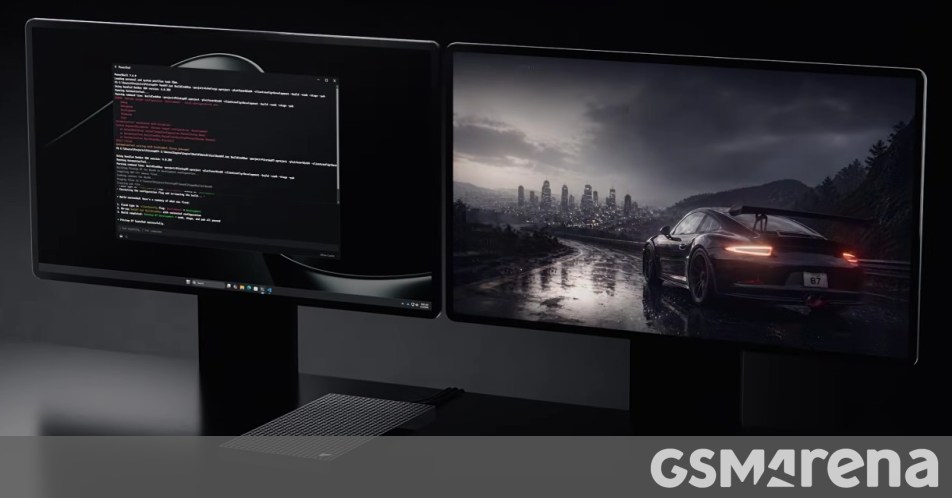
The Dev Box ships with Windows 11 Pro pre-configured for development work. On first boot, dark mode is enabled, popular dev tools are installed, and PowerShell 7 is the default terminal. More notably, WSL 2 is set up with GPU passthrough and CUDA support out of the box.
Microsoft doesn't emphasize this, but it matters: most AI tooling runs on Linux. Training frameworks, inference servers, and model fine-tuning pipelines are overwhelmingly Linux-first. WSL 2 with full GPU access lets developers run these tools natively without dual-booting or managing a separate Linux machine.
Hardware Design and Thermal Limits
The Dev Box has a 3D-printed aluminum body with 1,000 air vents. Microsoft calls this a nod to the 1,000 teraflops of compute performance. The design prioritizes cooling, though the system still requires active cooling. It can dissipate up to 100W of heat.
This is why Microsoft made a desktop version despite the Surface Laptop Ultra using the same RTX Spark chip. Laptops have to fit batteries and screens into a portable form factor. Thermal headroom is limited. The Dev Box can sustain higher performance because it doesn't have those constraints.
Connectivity includes one HDMI port, two USB-C ports, one USB-A port, an Ethernet jack, and a 3.5mm audio jack. Microsoft suggests two use cases: either as a primary development machine connected to a monitor, or as a headless AI inference server you access remotely from a lighter laptop.
Why This Matters for AI Development
Running large models locally changes the economics of AI development. Cloud GPU instances from AWS, Google Cloud, or Azure charge by the hour. An A100 instance costs roughly $3-4 per hour. Fine-tuning a model can take days. Running inference at scale adds up fast.
A local machine with sufficient memory eliminates per-hour charges. Developers can iterate without watching the bill. Teams can experiment with model architectures without budget approvals for cloud credits.
There's also a privacy angle. Some organizations can't send proprietary data to cloud providers. Local inference keeps sensitive information on-premises.
Community Response
On Hacker News, discussion centered on whether 128GB is actually enough for fine-tuning 120 billion parameter models. Some users pointed out that true fine-tuning at that scale might still require quantization or parameter-efficient methods. Others argued that for inference and light fine-tuning, 128GB is a significant step up from current consumer hardware.
Reddit's r/LocalLLaMA community expressed enthusiasm about the possibility of unrestricted local AI development. Several users speculated about whether Nvidia might release a consumer version of the RTX Spark, or whether this will remain a developer-only product.
Availability and Pricing
Microsoft says the Surface RTX Spark Dev Box will be available later this year. In the US, it will be sold exclusively through Microsoft.com. The company hasn't announced pricing or availability for other regions.
The Surface Laptop Ultra, which uses the same chip, also lacks pricing details. Microsoft suggests the Dev Box should cost less than the laptop since it doesn't include a display or battery. But without official numbers, that's speculation.
Logicity's Take
Frequently Asked Questions
What GPU is in the Surface RTX Spark Dev Box?
The Dev Box uses Nvidia's RTX Spark chip, which combines a Blackwell-architecture GPU with 6,144 CUDA cores and a 20-core Arm Grace CPU. Microsoft says performance is comparable to an RTX 5070.
How much RAM does the Surface RTX Spark Dev Box have?
It has 128GB of unified memory shared between the CPU and GPU. This allows large AI models to fit entirely in memory during inference.
Can the Dev Box run Linux?
It ships with Windows 11 Pro, but WSL 2 is pre-configured with GPU passthrough and CUDA support. This lets developers run Linux-based AI tools natively.
When will the Surface RTX Spark Dev Box be available?
Microsoft says it will be available later this year, sold exclusively through Microsoft.com in the US. Pricing and international availability haven't been announced.
What's the difference between the Dev Box and Surface Laptop Ultra?
Both use the same RTX Spark chip. The Dev Box is a desktop without a screen or battery, which allows better sustained performance due to improved thermal headroom.
Cooling innovations relevant to high-performance workstations
Need Help Implementing This?
Source: GSMArena.com / Peter
Manaal Khan
Tech & Innovation Writer
اقرأ أيضاً

رأي مغاير: كيف يؤثر اختراق الأمن الداخلي الأميركي على شركاتنا الخاصة؟
في ظل اختراق عقود الأمن الداخلي الأميركي مع شركات خاصة، نناقش تأثير هذا الاختراق على مستقبل الأمن السيبراني. نستعرض الإحصاءات الموثوقة ونناقش كيف يمكن للشركات الخاصة أن تتعامل مع هذا التهديد. استمتع بقراءة هذا التحليل العميق

الإنسان في زمن ما بعد الوجود البشري: نحو نظام للتعايش بين الإنسان والروبوت - Centre for Arab Unity Studies
في هذا المقال، سنناقش كيف يمكن للبشر والروبوتات التعايش في نظام متكامل. سنستعرض التحديات والحلول المحتملة التي تضعها شركات مثل جوجل وأمازون. كما سنلقي نظرة على التوقعات المستقبلية وفقًا لتقرير ماكنزي

إطلاق ناسا لمهمة مأهولة إلى القمر: خطوة تاريخية نحو استكشاف الفضاء
تعتبر المهمة الجديدة خطوة هامة نحو استكشاف الفضاء وتطوير التكنولوجيا. سوف تشمل المهمة إرسال رواد فضاء إلى سطح القمر لconducting تجارب علمية. ستسهم هذه المهمة في تطوير فهمنا للفضاء وتحسين التكنولوجيا المستخدمة في استكشاف الفضاء.