JAXA Astronaut Captures Rare ISS Aurora Photo in Reverse Flight
Key Takeaways
- The photo captures the ISS hardware, Earth's red and green auroras, and deep space objects including Alpha Centauri in a single frame
- The rare perspective was only possible because the station was flying in a reversed orientation
- Yui took the image from the Kibo Japanese Experiment Module during his nearly five-month Crew-11 mission
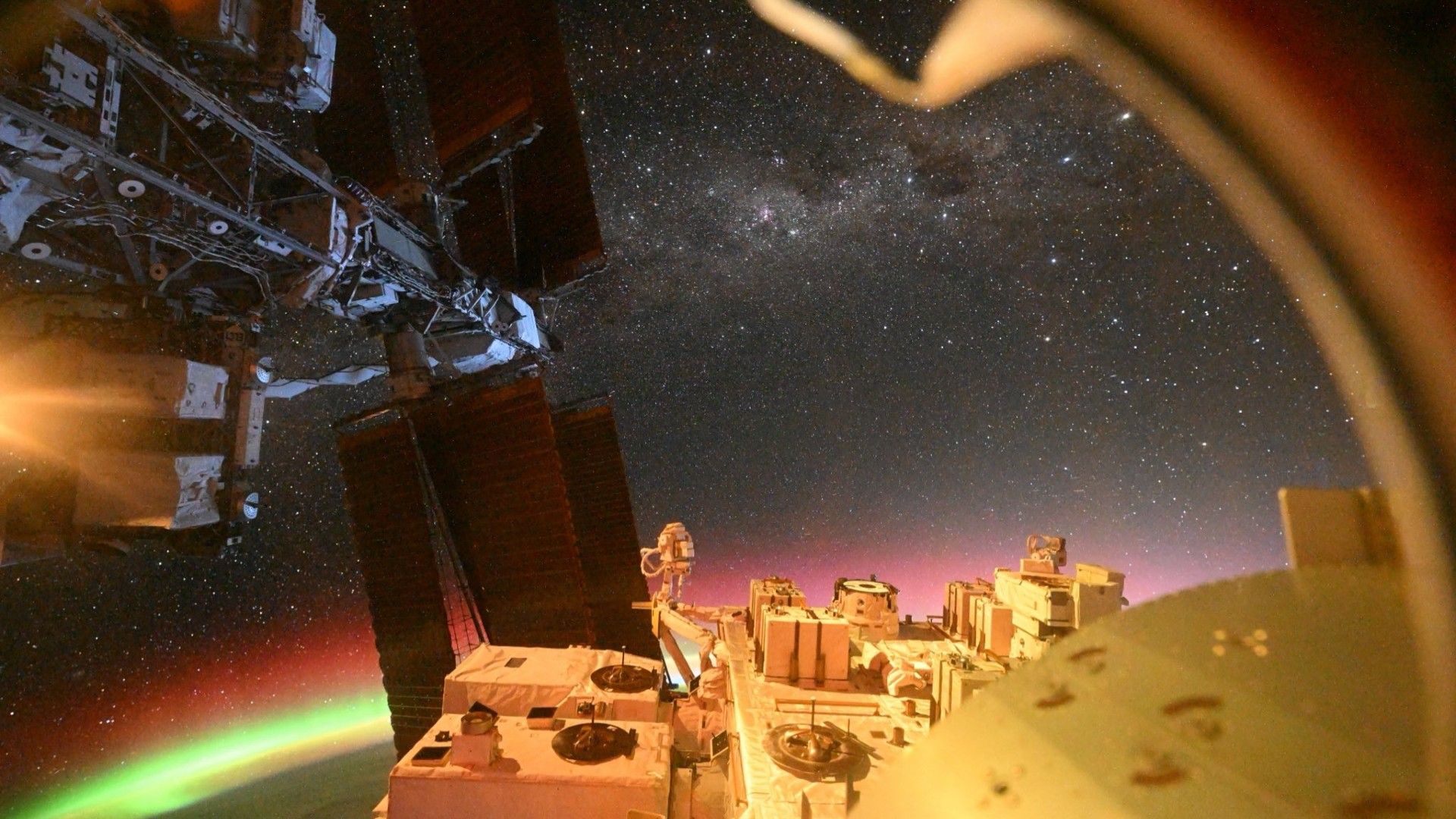
JAXA astronaut Kimiya Yui has shared a photograph from the International Space Station that packs three cosmic layers into a single frame: the station's own hardware, Earth's glowing auroras, and a slice of deep space stretching toward Alpha Centauri.
The image, captured during Yui's nearly five-month SpaceX Crew-11 mission, shows the ISS solar panels extending into the void while red and green auroras shimmer in Earth's atmosphere below. Beyond the planet's edge, the Southern Cross constellation, the Coalsack nebula, and the star Eta Carinae are all visible.
What makes the shot particularly unusual is the station's position. The ISS was flying in a reversed orientation, with its front and back swapped from the normal direction of travel.
“This scene lets you feel the three-dimensional depth of the universe, from the window frame just a few centimeters from the camera, to the solar panels dozens of meters away, to the auroras.”
— Kimiya Yui, JAXA Astronaut
Why the Reversed Orientation Matters
The ISS normally maintains a specific orientation as it orbits Earth at roughly 250 miles altitude. Flight controllers occasionally rotate the station for operational reasons, but these reversed positions are uncommon. For Yui, the non-standard configuration opened a viewing angle from the Kibo Japanese Experiment Module that he called "a very rare sight."
Yui posted the image on X on May 14, describing how the composition places the station's truss structure against the backdrop of deep space. The framing creates a visual line from the immediate hardware out toward the cosmos.
What's Visible in the Frame
The photograph layers multiple astronomical features. In the foreground, the ISS solar panels and truss structure appear rigid against the black of space. Just below, Earth's atmosphere glows with auroras, the result of charged particles from the sun colliding with atmospheric gases.
- Alpha Centauri: Our nearest stellar neighbor, visible in the upper right corner
- The Coalsack Nebula: A dark nebula appearing as a void against the Milky Way
- The Southern Cross: The famous constellation visible from the southern hemisphere
- Eta Carinae: A massive star system roughly 7,500 light-years from Earth
Yui noted that the auroras appear differently from orbit than they do from Earth's surface. When viewed from above, the lights show their full structure through the thin atmosphere rather than just their lower edges.
The Crew-11 Mission
Yui completed his mission aboard the ISS in January after roughly five months in orbit. He flew alongside NASA astronauts Zena Cardman and Michael Fincke, as well as Roscosmos cosmonaut Oleg Platonov. The crew conducted science experiments and station maintenance throughout their stay.
The ISS experiences 16 sunrises and sunsets every 24 hours as it completes an orbit roughly every 90 minutes. This constant shift between day and night gives astronauts frequent opportunities to photograph Earth in different lighting conditions, though the specific alignment Yui captured required the unusual station orientation.
“With the ISS truss extending toward the abyss of space, this composition seems to symbolize the future where humanity's wisdom will challenge the deep cosmos.”
— Kimiya Yui, JAXA Astronaut
Technical Difficulty of the Shot
Space photography from the ISS presents specific challenges. Windows on the station can introduce reflections, and the rapid orbital motion means lighting conditions change constantly. The Kibo module where Yui took this photo has an Earth-facing window designed for observation and photography.
Online discussions in space enthusiast communities have highlighted the specific "translucent" quality of auroras when viewed from above the atmosphere. The perspective strips away the atmospheric haze that ground-based observers see, revealing the lights' structure more clearly.
Logicity's Take
Frequently Asked Questions
Why was the ISS flying in a reversed orientation?
The ISS occasionally rotates for operational reasons including thermal management and docking preparations. These reversed positions are uncommon and create viewing angles not normally available from the station's windows.
How long was Kimiya Yui on the ISS?
Yui spent nearly five months aboard the station as part of the SpaceX Crew-11 mission, returning to Earth in January.
What astronomical objects are visible in the photograph?
The image shows Alpha Centauri, the Coalsack Nebula, the Southern Cross constellation, and the star Eta Carinae, along with red and green auroras in Earth's atmosphere.
Where on the ISS was the photo taken?
Yui photographed the scene from a window in the Kibo Japanese Experiment Module, which has an Earth-facing observation window.
Tips for capturing your own astronomical photographs from Earth
Need Help Implementing This?
Source: Latest from Space.com
Huma Shazia
Senior AI & Tech Writer
اقرأ أيضاً

رأي مغاير: كيف يؤثر اختراق الأمن الداخلي الأميركي على شركاتنا الخاصة؟
في ظل اختراق عقود الأمن الداخلي الأميركي مع شركات خاصة، نناقش تأثير هذا الاختراق على مستقبل الأمن السيبراني. نستعرض الإحصاءات الموثوقة ونناقش كيف يمكن للشركات الخاصة أن تتعامل مع هذا التهديد. استمتع بقراءة هذا التحليل العميق

الإنسان في زمن ما بعد الوجود البشري: نحو نظام للتعايش بين الإنسان والروبوت - Centre for Arab Unity Studies
في هذا المقال، سنناقش كيف يمكن للبشر والروبوتات التعايش في نظام متكامل. سنستعرض التحديات والحلول المحتملة التي تضعها شركات مثل جوجل وأمازون. كما سنلقي نظرة على التوقعات المستقبلية وفقًا لتقرير ماكنزي

إطلاق ناسا لمهمة مأهولة إلى القمر: خطوة تاريخية نحو استكشاف الفضاء
تعتبر المهمة الجديدة خطوة هامة نحو استكشاف الفضاء وتطوير التكنولوجيا. سوف تشمل المهمة إرسال رواد فضاء إلى سطح القمر لconducting تجارب علمية. ستسهم هذه المهمة في تطوير فهمنا للفضاء وتحسين التكنولوجيا المستخدمة في استكشاف الفضاء.