Intel Core Ultra 5 250K Plus vs AMD Ryzen 5 7600X3D
Key Takeaways
- Intel's 250K Plus uses 18 cores on 3nm while AMD's 7600X3D has 6 cores with 102MB cache
- The 250K Plus boosts to 5.3 GHz compared to AMD's 4.7 GHz ceiling
- Both processors sell for $200-$230, making this a true value showdown
Arrow Lake Refresh Meets 3D V-Cache
Intel's Arrow Lake Refresh desktop CPUs finally deliver what the original Arrow Lake promised but failed to achieve. The Core Ultra 5 250K Plus represents Intel's second attempt at its hybrid architecture for desktop gamers. AMD's Ryzen 5 7600X3D counters with its proven 3D V-Cache technology, which stacks additional cache memory directly on the processor die.
Both chips target the same buyer: someone building a capable mid-range gaming PC without overspending on the processor. At $200-$230 street prices, these represent the sweet spot where price meets performance for mainstream gamers.
Specifications: Two Different Philosophies
| Specification | Intel Core Ultra 5 250K Plus | AMD Ryzen 5 7600X3D |
|---|---|---|
| Architecture | Arrow Lake (TSMC 3nm) | Zen 4 (TSMC 5nm) |
| Cores / Threads | 18 (6P+12E) / 18 | 6 / 12 |
| Base / Boost Clock | 4.2 / 5.3 GHz | 4.1 / 4.7 GHz |
| Total Cache | 60MB (30+30) | 102MB (6+96) |
| Base / Max TDP | 125W / 159W | 65W / 88W |
| Memory Support | DDR5-7200 MT/s | DDR5-5200 MT/s |
| MSRP | $199 | $299.99 |
| Street Price | $200-$220 | $200-$230 |
The architectural differences are stark. Intel's 250K Plus uses a hybrid design with six performance cores and 12 efficiency cores, all on TSMC's cutting-edge 3nm process. AMD sticks to a traditional six-core layout but compensates with a massive 102MB cache pool. That's 96MB of L3 cache stacked using 3D V-Cache technology, plus 6MB of L2.
Clock speeds favor Intel by a wide margin. The 250K Plus boosts to 5.3 GHz on its P-cores and 4.6 GHz on E-cores. AMD's 7600X3D tops out at 4.7 GHz. However, raw frequency doesn't tell the whole story. AMD's cache advantage means the CPU spends less time fetching data from slower memory, which often matters more in games than peak clock speed.
Power and Platform Considerations
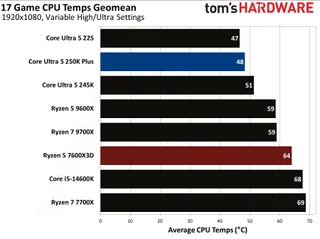
Power consumption differs significantly between these processors. Intel's 250K Plus has a 125W base TDP that climbs to 159W under maximum load. AMD's 7600X3D runs much cooler at 65W base and 88W maximum. For builders prioritizing efficiency or working with compact cases, the AMD chip requires substantially less cooling capacity.
Memory support also varies. Intel officially supports DDR5-7200 MT/s speeds, while AMD's spec sheet lists DDR5-5200 MT/s. In practice, both platforms can run faster memory with compatible motherboards, but Intel's higher official ceiling suggests better memory controller tuning for high-speed kits.
Gaming Performance: Where It Matters
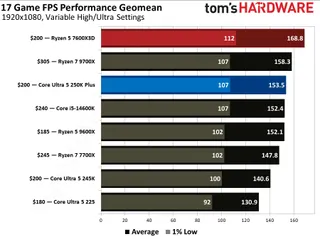
For gaming, the Ryzen 5 7600X3D's 3D V-Cache technology has proven its worth since AMD introduced it with the 5800X3D. The massive cache pool keeps frequently accessed game data close to the CPU cores, reducing latency and smoothing frame delivery. This matters most at lower resolutions where the GPU isn't the bottleneck.
Intel's 250K Plus fights back with raw frequency and improved IPC (instructions per clock) from the Arrow Lake refresh. The hybrid architecture means the chip can handle background tasks on efficiency cores while dedicating performance cores to the game itself.
Productivity and Multi-threaded Workloads
Outside of gaming, the core count advantage swings to Intel. With 18 cores versus six, the 250K Plus handles content creation, video encoding, and multi-threaded workloads more effectively. The efficiency cores may run slower than performance cores, but they still contribute meaningful throughput for parallelizable tasks.
AMD's 7600X3D was designed primarily as a gaming chip. Its six cores handle everyday productivity fine, but demanding workloads like 4K video rendering or large code compilation favor Intel's higher core count.
Value Proposition
Pricing makes this comparison interesting. Intel set the 250K Plus MSRP at $199, while AMD originally launched the 7600X3D at $299.99. Street prices have converged, with both chips selling between $200 and $230 depending on retailer and promotions.
Platform costs matter too. Intel's LGA 1851 socket requires a 800-series motherboard. AMD's AM5 platform has been on the market longer, meaning more motherboard options and potentially better deals on last-generation boards. However, AM5 will support future Ryzen generations, while Intel's platform roadmap remains less certain.
Logicity's Take
Which Should You Buy?
The choice depends on your primary use case. Pure gamers who want maximum frame rates at 1080p or 1440p should lean toward the Ryzen 5 7600X3D. Its cache advantage translates directly to smoother gameplay in CPU-limited scenarios.
Builders who game but also stream, edit video, or run development workloads should consider the Core Ultra 5 250K Plus. The extra cores provide headroom for multitasking that AMD's six-core chip can't match.
✅ Pros
- • Intel 250K Plus: 18 cores for better productivity performance
- • Intel 250K Plus: Higher boost clocks up to 5.3 GHz
- • Intel 250K Plus: DDR5-7200 official memory support
- • AMD 7600X3D: 102MB cache for gaming performance
- • AMD 7600X3D: Much lower power consumption at 65-88W
❌ Cons
- • Intel 250K Plus: Higher power draw requires better cooling
- • Intel 250K Plus: Newer platform with less motherboard variety
- • AMD 7600X3D: Only six cores limits productivity workloads
- • AMD 7600X3D: Lower official memory speed support
Another gaming hardware performance comparison
Frequently Asked Questions
Is the Intel Core Ultra 5 250K Plus better than the Ryzen 5 7600X3D for gaming?
It depends on the game and resolution. AMD's 3D V-Cache gives the 7600X3D an edge in cache-sensitive titles, while Intel's higher clocks help in others. At similar prices, both are competitive gaming choices.
Which processor uses less power?
The AMD Ryzen 5 7600X3D runs significantly cooler with a 65W base TDP versus Intel's 125W. AMD's maximum power draw of 88W is also much lower than Intel's 159W ceiling.
What motherboard do I need for the Core Ultra 5 250K Plus?
Intel's 250K Plus requires an LGA 1851 socket motherboard with an 800-series chipset (Z890, B860, etc.). It won't work with older Intel platforms.
Is 3D V-Cache worth it for non-gaming workloads?
Generally no. The 3D V-Cache primarily benefits gaming and specific applications that thrash the cache. For productivity work, Intel's higher core count typically provides more value.
Can both processors be overclocked?
Both chips are unlocked for overclocking. However, the 7600X3D has limited overclocking headroom due to heat constraints from the stacked cache, while Intel's 'K' designation indicates full overclocking support.
Need Help Implementing This?
Source: Latest from Tom's Hardware
Manaal Khan
Tech & Innovation Writer
اقرأ أيضاً

رأي مغاير: كيف يؤثر اختراق الأمن الداخلي الأميركي على شركاتنا الخاصة؟
في ظل اختراق عقود الأمن الداخلي الأميركي مع شركات خاصة، نناقش تأثير هذا الاختراق على مستقبل الأمن السيبراني. نستعرض الإحصاءات الموثوقة ونناقش كيف يمكن للشركات الخاصة أن تتعامل مع هذا التهديد. استمتع بقراءة هذا التحليل العميق

الإنسان في زمن ما بعد الوجود البشري: نحو نظام للتعايش بين الإنسان والروبوت - Centre for Arab Unity Studies
في هذا المقال، سنناقش كيف يمكن للبشر والروبوتات التعايش في نظام متكامل. سنستعرض التحديات والحلول المحتملة التي تضعها شركات مثل جوجل وأمازون. كما سنلقي نظرة على التوقعات المستقبلية وفقًا لتقرير ماكنزي

إطلاق ناسا لمهمة مأهولة إلى القمر: خطوة تاريخية نحو استكشاف الفضاء
تعتبر المهمة الجديدة خطوة هامة نحو استكشاف الفضاء وتطوير التكنولوجيا. سوف تشمل المهمة إرسال رواد فضاء إلى سطح القمر لconducting تجارب علمية. ستسهم هذه المهمة في تطوير فهمنا للفضاء وتحسين التكنولوجيا المستخدمة في استكشاف الفضاء.